Social anxiety affects roughly 15 million American adults, according to the National Institute of Mental Health, making it one of the most common anxiety disorders in the country. For introverts, it can feel especially tangled: the fear of judgment layered over a genuine preference for quiet. These 7 strategies address that specific combination with practical, evidence-backed approaches you can start using today.
Social anxiety and introversion are not the same thing. Introversion is a personality trait. Social anxiety is a fear response. Many introverts carry both, and untangling them is where real relief begins. What follows is not a list of tips to become someone you’re not. It’s a set of tools to help you show up as yourself without the weight of dread pulling you under.

Our mental wellness content explores the full range of emotional challenges introverts face, and social anxiety adds a particular layer worth examining on its own. You can find more in-depth resources at the Ordinary Introvert Mental Health Hub.
What Is Social Anxiety and Why Does It Hit Introverts So Hard?
Social anxiety disorder involves an intense, persistent fear of being watched, judged, or humiliated in social situations. A 2021 review published by the American Psychological Association describes it as more than shyness: it’s a pattern of avoidance that can shrink a person’s world over time.
What’s your personality type?
Take our free 40-question assessment and get a detailed personality profile with dimension breakdowns, context analysis, and personalised insights.
Discover Your Type8-12 minutes · 40 questions · Free
For introverts, the overlap is real. We already process social interaction more intensely than extroverts. We notice more, feel more, and recover more slowly from overstimulating environments. Add a fear of negative evaluation on top of that heightened sensitivity, and social situations can feel genuinely threatening rather than simply draining.
My own experience with this started in my advertising career. I ran client meetings for Fortune 500 brands, stood in front of rooms full of executives, and somehow managed to look composed. Internally, I was cataloguing every micro-expression, second-guessing every sentence, and replaying the meeting for hours afterward. That’s not normal professional diligence. That’s anxiety wearing a competent mask.
Recognizing the difference between introversion and anxiety was the first step toward actually addressing the anxiety part. Introversion didn’t need fixing. The anxiety did.
Can You Manage Social Anxiety Without Medication?
Yes, and many people do. That said, medication is a valid and sometimes necessary tool, and there’s no shame in using it. A 2023 clinical overview from the Mayo Clinic notes that cognitive behavioral therapy (CBT) is considered the gold standard treatment for social anxiety disorder, often producing lasting results even without pharmaceutical support.
The strategies below are grounded in CBT principles, exposure therapy concepts, and behavioral science. They are not a replacement for professional care if you’re experiencing severe anxiety. Consider them a starting point, a set of practices you can layer into daily life alongside whatever professional support you choose.

Strategy 1: Separate the Thought from the Fact
Social anxiety runs on a specific kind of mental fuel: the assumption that your worst-case interpretation of a situation is accurate. Someone didn’t respond to your email, so they must be annoyed with you. You stumbled over a word in a meeting, so everyone noticed and lost confidence in you. Your mind presents these stories as facts. They are not.
Cognitive restructuring, a core CBT technique, involves identifying these automatic thoughts and examining the actual evidence for and against them. Ask yourself: what’s the most realistic explanation for what just happened? Not the most optimistic, the most realistic.
A practical way to start is keeping a small log. Write down the anxious thought, the situation that triggered it, and then write two or three alternative explanations. Over time, your brain begins to default to the realistic interpretation rather than the catastrophic one. It takes repetition, but it works.
During my agency years, I kept a version of this in my head during post-meeting debriefs. Instead of letting the spiral start, I’d ask myself what the most neutral reading of the room was. That reframe didn’t eliminate anxiety, but it shortened the recovery time significantly.
Strategy 2: Use Gradual Exposure to Shrink the Fear
Avoidance is the engine that keeps social anxiety running. Every time you skip the work event, leave the party early, or decline the invitation, your nervous system files that away as confirmation that the situation was genuinely dangerous. The fear grows stronger because you never got the evidence that you could survive it.
Gradual exposure works by building a hierarchy of feared situations, from mildly uncomfortable to highly distressing, and working through them in order. You start small. Make eye contact with a cashier. Say hello to a neighbor. Ask a question in a low-stakes meeting. Each small success rewires the threat response slightly.
The APA’s guidance on exposure therapy emphasizes that success doesn’t mean eliminate discomfort but to demonstrate to yourself that you can tolerate it. That shift in perspective changes everything. You’re not trying to feel comfortable. You’re proving you can function while uncomfortable.
For introverts specifically, it helps to design your exposure ladder around situations that matter to you, not generic social scenarios. If networking events feel pointless and terrifying, start with one-on-one coffee conversations instead. Build toward what’s actually relevant to your life.
You might also find introvert-work-lunches-social-eating-survival helpful here.
Strategy 3: Prepare Without Over-Preparing
Introverts often do their best thinking in advance. Preparation is a genuine strength. The problem comes when preparation tips into rehearsal obsession, scripting every possible conversational branch, anticipating every way things could go wrong, and then feeling blindsided when the actual interaction deviates from the script.
Useful preparation looks like this: know your core points, have a few questions ready, and give yourself permission to not have an answer for everything. Set a time limit on prep. Twenty minutes of focused preparation is almost always more effective than two hours of anxious rehearsal.
There’s also a specific kind of preparation that helps with social anxiety: preparing your exit strategy. Knowing you can leave a situation if you need to, having a clear reason ready, actually reduces the anxiety going in. The option to leave makes staying easier.

Strategy 4: Shift Your Focus Outward During Conversations
One of the most counterintuitive truths about social anxiety is that self-focus makes it worse. When you’re in a conversation and most of your mental bandwidth is spent monitoring how you’re coming across, you have very little attention left for actually listening. The conversation suffers, you notice it suffering, and the anxiety spikes.
Shifting attention outward, genuinely focusing on what the other person is saying, what they seem to feel, what question you’re actually curious about, interrupts that loop. A 2019 study cited by Psychology Today found that attention-training techniques significantly reduced social anxiety symptoms by redirecting self-monitoring toward external cues.
Introverts actually have an advantage here. We’re naturally curious about people. We ask good questions. We notice things others miss. Lean into that. Let genuine interest in the other person be your anchor instead of trying to manage your own performance.
A simple practice: before any social interaction, pick one thing you’re genuinely curious to learn about the person you’ll be talking to. That single point of real interest can carry an entire conversation and quiet the internal critic at the same time.
Strategy 5: Build a Recovery Ritual That Actually Restores You
Managing social anxiety isn’t only about what happens during social situations. What happens after matters just as much. For introverts with anxiety, the post-event period can become a spiral of rumination, replaying the conversation, cataloguing perceived missteps, and building a case against yourself.
For more on this topic, see financial-anxiety-for-introverts.
A deliberate recovery ritual interrupts that spiral before it starts. The ritual doesn’t need to be elaborate. It needs to be consistent and genuinely restorative for you specifically. Some people walk. Some cook. Some read. Some sit in silence with good music. What matters is that the activity requires enough gentle attention to prevent rumination without being demanding enough to drain you further.
My own version of this evolved over years of trial and error. After high-stakes client presentations, I’d give myself exactly twenty minutes to write down anything that genuinely went wrong and one thing I’d do differently. Then I’d close the notebook and do something completely unrelated. The act of writing it down gave my brain permission to stop processing. It had been recorded. It didn’t need to loop.
A 2020 study from the National Institutes of Health found that expressive writing about stressful events reduced anxiety symptoms and improved emotional regulation over time. The science backs what many introverts discover instinctively: getting it out of your head and onto a page helps.
Strategy 6: Reframe What Success in a Social Situation Actually Means
Social anxiety often comes with an impossibly high bar for what counts as a successful interaction. Success means everyone liked you. Success means you said exactly the right thing. Success means you felt comfortable the entire time. By that standard, almost no social interaction qualifies.
A more useful definition of success: you showed up, you stayed present for a reasonable amount of time, and you were genuine. That’s it. Comfort is not the measure. Presence is.
This reframe is especially important for introverts because we often hold ourselves to a standard that assumes we should perform like extroverts. We should want to be there. We should enjoy the energy of the room. We should leave feeling energized. None of that is true for us, and holding ourselves to it sets us up to feel like we failed every single time.
Success, redefined, becomes achievable. Achievable success builds confidence. Confidence, over time, reduces anxiety. The cycle runs in both directions. You get to choose which direction to start it moving.

Strategy 7: Know When to Seek Professional Support
Self-help strategies are genuinely effective for mild to moderate social anxiety. For severe anxiety, one that’s causing you to avoid important relationships, limit your career, or experience significant distress on a regular basis, professional support is not optional. It’s the right next step.
Cognitive behavioral therapy with a licensed therapist remains the most evidence-supported treatment available. The National Institute of Mental Health also notes that a combination of therapy and medication can be highly effective when anxiety is severe or when therapy alone hasn’t produced enough relief.
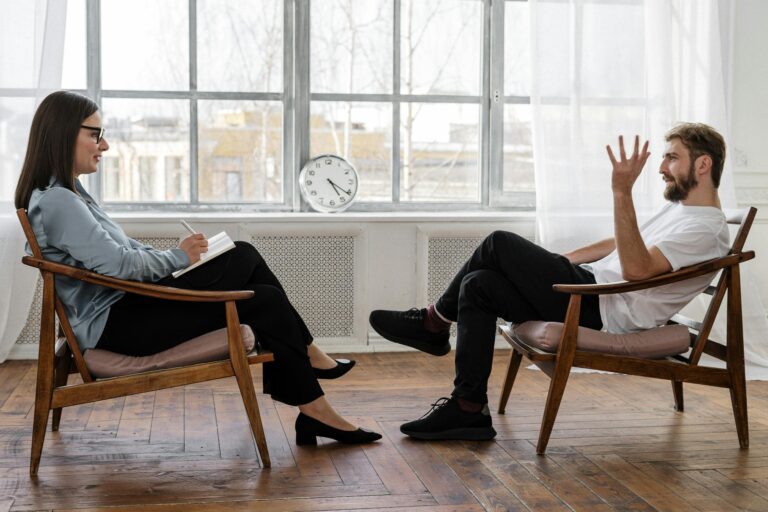
Finding a therapist who understands introversion is worth the extra effort. A therapist who treats your need for solitude as a symptom to correct rather than a trait to work with will make the process harder than it needs to be. Look for someone with specific experience in anxiety disorders and ideally some familiarity with introversion or high sensitivity.
Telehealth has made access significantly easier. The U.S. Department of Health and Human Services maintains a resource directory for finding mental health support, including low-cost options. There’s no reason to white-knuckle through severe anxiety alone when effective help exists.
How Do These Strategies Work Together?
None of these seven strategies is meant to stand alone. They work best as a layered system. Cognitive restructuring (Strategy 1) gives you the mental clarity to attempt exposure (Strategy 2). Thoughtful preparation (Strategy 3) makes the exposure less overwhelming. Outward focus (Strategy 4) keeps you present during the interaction. A recovery ritual (Strategy 5) prevents the post-event spiral. Redefining success (Strategy 6) keeps the whole effort sustainable. And knowing when to get professional help (Strategy 7) ensures you’re not carrying more than self-help can reasonably address.
Start with one. Pick the strategy that feels most relevant to where you are right now. Use it consistently for two weeks before adding another. Stacking too many new practices at once is a reliable way to abandon all of them.
What I’ve found, both personally and through years of writing about introvert experience, is that progress with social anxiety rarely looks like a dramatic shift. It looks like a slightly shorter recovery time. A slightly quieter inner critic. A slightly easier yes to the invitation you would have declined six months ago. Small, cumulative, real.

Find more practical tools for managing anxiety and understanding your introvert experience in the Ordinary Introvert Mental Health Hub.
About the Author
Keith Lacy is an introvert who’s learned to embrace his true self later in life. After 20 years in advertising and marketing leadership, including running agencies and managing Fortune 500 accounts, Keith now channels his experience into helping fellow introverts understand their strengths and build fulfilling careers. As an INTJ, he brings analytical depth and authentic perspective to every article, drawing from both professional expertise and personal growth.
Frequently Asked Questions
Is social anxiety the same as introversion?
No. Introversion is a personality trait characterized by a preference for quieter, less stimulating environments and a need for solitude to recharge. Social anxiety is a fear-based condition involving dread of judgment, embarrassment, or humiliation in social situations. Many introverts do experience social anxiety, but the two are distinct. An introvert can enjoy social situations without anxiety. A person with social anxiety may be extroverted by nature yet still experience significant fear in social settings.
What are the most effective strategies for managing social anxiety?
Cognitive behavioral therapy is widely considered the most effective approach, particularly techniques like cognitive restructuring and gradual exposure. Self-help strategies that mirror CBT principles, including challenging anxious thoughts, building an exposure hierarchy, shifting attention outward during conversations, and creating post-event recovery rituals, have strong evidence behind them. For moderate to severe anxiety, working with a licensed therapist produces the most reliable and lasting results.
Can introverts overcome social anxiety on their own?
Many introverts with mild to moderate social anxiety make meaningful progress using self-directed strategies based on CBT principles. Consistent practice of cognitive restructuring, gradual exposure, and attention-shifting techniques can significantly reduce anxiety over time. That said, severe social anxiety, particularly when it’s causing avoidance of important life areas, typically requires professional support. Self-help and therapy are not mutually exclusive and often work well together.
How long does it take for social anxiety strategies to work?
Progress varies significantly depending on the severity of anxiety, consistency of practice, and whether professional support is involved. Many people notice some reduction in anxiety within a few weeks of consistent practice. Meaningful, lasting change typically develops over three to six months. Exposure-based approaches in particular require repeated practice before the fear response begins to diminish. Progress tends to be gradual rather than dramatic, which is normal and expected.
What’s the difference between social anxiety and general shyness?
Shyness is a temperament trait involving discomfort or inhibition in new social situations. It’s common, relatively mild, and doesn’t typically interfere significantly with daily functioning. Social anxiety disorder is a clinical condition involving intense, persistent fear of social situations, active avoidance behavior, and significant distress that affects relationships, work, and quality of life. Shyness may fade as a person becomes more comfortable in a situation. Social anxiety tends to persist and often requires deliberate intervention to improve.