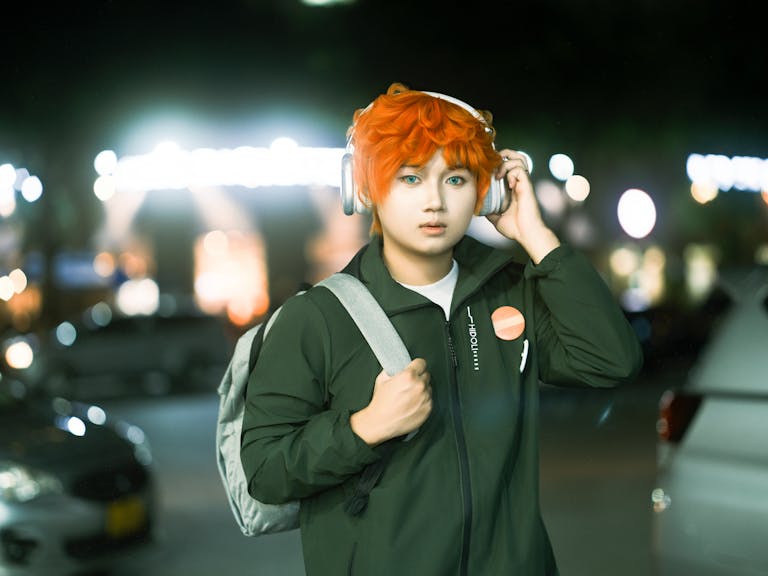
Yes, INFJs frequently feel conspicuous, and the experience runs deeper than ordinary self-consciousness. Because their dominant function is introverted intuition (Ni), they process the world through an intense internal lens, which often creates a disorienting gap between how vividly they experience themselves internally and how invisible they feel they should be externally. That tension produces a persistent, low-grade sense of being seen, scrutinized, or somehow out of place, even in rooms where nobody is paying them particular attention.
It’s a paradox worth sitting with. The same person who craves depth and meaning in every interaction can also feel profoundly exposed by a single glance from a stranger. The same person who reads a room with uncanny accuracy can convince themselves, seconds later, that everyone in that room is reading them right back.

Spend enough time in the INFJ experience and you start to see how much of their inner world shapes their outer discomfort. Our INFJ Personality Type hub covers the full range of what makes this type so layered and compelling, but the question of feeling conspicuous touches something particularly raw. It gets at the friction between an intensely rich inner life and a world that doesn’t always feel safe enough to inhabit fully.
Why Does the INFJ Inner World Create Outer Discomfort?
My own experience as an INTJ running ad agencies for over two decades gave me a front-row seat to a specific kind of self-consciousness. I’d walk into a client pitch, completely prepared, and still feel that strange prickling awareness of being watched. Not because anyone was staring, but because my internal processing was so loud it felt like it must be visible somehow. INFJs describe something similar, only amplified considerably.
The INFJ’s dominant Ni function works by synthesizing patterns, impressions, and meaning beneath the surface of events. It’s a deeply inward function, which means the richest part of the INFJ experience is happening somewhere nobody else can see. Yet that invisible processing creates an almost physical sense of weight. INFJs often describe feeling like they’re carrying something heavy into every room, something that other people might sense even if they can’t name it.
Their auxiliary function, extraverted feeling (Fe), adds another dimension. Fe orients outward, scanning the emotional atmosphere of any group, picking up on subtle shifts in mood, tension, or connection. So while Ni is processing meaning internally, Fe is simultaneously broadcasting sensitivity externally. The INFJ is both deeply private and acutely attuned to the social environment, and that combination can feel like standing in a spotlight you didn’t ask for.
A 2023 study published in Frontiers in Psychology found significant links between high emotional sensitivity and heightened self-focused attention in social contexts, suggesting that people who process emotional information more deeply are also more prone to feeling observed or evaluated. For INFJs, this isn’t a character flaw. It’s the predictable outcome of how their cognitive architecture works.
Is Feeling Conspicuous the Same as Social Anxiety?
Not exactly, and the distinction matters. Social anxiety is a clinical condition characterized by persistent fear of negative evaluation in social situations. Feeling conspicuous, as INFJs typically describe it, is more nuanced. It’s less about fear of judgment and more about a profound awareness of being a presence in a space, of taking up room, of being perceived at all.
Many INFJs report that they don’t necessarily dread what people will think of them. What unsettles them is the act of being seen when they haven’t chosen to reveal themselves. There’s a meaningful difference between sharing something intentionally and feeling like something is leaking out of you without permission. INFJs are extraordinarily private people. The idea that their inner world might be partially visible to others, that someone might catch a glimpse of the intensity they work so hard to contain, can feel genuinely alarming.
This connects to something I’ve observed in the way INFJs communicate professionally. Their INFJ communication blind spots often stem from this very dynamic: because they’re so aware of being perceived, they sometimes over-edit themselves into vagueness, or they share so carefully that the real meaning gets lost in translation. The conspicuousness they feel pushes them toward careful concealment, which paradoxically creates its own communication problems.
That said, the overlap between feeling conspicuous and anxiety is real. Research from PubMed Central indicates that high empathy and emotional sensitivity are associated with elevated stress responses in social environments. For INFJs who are already prone to absorbing the emotional states of those around them, feeling conspicuous can escalate into genuine distress, particularly in unfamiliar or high-stakes settings.

How Does Empathy Intensify the Feeling of Being Watched?
One of the less obvious contributors to INFJ conspicuousness is their empathic capacity. INFJs are frequently described as empaths, people who don’t just understand the emotions of others intellectually but absorb them somatically, as felt experience. This ability runs in both directions. Because INFJs can read other people so accurately, they assume, often correctly, that perceptive people can read them just as well.
It’s a kind of projection, but not the distorted kind. It’s the logical extension of knowing how much you yourself pick up on. If you can sense that your colleague is carrying grief even though she’s smiling, you reasonably conclude that someone equally perceptive could sense what you’re carrying. And since INFJs are almost always carrying something, that conclusion produces a near-constant awareness of potential exposure.
Psychology Today describes empathy as the ability to understand and share the feelings of another person, but for INFJs the process is less voluntary than that description implies. They don’t choose to tune in. They’re already tuned in before they’ve made any conscious decision. That involuntary quality is part of what makes social environments feel so demanding, and part of what makes feeling conspicuous feel so hard to shake.
In my agency years, I worked alongside people I’d now recognize as likely INFJs, creative directors and strategists who seemed to absorb the entire emotional weather of a client meeting before a single word was spoken. They were invaluable for that reason. They could sense where a relationship was heading before the data confirmed it. Yet those same people often struggled visibly in large group settings, not because they lacked confidence in their work, but because the sheer volume of incoming emotional information made them feel like they were standing under a floodlight.
What Role Does the INFJ’s Rarity Play in Feeling Out of Place?
INFJs are consistently identified as one of the rarest personality types, representing roughly one to two percent of the general population according to 16Personalities. That statistical reality has psychological consequences. When your way of processing the world is genuinely uncommon, you spend a lot of time in environments that weren’t designed for how you think, feel, or communicate. That mismatch creates its own kind of conspicuousness.
It’s not just that INFJs feel different. They often are different, in ways that are hard to articulate but easy to sense. They bring unusual depth to casual conversations. They care about things other people seem to find abstract or unnecessary. They notice subtext in situations where most people are responding only to the surface. All of this can make them feel like they’re operating on a slightly different frequency, present in the same room but tuned to a different signal.
If you’ve never taken a personality assessment and you’re wondering whether any of this resonates with your own experience, our free MBTI personality test can offer some useful clarity about your own type and cognitive wiring.
The rarity factor also affects how INFJs are perceived by others, which feeds back into how conspicuous they feel. People who operate differently from the norm tend to get noticed, even when they’re trying hard not to be. An INFJ who is quietly observing a room may be perceived as mysterious, intense, or aloof, none of which are labels they asked for, and all of which reinforce the sense that they stand out whether they want to or not.

How Does the INFJ Tendency to Avoid Conflict Amplify Self-Consciousness?
There’s a specific mechanism here worth examining carefully. INFJs have a strong drive toward harmony, rooted in their auxiliary Fe. They’re acutely sensitive to interpersonal friction and will often go to significant lengths to prevent it. That peace-keeping instinct is genuinely valuable, but it comes with a cost: when INFJs suppress their own reactions in order to maintain surface calm, they become hyperaware of the gap between what they’re feeling and what they’re showing.
That gap is exhausting to manage. And the effort of managing it, of monitoring your expression, choosing your words carefully, modulating your tone, creates exactly the kind of self-focused attention that makes you feel conspicuous. You become so aware of your own performance that you start to feel like everyone else must be watching it too.
The hidden cost of keeping peace for INFJs is partly this: the energy spent on conflict avoidance gets redirected into self-monitoring, which amplifies the very discomfort they were trying to prevent. They avoid the confrontation, but they don’t escape the tension. It just moves inward, where it compounds.
This pattern also shows up in how INFJs handle situations where they feel they’ve said or done something wrong. Their tertiary Ti function kicks in, analyzing and re-analyzing the interaction, looking for where things went sideways. Combined with the Fe-driven concern for how others are feeling, this produces a kind of retrospective conspicuousness: a replay of moments where they felt exposed, scrutinized, or misread.
INFPs share some of this territory, though the internal experience differs. Where INFJs tend to monitor the external social environment obsessively, INFPs are more likely to take interpersonal friction personally. Understanding why INFPs take everything personal illuminates a parallel but distinct pattern of self-consciousness that’s worth distinguishing from the INFJ version.
Can Feeling Conspicuous Actually Be a Strength?
This is where the reframe becomes genuinely useful rather than just comforting. The hyperawareness that makes INFJs feel conspicuous is the same capacity that makes them extraordinarily effective in certain professional and personal contexts. You cannot be exquisitely attuned to the emotional temperature of a room without also being capable of influencing it with precision.
In my years running agencies, I watched introverted leaders who understood this principle outperform their louder, more visibly confident peers consistently. They didn’t command attention through volume. They shaped conversations through careful observation and well-timed insight. The quiet intensity that INFJs bring to influence is directly connected to the same sensitivity that makes them feel watched. You can’t separate the two.
A 2022 study from PubMed Central on emotional intelligence and leadership effectiveness found that leaders who scored high on emotional awareness and social attunement were rated more effective by their teams, particularly in contexts requiring trust and long-term relationship management. INFJs, with their Fe-driven sensitivity and Ni-powered pattern recognition, are naturally positioned for exactly this kind of leadership.
Feeling conspicuous can also be a signal worth paying attention to. When an INFJ feels particularly exposed or out of place, that sensation often contains useful information about the environment, about misaligned values, about social dynamics that aren’t functioning well. The discomfort isn’t arbitrary. It’s data, filtered through a remarkably sensitive instrument.

What Happens When the Feeling of Being Conspicuous Becomes Overwhelming?
There’s a threshold beyond which the ordinary INFJ self-consciousness tips into something more disabling. When the feeling of being watched becomes constant and distressing, when it starts shaping decisions about which rooms to enter and which conversations to have, it deserves serious attention.
One of the more painful expressions of this is the INFJ door slam, the abrupt withdrawal from relationships or situations that have become too exposing or too painful to sustain. What looks from the outside like coldness or sudden indifference is often the culmination of a long period of feeling too seen in all the wrong ways. The reasons INFJs door slam are complex, but the feeling of conspicuous vulnerability is almost always part of the picture.
When INFJs reach this point, the instinct is often to retreat entirely, to make themselves smaller and less visible. That instinct is understandable, but it’s worth examining whether withdrawal is actually serving them or simply postponing the discomfort. Genuine relief comes from developing a more stable relationship with visibility, not from eliminating it.
The National Institutes of Health notes that avoidance behaviors in response to social anxiety tend to reinforce the underlying fear rather than reduce it. For INFJs, this means that the more they organize their lives around not being seen, the more threatening ordinary visibility becomes. The path forward involves gradual, intentional exposure to being present without the armor of perfect self-control.
Difficult conversations are a particular flashpoint. INFJs who feel conspicuous often find that the prospect of a direct, emotionally charged exchange amplifies every self-conscious instinct they have. Yet avoiding those conversations compounds the problem. Exploring the hidden cost of keeping peace shows clearly that the short-term relief of avoidance carries long-term relational and psychological costs that are hard to walk back.
How Can INFJs Build a Healthier Relationship With Being Seen?
The work here isn’t about becoming comfortable with constant visibility. INFJs are introverts. They will always need privacy, solitude, and the freedom to process internally. The goal, more accurately, is developing enough tolerance for being seen that it stops functioning as a threat.
One approach that I’ve found genuinely useful, both personally and in observing others, is separating the sensation of being noticed from the story attached to it. Feeling conspicuous is a sensation. “Everyone is judging me negatively” is a story. INFJs are gifted storytellers, which means they’re also prone to building elaborate narratives around minimal evidence. Noticing when the narrative has outrun the data is a meaningful first step.
Choosing contexts intentionally matters enormously. INFJs who feel conspicuous in large, unstructured social settings often feel completely at ease in one-on-one conversations or small groups organized around shared purpose. Working with their natural preferences rather than against them isn’t avoidance. It’s intelligent self-management.
Developing the capacity to have hard conversations directly also helps. INFJs who can express their experience honestly, even imperfectly, feel less like they’re hiding something that might leak out. The approach INFPs use for hard talks offers some transferable principles here, particularly around staying grounded in your own perspective without losing the relational thread. The specifics differ between the two types, but the underlying challenge of speaking authentically under pressure is shared.
Finally, INFJs benefit from relationships where being known feels safe rather than threatening. That kind of safety doesn’t eliminate the feeling of conspicuousness entirely, but it changes its quality. Being seen by someone who sees you well is a very different experience from being exposed to a crowd that doesn’t know you at all.

There’s a lot more to explore about what makes INFJs tick, including how their intensity shows up in relationships, work, and personal growth. Our complete INFJ Personality Type hub is a good place to keep going if this article has raised questions you want to sit with longer.
About the Author
Keith Lacy is an introvert who’s learned to embrace his true self later in life. After 20 years in advertising and marketing leadership, including running agencies and managing Fortune 500 accounts, Keith now channels his experience into helping fellow introverts understand their strengths and build fulfilling careers. As an INTJ, he brings analytical depth and authentic perspective to every article, drawing from both professional expertise and personal growth.
Frequently Asked Questions
Do INFJs actually feel more conspicuous than other introverted types?
INFJs tend to experience conspicuousness more intensely than many other introverted types because of the specific combination of their dominant Ni and auxiliary Fe. Ni creates a rich, absorbing inner world that feels private and weighty, while Fe constantly scans the social environment for emotional information. That dual awareness, deeply inward and acutely outward at the same time, produces a particular kind of self-consciousness that feels like being visible even when you’re trying hard not to be. Other introverted types may prefer privacy without necessarily feeling that their inner life is somehow legible to others.
Is the INFJ feeling of being conspicuous related to their empathy?
Yes, directly. INFJs are often described as empaths because they absorb the emotional states of others involuntarily and with considerable accuracy. Because they know how much they pick up on in others, they logically assume that perceptive people can sense what they’re carrying. That assumption, which is often correct, creates a near-constant awareness of potential emotional exposure. The more attuned you are to others’ inner worlds, the more you tend to believe your own inner world is equally visible.
How does conflict avoidance make INFJs feel more self-conscious?
When INFJs suppress their genuine reactions in order to maintain harmony, they create an internal gap between what they’re feeling and what they’re showing. Managing that gap requires constant self-monitoring, which is itself a form of heightened self-consciousness. The effort of controlling how you appear makes you more aware of how you appear, which amplifies the feeling of being observed. Paradoxically, the peace-keeping behavior that INFJs use to reduce social friction often increases their internal sense of being on display.
Can an INFJ’s feeling of conspicuousness become a professional asset?
Absolutely. The same sensitivity that makes INFJs feel conspicuous also makes them extraordinarily perceptive about the emotional dynamics of any environment they’re in. In professional contexts, this translates into the ability to read clients, colleagues, and team dynamics with unusual accuracy, to sense where a relationship is heading before the data confirms it, and to influence group dynamics through well-timed, carefully considered contributions. The hyperawareness isn’t a liability to be eliminated. It’s a capacity to be channeled.
What’s the difference between an INFJ feeling conspicuous and having social anxiety?
Social anxiety is a clinical condition involving persistent fear of negative evaluation in social situations, often accompanied by avoidance behaviors and significant functional impairment. The INFJ experience of feeling conspicuous is more nuanced: it’s less about fearing judgment and more about a deep discomfort with being perceived at all, particularly when that perception feels involuntary. INFJs often feel exposed not because they expect criticism but because their inner world feels private and weighty, and the idea that it might be partially visible to others is unsettling in itself. That said, the two experiences can overlap, and INFJs who find their self-consciousness significantly limiting their lives may benefit from professional support.