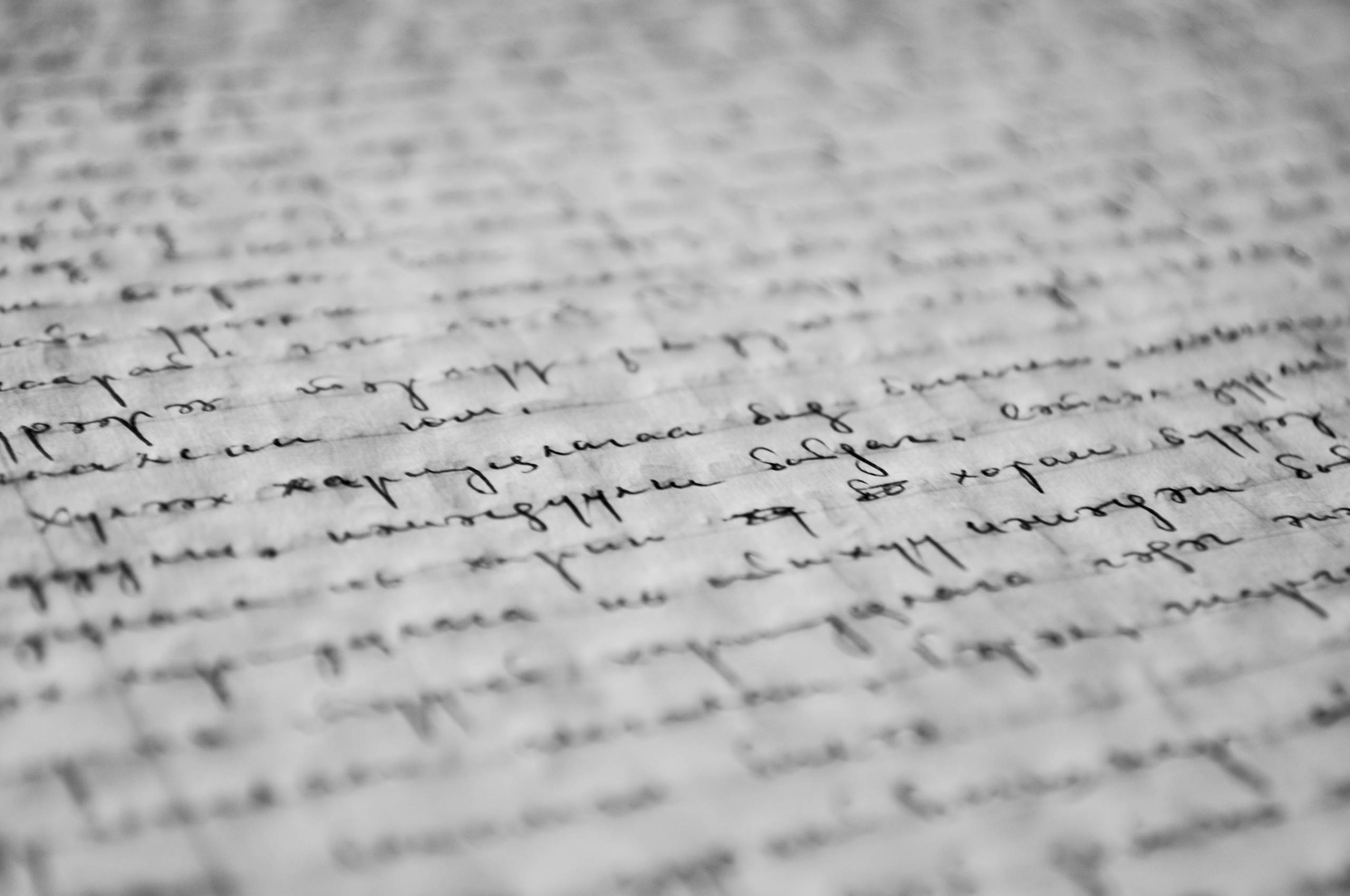
INFP handwriting tends to be expressive, inconsistent in size and spacing, and deeply personal in style, often shifting between neat and chaotic depending on the emotional state of the writer. Where other types might develop a steady, practiced hand, INFPs frequently write in a way that mirrors their inner world: fluid, layered, and resistant to rigid uniformity.
That inconsistency isn’t a flaw. It’s a fingerprint of how the INFP mind actually works, processing meaning through feeling before form, and letting the pen follow the heart rather than the ruler.

If you’ve ever looked at your own handwriting and wondered why it looks so different from one page to the next, or why it feels like a mood rather than a method, you might be seeing your personality type expressed in ink. And if you’re not sure of your type yet, our free MBTI personality test is a good place to start before we go further.
Our INFP Personality Type hub covers the full range of what makes this type distinct, from how they communicate to how they handle conflict to what drives them creatively. Handwriting sits at an interesting intersection of all of those things, because it’s one of the few places where the internal world of an INFP becomes visible without being filtered through words.
Why Does Handwriting Reflect Personality at All?
Graphology, the study of handwriting as a window into personality, has a complicated relationship with mainstream psychology. Some practitioners make sweeping claims about character that go well beyond what the evidence supports. Even so, the basic premise that handwriting is a motor habit shaped by the nervous system, emotional state, and habitual cognitive patterns has some grounding in how we understand fine motor control and self-expression.
What we do know is that handwriting varies with mood, stress, and attention. A person writing under pressure writes differently than one writing in a relaxed state. Someone who processes information visually and spatially often develops different letter shapes than someone who processes sequentially. These aren’t mystical connections. They’re downstream effects of how the brain organizes movement and meaning together.
For INFPs specifically, whose dominant cognitive function is introverted feeling (Fi), the writing hand is often following an emotional current that runs below conscious awareness. Fi doesn’t evaluate situations against external standards. It measures everything against an internal value system that is deeply personal and often hard to articulate. When that function is running the show, even something as mundane as forming letters on a page gets filtered through it.
There’s also the role of auxiliary Ne, extraverted intuition, which pulls the INFP’s attention in multiple directions simultaneously, connecting ideas and possibilities in ways that can make sustained, uniform output difficult. You start writing one way, a thought shifts, and your pen shifts with it. That’s not carelessness. That’s Ne doing what it does.
What Are the Common Traits of INFP Handwriting?
No two INFPs write identically, and that’s almost the point. Still, certain patterns show up often enough to be worth examining.
Variable Size and Pressure
Many INFPs write with letters that shift in size across a single page. Some words get large and expressive when the content feels emotionally significant. Others shrink when the writer is uncertain or moving through something internally complex. Pressure on the page often varies too, heavier when feeling deeply, lighter when distracted or reflective.
I noticed something similar in my own writing during the years I ran my agency. My handwriting in meeting notes was tight, controlled, almost mechanical. But when I was writing in my personal notebooks at home, processing a difficult client situation or working through a creative problem, the letters sprawled. The pen moved differently when the audience was only me.
Rounded, Organic Letterforms
INFPs often gravitate toward rounded letters rather than angular ones. Sharp, geometric handwriting tends to show up in types who prioritize efficiency and structure in their thinking. The INFP, whose cognitive wiring leans toward warmth, nuance, and connection, often produces letterforms that reflect those same qualities: soft curves, open loops, letters that lean slightly rather than stand at rigid attention.
This isn’t universal, and it’s worth saying clearly that handwriting style is also shaped by education, culture, and the specific cursive or print systems a person learned as a child. Still, many INFPs report that their handwriting feels more natural when it’s allowed to be loose and organic rather than forced into precision.
Inconsistent Spacing and Slant
Ask an INFP to write the same sentence twice and the spacing between words will likely differ. The slant of letters might shift mid-paragraph. Some graphologists associate rightward slant with emotional expressiveness and openness to others, while leftward slant is sometimes linked to self-containment and inward focus. INFPs, who move between both states depending on energy and trust, sometimes show both slants in the same piece of writing.
That internal movement between openness and self-protection shows up in other areas too. The way INFPs approach difficult conversations, for instance, often mirrors this same push and pull. If you recognize that pattern in yourself, the piece on how INFPs can handle hard talks without losing themselves gets into the mechanics of that dynamic in a way that might feel familiar.
Personal Flourishes and Idiosyncratic Details
INFPs frequently develop small, personal details in their handwriting that aren’t taught anywhere. A particular way of crossing a “t” that curves unexpectedly. A capital “I” that looks nothing like the standard form. Loops that extend further than necessary. These aren’t errors. They’re expressions of individuality, the same impulse that makes INFPs resist being categorized or flattened into someone else’s template.
Authenticity is central to Fi, and that extends even to something as small as how a letter is formed. There’s a quiet refusal in INFP handwriting to be exactly like everyone else’s.
How Does the INFP’s Cognitive Stack Shape What Appears on the Page?
Understanding INFP handwriting means understanding, at least briefly, how the INFP cognitive stack operates. The dominant function is Fi, introverted feeling. The auxiliary is Ne, extraverted intuition. The tertiary is Si, introverted sensing. The inferior is Te, extraverted thinking.
Fi as dominant means that the INFP’s primary mode of processing is internal and values-based. Every experience, including the act of writing, gets filtered through a question that isn’t always conscious: does this feel true? Does this feel like me? That’s why an INFP might abandon a perfectly legible handwriting style in favor of one that feels more authentic, even if it’s harder for others to read.
Ne as auxiliary means the INFP’s attention is constantly being pulled toward connections, possibilities, and associations. Sustained, uniform output is genuinely difficult when the mind is simultaneously exploring three other threads. This shows up in handwriting as variation, the pen following the thought rather than a predetermined pattern.
Si as tertiary adds an interesting layer. Si in the INFP’s stack involves comparing present experience to past impressions and internal sensory data. A developed Si can actually help an INFP maintain more consistency in handwriting over time, because Si supports the kind of habitual, practiced repetition that produces a stable hand. Less-developed Si means the INFP may never settle into a single, consistent style, because the pull toward novelty from Ne keeps overriding the pull toward familiar patterns from Si.
Te as inferior is worth noting too. Te is the function most associated with external organization, efficiency, and measurable output. Because it sits in the inferior position for INFPs, it’s the function they’re least naturally comfortable with, and often the one that creates the most stress. Forced precision, including being told that handwriting must look a certain way, can feel like a Te demand that conflicts with everything Fi wants to do.

Does INFP Handwriting Change Depending on Context?
Almost certainly, yes. Context shapes handwriting for everyone, but it shapes it particularly dramatically for INFPs because their emotional state is so central to how they function.
Writing in a private journal, where the only reader is the self, tends to bring out the most unfiltered version of INFP handwriting. The letters are looser, more expressive, sometimes barely legible. There’s no performance happening. The hand is just following the feeling.
Writing in a professional or academic context introduces a kind of self-consciousness that can tighten everything up. The INFP knows they’re being observed or evaluated, and that awareness activates a more controlled, careful mode. The handwriting becomes more legible, more uniform, but also more effortful. It costs something to write that way for extended periods.
Writing during emotional distress often produces handwriting that’s notably different from either of those states. Letters might become smaller and more cramped, or larger and more erratic. Pressure increases. Lines drift. The body is expressing what the words might not be saying directly.
I’ve seen this in myself. During a particularly difficult period at my agency, when we were losing a major account and I was trying to hold the team together, my handwriting in my notebooks from that time looks almost like a different person wrote it. Tight, angular, pressed hard into the page. Nothing like the open, wandering script I default to when things feel settled.
That kind of emotional leakage into physical expression is something INFPs share, in different ways, with their close cousins the INFJs. The way INFJs experience their own communication patterns under stress is worth understanding if you’re trying to make sense of the broader intuitive-feeling landscape. The piece on INFJ communication blind spots covers some of that territory, and the parallels to INFP experience are striking.
Is There a Connection Between INFP Handwriting and Emotional Processing?
Writing by hand, as opposed to typing, has a different relationship to emotional processing. The physical act of forming letters slows the output down in a way that typing doesn’t. For INFPs, who process emotion deeply and often need time to understand what they’re actually feeling, that slowing-down can be genuinely useful.
There’s a reason journaling has such a strong following among INFPs. The handwritten journal isn’t just a record. It’s a processing tool. The act of moving a pen across paper, forming words in a particular way, at a particular speed, seems to help INFPs access layers of feeling that stay buried when they’re typing quickly or speaking aloud.
Some work in cognitive science suggests that the motor engagement of handwriting activates different neural pathways than typing, though the exact mechanisms are still being studied. What’s clear is that many INFPs report feeling more emotionally clear after handwriting than after typing the same content. The medium matters to them in a way it might not for types less oriented toward internal feeling states.
That same depth of emotional processing is what can make conflict so difficult for INFPs. When something feels wrong, it doesn’t just feel slightly off. It reverberates. Understanding why INFPs tend to take conflict so personally is part of understanding how their emotional world operates, and it connects directly to why expressive outlets like handwriting matter so much to them.
How Does INFP Handwriting Compare to INFJ Handwriting?
INFPs and INFJs are often grouped together because they share two letters and a general orientation toward depth, meaning, and connection. But their cognitive stacks are quite different, and those differences show up in handwriting tendencies too.
The INFJ’s dominant function is Ni, introverted intuition, which is convergent and pattern-focused. Where Ne pulls the INFP outward into multiple possibilities, Ni pulls the INFJ inward toward a single synthesized insight. INFJ handwriting often reflects this: it tends toward more consistency and deliberateness than INFP handwriting, even when it’s still expressive. There’s a sense of intention in INFJ script that INFP script sometimes lacks, because INFP handwriting is more reactive to the moment.
INFJs also carry Fe as auxiliary, extraverted feeling, which orients them toward how their expression lands with others. That awareness of external reception can make INFJs slightly more self-editing in their handwriting, particularly in social contexts. INFPs, whose Fi is deeply internal, are less naturally concerned with how their handwriting appears to others, at least when they’re writing for themselves.
Both types can struggle with conflict avoidance and the emotional cost of keeping difficult feelings unexpressed. The INFJ version of that struggle has its own particular texture, including the famous door slam that happens when an INFJ’s tolerance finally runs out. If you’re curious about how that mechanism works, the piece on why INFJs door slam and what alternatives exist is worth reading alongside the INFP material.

What INFPs and INFJs share is a tendency to use writing, including handwriting, as a form of self-communion. Both types often find that putting words on a physical page helps them understand their own inner landscape in ways that conversation doesn’t always reach. The difference is in the quality of that inner landscape: the INFP’s is more diffuse and values-saturated, while the INFJ’s is more focused and meaning-convergent.
INFJs have their own relationship with influence and expression that operates quietly but with real intensity. The piece on how INFJ quiet intensity actually works captures something that INFP readers might recognize in themselves too, even if the mechanism underneath it differs.
What Does INFP Handwriting Look Like in Creative vs. Functional Writing?
There’s often a visible difference between an INFP’s creative handwriting and their functional handwriting, and the gap can be surprisingly large.
Creative handwriting, the kind that appears in personal journals, poetry drafts, letters to close friends, or sketchbooks, tends to be the most authentically INFP. Letters might be decorated. Words might be underlined or circled. Margins fill with notes and arrows. The page becomes a visual expression of a mind that doesn’t process in straight lines.
Functional handwriting, the kind produced for grocery lists, meeting notes, or form-filling, tends to be more compressed and less expressive. The INFP is operating in a mode that feels slightly foreign, producing output for a purpose rather than for meaning. The handwriting often looks more effortful and less natural as a result.
Some INFPs describe a low-level frustration with having to write in purely functional ways, a sense that the medium is being used below its potential. That frustration is worth taking seriously, because it points to something real about how this type relates to expression. Writing, for an INFP, is rarely just information transfer. It’s almost always also an act of meaning-making.
That need for meaning in communication extends beyond handwriting into every form of expression the INFP uses. The difficulty INFJs share around keeping peace at the expense of honest communication, explored in the piece on the hidden cost of avoiding difficult conversations, resonates with INFPs who often face the same dilemma from a slightly different angle.
Can Handwriting Analysis Actually Reveal MBTI Type?
This is worth being honest about. Graphology as a formal discipline has not been validated as a reliable predictor of personality type in the way that MBTI assessment has. The connection between handwriting and personality is real in a general sense, meaning that emotional state, cognitive style, and habitual patterns do influence motor output. But the leap from “this person’s handwriting has certain qualities” to “this person is an INFP” is not one that holds up under rigorous testing.
What handwriting can do is offer a kind of soft confirmation. If you already know you’re an INFP, and you look at your handwriting and recognize the variability, the personal flourishes, the emotional responsiveness encoded in the pressure and slant, that recognition can be meaningful. It’s another data point in the larger picture of self-understanding.
What it can’t do reliably is serve as a diagnostic tool. Two INFPs raised in different countries, educated in different handwriting systems, and with different fine motor histories will write very differently from each other. The cognitive fingerprint is there, but it’s filtered through too many other variables to read directly off the page.
There’s a useful parallel here to how MBTI itself works. The framework describes cognitive preferences, not behaviors. Two people with the same type can behave very differently in the same situation. The type describes the underlying orientation, not the surface output. Handwriting is surface output. Personality type is the orientation underneath it. Both matter, but they’re not the same thing.
For a grounding in how personality frameworks actually work, 16Personalities’ theory overview offers a readable explanation of the cognitive approach to type. And for anyone curious about the neuroscience of how emotional states affect physical expression, this PubMed Central article on emotion and motor control offers some relevant context.
Why Do INFPs Often Feel a Deep Connection to Handwriting as a Medium?
Ask many INFPs whether they prefer handwriting or typing for personal expression, and the answer is often handwriting, even among those who spend most of their professional lives on keyboards. There’s something about the physical act that feels more honest to them.
Part of that is the pace. Handwriting forces a slower output than typing, and that slower pace gives the INFP’s Fi time to catch up with what’s being expressed. The feeling can be named more accurately when the hand is moving at a pace that allows for reflection rather than reaction.
Part of it is also the irreversibility. You can’t ctrl-Z a pen stroke the way you can delete a typed word. That permanence, which might feel like a constraint to some types, often feels like commitment to an INFP. The word on the page was chosen. It stays. There’s a kind of integrity in that.
And part of it is simply that handwriting is personal in a way that typed text isn’t. A handwritten letter carries the physical trace of the person who wrote it. The pressure, the slant, the idiosyncratic letter shapes are all present in a way that a font never is. For INFPs, who value authentic personal connection above almost everything else, that trace of the self in the written mark matters.
The psychology of empathy and connection, which underlies so much of what makes INFPs tick, is explored thoughtfully at Psychology Today’s overview of empathy. And for anyone interested in the broader relationship between personality and physical self-expression, this Frontiers in Psychology piece on personality and expressive behavior offers some grounding.

What Can INFPs Learn From Paying Attention to Their Own Handwriting?
Treating your own handwriting as a source of self-information, rather than just a functional output, can be a surprisingly useful practice for INFPs.
Notice when your handwriting changes. If your usual loose, expressive script suddenly becomes cramped and tight, something is probably constricting you emotionally. If your handwriting becomes unusually large and sweeping, you might be in a period of expansion, creative energy, or emotional openness. The hand often knows what the mind hasn’t quite articulated yet.
Pay attention to what you write most freely versus what feels effortful. The content that flows easily in handwriting is often the content closest to your actual values and feelings. The content that comes out stilted and over-corrected is often the content where you’re managing external expectations rather than expressing internal truth.
Consider keeping a handwritten journal specifically for processing emotional content. Not as a record of events, but as a space where the hand can follow the feeling without being edited for an audience. Many INFPs find that this practice surfaces insights that never emerge from typed journaling or spoken reflection.
That kind of self-attunement is worth cultivating, because INFPs who are disconnected from their own inner signals tend to struggle more with everything from decision-making to conflict. The work of staying connected to the self isn’t always dramatic. Sometimes it looks like sitting with a pen and a notebook and letting the letters do what they need to do.
The broader connection between self-awareness and communication is something INFJs wrestle with too, particularly around how their quiet intensity lands with others. That dynamic, examined in the piece on how INFJs influence without formal authority, has echoes in the INFP experience of trying to express depth in a world that often prefers surface.
There’s also the question of what happens when INFPs try to suppress that expressive impulse entirely, whether in handwriting or in other forms of communication. The cost of that suppression is real, and it tends to show up eventually, in conflict avoidance, in emotional withdrawal, in the kind of quiet resentment that builds when authentic expression has no outlet. Understanding how emotional suppression affects wellbeing, as this PubMed Central piece explores, adds useful context to why expressive practices matter for feeling-dominant types.
For INFPs specifically, the research on personality and emotional regulation from PubMed Central offers some grounding in why types with strong internal feeling functions often benefit from expressive outlets that operate outside of verbal language.
At the end of the day, INFP handwriting is just one small window into a personality type that operates with unusual depth and emotional complexity. But it’s a window worth looking through, because what you see there is often more honest than what appears in more managed forms of communication.
If you want to go deeper into what makes INFPs tick across every area of life, from how they love to how they lead to how they handle conflict, our complete INFP Personality Type resource hub brings it all together in one place.
About the Author
Keith Lacy is an introvert who’s learned to embrace his true self later in life. After 20 years in advertising and marketing leadership, including running agencies and managing Fortune 500 accounts, Keith now channels his experience into helping fellow introverts understand their strengths and build fulfilling careers. As an INTJ, he brings analytical depth and authentic perspective to every article, drawing from both professional expertise and personal growth.
Frequently Asked Questions
Does INFP handwriting look different from other personality types?
INFP handwriting tends to be more expressive, variable, and personally idiosyncratic than handwriting from types with a stronger preference for external structure and consistency. The variability in size, pressure, and slant reflects the INFP’s dominant Fi function and auxiliary Ne, which prioritize internal authenticity and open-ended exploration over uniform output. That said, handwriting is also shaped by education, culture, and individual motor history, so no single style is universal to the type.
Can you identify someone’s MBTI type from their handwriting alone?
Not reliably. While handwriting does reflect aspects of personality, including emotional state and habitual cognitive patterns, the variables that shape handwriting are too numerous for it to serve as a diagnostic tool for MBTI type. Graphology has not been validated as a predictor of specific personality types. Handwriting can offer soft confirmation for someone who already knows their type, but it shouldn’t be used as a primary method of type identification.
Why do INFPs often prefer handwriting over typing for personal expression?
Many INFPs find that handwriting’s slower pace gives their dominant Fi function time to catch up with what’s being expressed, allowing for more accurate emotional articulation. The physical permanence of ink on paper also appeals to the INFP’s sense of authenticity and commitment. Additionally, handwriting carries a personal trace, the pressure, slant, and idiosyncratic letterforms of the individual, that typed text cannot replicate, and that trace of self matters to a type that values genuine personal expression above almost everything else.
How does emotional state affect INFP handwriting?
Quite significantly. INFPs in emotional distress often produce handwriting that is noticeably different from their baseline, sometimes tighter and more cramped, sometimes larger and more erratic, with heavier pressure on the page. In states of creative flow or emotional openness, INFP handwriting tends to become looser, more expressive, and more idiosyncratic. Because Fi is the INFP’s dominant function and emotional state is central to how they process everything, the hand tends to follow the feeling in ways that are often visible on the page.
Is journaling by hand beneficial for INFPs?
Many INFPs report that handwritten journaling is a more effective emotional processing tool than typed journaling. The physical act of forming letters at a slower pace seems to help INFPs access layers of feeling that stay buried during faster forms of output. The private, unedited nature of a handwritten journal also aligns with the INFP’s need for a space where Fi can operate without external judgment or performance. For INFPs who struggle to articulate their inner world in conversation, handwritten journaling can serve as a consistent and valuable self-awareness practice.