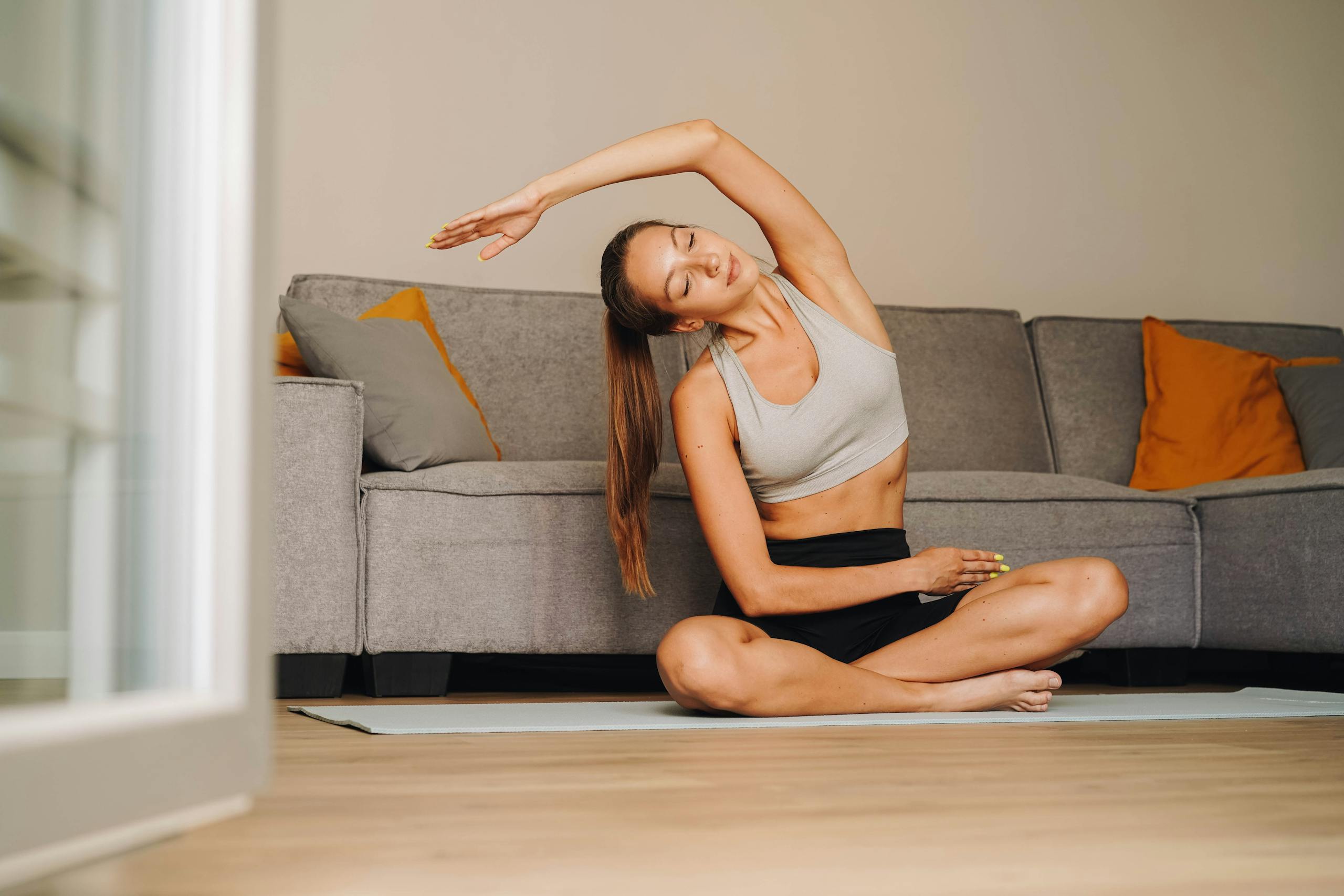
Homebody yoga and wellness practices give introverts a way to restore energy, process emotion, and care for their bodies without the social overhead of a studio class. A quiet mat in a familiar room, a breathing practice that fits between meetings, a gentle routine built entirely around your own rhythms: these aren’t compromises. They’re the actual point.
Many introverts find that the wellness industry, with its group classes, loud playlists, and instructor-led energy, was never really designed with them in mind. Homebody yoga reclaims that space and makes it genuinely yours.
If you’ve been exploring how your home environment shapes your mental and physical health, our Introvert Home Environment hub covers the full range of ways introverts can design their spaces and routines to work with their wiring, not against it.

Why Does Yoga Feel So Different at Home?
There’s a particular kind of exhaustion that comes from performing wellness. I discovered this somewhere around year twelve of running my agency, when a well-meaning business partner dragged me to a hot yoga class as a “team bonding” exercise. I lasted forty minutes before the combination of forced proximity, mirrored walls, and an instructor calling out my alignment in front of fifteen strangers made me feel worse than when I’d walked in. I didn’t go back.
What drains your social battery?
Not all social exhaustion is the same. Our free quiz identifies your specific drain pattern and gives you personalised recharging strategies.
Find Your Drain PatternUnder 2 minutes · 8 questions · Free
What I eventually figured out, years later when I started practicing at home, was that the problem wasn’t yoga. The problem was the environment. Studio yoga layers a social performance on top of a physical one. You’re managing how you look, whether you’re keeping up, what the person next to you thinks of your downward dog. For someone whose nervous system is already processing the room at full bandwidth, that’s a significant tax on what’s supposed to be restorative.
Home practice removes all of that. There’s no audience. No comparison. The only feedback loop is the one between your body and your breath. For introverts who process deeply and notice everything, that quieter feedback loop is where real progress actually lives.
There’s also something worth naming about the sensory dimension of this. Many introverts, particularly those with high sensitivity, find that studio environments carry a kind of ambient noise even when they’re quiet: the collective energy of other bodies, the instructor’s cues arriving before you’ve finished processing the last one, the faint chemical smell of borrowed mats. At home, you control all of it. The temperature, the scent, the silence. That level of environmental control isn’t a luxury. For a nervous system that’s always taking in more than average, it’s a genuine wellness variable.
What Does a Real Homebody Yoga Practice Actually Look Like?
One of the things I’ve noticed in my own practice, and in conversations with other introverts who’ve made this shift, is that home yoga tends to become something more personal and more honest than studio yoga ever was. Without the structure of a class format, you start to figure out what you actually need rather than what the curriculum provides.
Some days that’s forty minutes of slow flow with a YouTube instructor whose voice you’ve come to trust. Other days it’s fifteen minutes of yin poses while listening to a podcast, or a ten-minute breathwork session before a difficult call. The practice shapes itself around your life rather than the other way around.
A few elements tend to anchor a sustainable home practice:
A Dedicated, Even Small, Space
You don’t need a studio-sized room. What you need is a corner that signals to your brain that this is where restoration happens. I cleared a six-by-four-foot section of my home office, moved a chair, and put down a mat. That’s it. The spatial consistency matters more than the square footage. Your nervous system learns to downshift when it recognizes the environment.
This connects to something I’ve written about in the context of HSP minimalism: when you strip away visual and sensory clutter, your body spends less energy managing stimulation and more energy actually resting. A yoga corner that’s clean and intentional does the same work.
Consistency Over Duration
The introvert tendency toward depth can work against us here. We want to do the full practice, or we feel like it doesn’t count. I spent months skipping my mat entirely because I didn’t have a full hour, which meant I was doing nothing instead of something. Ten minutes of intentional movement and breath is worth more than a perfect hour that never happens. Showing up matters more than showing up completely.
Choosing Instruction That Matches Your Temperament
Not all online yoga instruction is created equal for introverts. Some instructors are high-energy and directive in a way that replicates the studio dynamic. Others are quieter, more contemplative, and leave more silence in their cues. It’s worth taking the time to find a voice and a style that feels like a conversation rather than a performance. Many introverts gravitate toward yin yoga, restorative yoga, and yoga nidra specifically because the pace allows for the kind of internal processing that suits their natural rhythm.

How Does Yoga Support Introvert Mental Health Specifically?
The mental health benefits of yoga aren’t generic. For introverts, certain dimensions of the practice seem to land with particular weight.
Breathwork, for instance, has a documented effect on the autonomic nervous system. Published research in PubMed Central has examined how controlled breathing practices influence the parasympathetic nervous system, the branch responsible for the “rest and digest” state that many introverts find genuinely difficult to access after a day of social and professional demands. When I was running client presentations back to back, my body was in a near-constant activation state by mid-afternoon. I didn’t have language for that at the time. I just knew I felt depleted in a way that sleep alone didn’t fix.
Yoga gave me a physiological off-ramp. Not metaphorically. The slow exhale-to-inhale ratio in practices like pranayama actually signals the nervous system to downshift. That’s not a small thing when your baseline is running hot from processing a full day of external input.
There’s also the dimension of body awareness. Introverts tend to live significantly in their heads. The internal world of ideas, analysis, and reflection is genuinely compelling, and the body can become something of an afterthought. Yoga reverses that, not by forcing you out of your inner life, but by bringing physical sensation into it. You start noticing where you hold tension, which for me was always the jaw and the shoulders, and you develop a relationship with that information rather than ignoring it until it becomes a problem.
A PubMed Central review on mindfulness and psychological well-being points toward the connection between body-based practices and reduced anxiety, which maps onto what many introverts experience when they develop a consistent home practice. The mechanism isn’t mystical. Paying sustained attention to physical sensation anchors you in the present moment, which interrupts the kind of ruminative thinking that introverts are particularly prone to.
What Wellness Practices Pair Well With Home Yoga?
Yoga works best as part of a broader wellness ecosystem rather than a standalone fix. For introverts building a home-centered approach to their health, a few practices tend to amplify each other in useful ways.
Journaling and Reflective Writing
Yoga surfaces things. Emotions, memories, physical sensations that carry emotional weight. Having a journaling practice that follows your mat time gives those surfaces somewhere to go. I keep a simple notebook near my yoga corner and spend five to ten minutes writing after practice, not structured reflection, just whatever comes up. Some of the clearest thinking I’ve done about my agency years, the decisions I made well and the ones I regret, came in those post-yoga pages.
There’s something about the combination of physical movement and quiet reflection that loosens material that stays stuck when you approach it directly. Introverts who process deeply tend to find this pairing particularly productive.
Intentional Rest and Sleep Hygiene
Evening yoga, particularly yin or restorative styles, functions as a genuine sleep preparation tool. The parasympathetic activation that breathwork and slow movement create makes the transition to sleep more natural. For introverts who tend to lie awake processing the day, a twenty-minute evening practice can interrupt that loop before it starts.
Curating Your Wellness Environment
The physical objects around your practice space matter more than wellness culture typically acknowledges. A candle, a specific playlist, a plant, a weighted blanket nearby for savasana: these aren’t indulgences. They’re environmental cues that help your nervous system recognize the transition from work mode to restoration mode. If you’re looking for thoughtful additions to your home wellness space, the gifts for homebodies resource has genuinely useful ideas for building a space that supports this kind of intentional living.
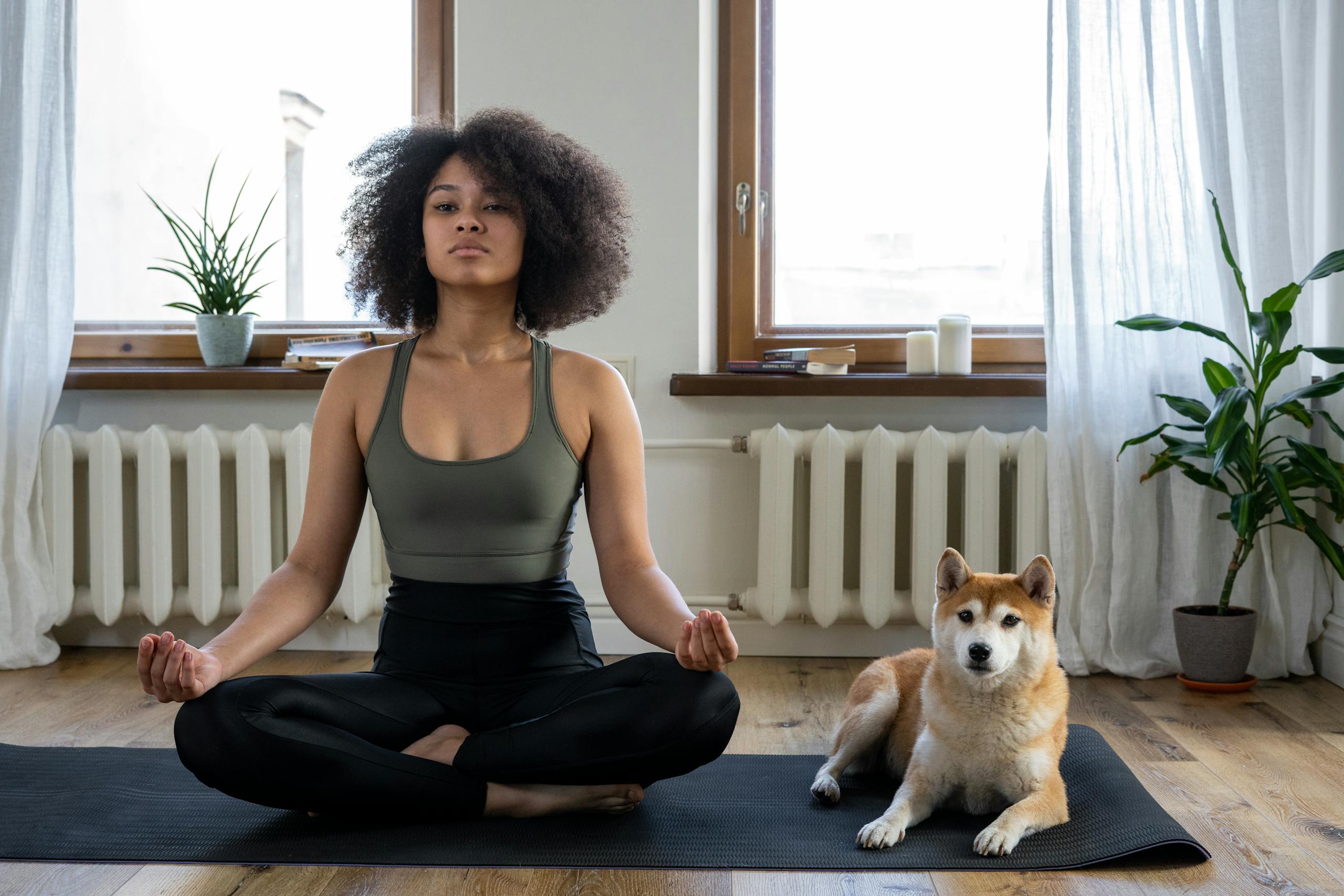
How Do You Build a Sustainable Home Yoga Routine Without Burning Out?
Burnout recovery was something I became an unwilling expert in during my agency years. The pattern was always the same: push hard, ignore the signals, hit a wall, recover enough to push again. I cycled through that loop for the better part of a decade before I understood that the recovery phase wasn’t a failure state. It was information. My body was telling me something I hadn’t learned to hear.
Home yoga, when approached with some self-awareness, becomes a practice in reading that information rather than overriding it. The challenge is that introverts who are also high achievers, and there are many of us, can turn a wellness practice into another performance metric. Suddenly you’re tracking streak days, comparing your flexibility to where you were three months ago, feeling guilty about missing Tuesday.
A few principles that have helped me keep the practice genuinely restorative rather than quietly competitive:
Separate Practice From Progress
Progress in yoga is real, but it’s not the point of a wellness practice. The point is showing up for your body today, with what it has today. Some of my most valuable sessions have been the ones where I lay in child’s pose for most of the time because that’s what my body asked for. That’s not a failed workout. That’s listening.
Build In Social Recharge Time Alongside Physical Practice
Physical wellness and social wellness are different systems, and introverts need to manage both. A yoga practice addresses the physical and the emotional, but it doesn’t replace the need for meaningful connection. What it can do is help you show up more fully for the connections that matter, because you’re not running on empty when you arrive.
Some introverts find that low-pressure digital communities offer a useful middle ground between isolation and the social overhead of in-person groups. Chat rooms for introverts can be a surprisingly good way to share a practice with others without the performance element of showing up in person.
Protect the Practice From Your Calendar
In my agency years, anything that wasn’t billable or client-facing eventually got pushed out of the schedule. Self-care was always the first casualty. What I’ve learned since is that treating wellness time as negotiable is how it disappears entirely. Even fifteen minutes blocked on a calendar, treated with the same seriousness as a client call, is more sustainable than an open-ended intention to practice “when there’s time.”
What Should Introverts Know About Yoga Philosophy?
Yoga’s philosophical roots offer something that the physical practice alone doesn’t always surface: a framework for understanding why rest and withdrawal are not weaknesses. The concept of pratyahara, one of yoga’s classical limbs, describes the withdrawal of the senses from external stimulation as a necessary step toward clarity and inner awareness. For introverts, this isn’t an advanced spiritual practice. It’s a description of something they do naturally and often feel vaguely apologetic about.
Reading about yoga philosophy, even casually, can be a genuinely validating experience for introverts who’ve spent years treating their need for solitude as a social liability. The tradition doesn’t pathologize inwardness. It treats it as a prerequisite for depth. That reframe matters.
If you’re drawn to exploring the intellectual and philosophical dimensions of homebody living more broadly, the homebody book recommendations at Ordinary Introvert include titles that take this kind of reflective, inward orientation seriously as a way of life rather than a personality quirk to be corrected.
How Does Emotional Resilience Connect to a Home Wellness Practice?
Emotional resilience, for introverts, isn’t about developing a thicker skin. It’s about building a more reliable relationship with your own internal states so that difficult emotions don’t accumulate into a backlog that eventually overwhelms you. That’s a different project than the one most resilience frameworks describe.
What I’ve found, both personally and in watching people I’ve worked with over the years, is that introverts who have a consistent physical practice tend to handle emotional difficulty with more steadiness. Not because they feel less, but because they’ve developed a habit of checking in with their bodies regularly. The mat becomes a place where you notice what’s actually happening rather than what you’ve been telling yourself is happening.
There was a period during a particularly difficult agency transition, a merger that went badly and took two years to unwind, when my yoga practice was the one hour of the day where I wasn’t managing anyone else’s anxiety. I wasn’t performing confidence for my team, or steadiness for my clients, or optimism for my partners. I was just on a mat, breathing, noticing what was actually true. That hour didn’t fix anything. But it kept me functional in a way that nothing else did.
The connection between body-based practices and emotional regulation is something that Frontiers in Psychology has examined in the context of mindfulness and self-regulation. The underlying mechanism involves developing what researchers call interoceptive awareness, the ability to notice and interpret signals from your own body. For introverts who are already attuned to subtle internal cues, yoga tends to deepen this capacity rather than build it from scratch.
Emotional resilience also connects to the quality of your inner life more broadly. Introverts who invest in depth, in meaningful conversations, in practices that allow genuine reflection rather than distraction, tend to have more access to their own emotional resources when things get hard. Home yoga is one piece of that larger picture.
What Are Common Mistakes Introverts Make When Starting Home Yoga?
A few patterns come up repeatedly, and most of them stem from applying extroverted wellness logic to an introverted life.
Treating It Like a Productivity Goal
The introvert tendency toward self-improvement can turn a wellness practice into a self-optimization project. You start tracking, comparing, measuring. Before long the practice is generating the same kind of performance anxiety it was supposed to relieve. Yoga works best when it’s approached with genuine curiosity rather than achievement orientation.
Choosing the Wrong Style for Your Nervous System
Power yoga and vinyasa flow have their place, but they’re not automatically the right entry point for introverts recovering from overstimulation. Starting with yin, restorative, or gentle hatha gives your nervous system time to actually settle rather than simply redirecting its activation into physical intensity. Match the practice to what your body needs, not to what looks most impressive on a fitness app.
Underestimating the Value of Consistency Over Intensity
A thirty-minute practice three times a week will do more for your wellbeing than a ninety-minute session once every two weeks. The nervous system benefits of yoga are cumulative and rhythmic. Regular, modest practice builds a baseline that occasional intense sessions simply don’t create.
Skipping Savasana
Savasana, the final resting pose, is where a significant portion of the practice’s integration happens. Many people skip it because lying still feels unproductive. For introverts, whose minds tend to keep running even when the body stops, learning to stay in savasana is itself a practice worth developing. The stillness is the point.
How Can You Make Your Home Yoga Space Work Harder for You?
The environment you practice in shapes the quality of the practice itself. This isn’t just aesthetics. Sensory cues genuinely influence your nervous system’s ability to shift states, and introverts tend to be more responsive to those cues than average.
A few things worth considering as you build your space:
Natural light, where possible, supports circadian rhythm and mood in ways that artificial light doesn’t replicate. If your yoga space gets morning sun, that’s a genuine asset for an early practice. Evening practice benefits from lower, warmer light that supports the transition toward rest.
Sound matters significantly. Some people practice in silence. Others find that ambient music, nature sounds, or a specific playlist creates a reliable entry point into a focused state. What you want to avoid is audio that demands attention rather than supporting it. Lyrics, news, anything that pulls your mind outward rather than inward, works against the practice.
Temperature is often overlooked. A room that’s slightly cool for movement but has a blanket available for savasana covers both ends of the practice without requiring you to manage it mid-session.
Finally, the visual field matters. A cluttered, visually busy space keeps your nervous system in a mild state of alert even when you’re trying to rest. This is the same principle that drives the connection between minimalist environments and reduced stress in highly sensitive people. A clear, intentional space does less work on your attention, which means more capacity for the practice itself.
There’s much more to explore about how your home environment can actively support your introvert wellbeing. The full Introvert Home Environment hub brings together resources on everything from sensory design to daily routines built around introvert energy patterns.
Running on empty?
Five drain profiles, each with specific triggers, warning signs, and a recharging playbook.
Take the Free QuizUnder 2 minutes · 8 questions · Free
About the Author
Keith Lacy is an introvert who’s learned to embrace his true self later in life. After 20 years in advertising and marketing leadership, including running agencies and managing Fortune 500 accounts, Keith now channels his experience into helping fellow introverts understand their strengths and build fulfilling careers. As an INTJ, he brings analytical depth and authentic perspective to every article, drawing from both professional expertise and personal growth.
Frequently Asked Questions
Is homebody yoga as effective as studio yoga for introverts?
For many introverts, homebody yoga is more effective precisely because it removes the social and sensory overhead of a studio environment. The physical benefits of yoga don’t depend on being in a group setting. What a home practice adds is the ability to tune the environment to your nervous system’s actual needs, choose your own pace, and practice without the performance layer that group classes often create. Consistency matters more than setting, and introverts tend to be more consistent when the environment supports rather than taxes them.
What type of yoga is best for introverts practicing at home?
Yin yoga, restorative yoga, and yoga nidra tend to suit introverts particularly well because their slower pace allows for the kind of internal processing that comes naturally to introverted nervous systems. That said, the best style is the one you’ll actually practice consistently. Some introverts find that a morning vinyasa flow suits their energy patterns, while others prefer gentle hatha in the evening. Experiment without pressure and let your body’s feedback guide the choice rather than what looks most rigorous.
How do I stay motivated with a home yoga practice when there’s no instructor or class structure?
Motivation is easier to sustain when you connect the practice to how it makes you feel rather than to external accountability. Keep the barrier to entry low: a mat already laid out, a short default practice you can do on low-energy days, a specific time that becomes habitual rather than negotiated. Online yoga platforms with consistent instructors whose style resonates with you can provide enough structure without the social pressure of a physical class. Many introverts also find that tracking how they feel after practice, rather than tracking performance metrics, builds a more honest and durable motivation.
Can home yoga help with introvert burnout and recovery?
Yes, and it’s one of the more reliable tools available. Introvert burnout typically involves a combination of nervous system overactivation, emotional depletion from sustained social performance, and a backlog of unprocessed internal experience. Yoga addresses all three: breathwork activates the parasympathetic nervous system, the physical practice provides a contained space for emotional release, and the quiet of a solo home practice gives the internal processor time to catch up. A consistent home yoga practice won’t prevent burnout entirely, but it significantly raises the threshold at which it occurs and shortens recovery time when it does.
How much space do I actually need for a home yoga practice?
A standard yoga mat is roughly 68 by 24 inches, and you need a bit of clearance on each side for arm extensions, which means a space of about six by six feet is genuinely sufficient for most practices. Many people practice in bedrooms, living rooms, or home offices by simply moving a piece of furniture. The space doesn’t need to be dedicated or permanent. What matters more than square footage is that the space can be made quiet and clear when you use it, and that it’s accessible enough that setting up doesn’t become a reason not to practice.