
Journaling works differently for people who live mostly inside their own heads. Not because the act itself changes, but because the internal landscape it meets is already so full, so layered, so constantly in motion that putting words to it creates a kind of pressure release that nothing else quite replicates.
For those of us wired for deep internal processing, a blank page isn’t intimidating. It’s an invitation. What happens in that space, and why it matters so much to how we regulate emotion, recover from stress, and make sense of our own complexity, is worth examining more closely than most journaling articles bother to.
There’s a whole world of mental health tools out there, but few fit the introvert’s internal architecture as naturally as writing does. Our Introvert Mental Health hub covers the broader picture, and this article sits inside that conversation as a specific look at what journaling does to an already deeply reflective mind, and why the effects go further than most people expect.

What Does Journaling Actually Do to an Overthinking Brain?
Overthinking gets a bad reputation. People treat it like a flaw to be corrected, a habit to be broken. But for many introverts, what looks like overthinking from the outside is actually something closer to deep processing. The brain is doing real work, sorting through information, weighing outcomes, running scenarios, trying to arrive at something true. The problem isn’t the thinking. It’s that the thinking has nowhere to land.
Career Coaching for Introverts
One-on-one career strategy sessions with Keith Lacy. 20 years of Fortune 500 leadership as an introvert, now helping others build careers that work with their wiring.
Learn More50-minute Zoom session · $175
Writing gives it somewhere to land.
When I was running my agency, I had a habit of lying awake at 2 AM mentally drafting conversations I hadn’t had yet. Presentations I needed to give. Difficult feedback for a creative director who was talented but derailing projects. I’d rehearse the whole thing in my head, sometimes for hours. What I didn’t realize at the time was that the rehearsal loop kept running because I’d never closed it. Writing it down, actually putting the words on paper, would have closed it. The brain registers written thought differently than circling thought. There’s a sense of completion that mental rehearsal alone never produces.
The research published in PubMed Central on expressive writing points to real physiological effects from this kind of written processing, including changes in how the body handles stress. But even without citing specific numbers, the experience is something many people recognize immediately. You write the thing down, and it stops looping. The thought doesn’t disappear, but it stops demanding your attention at every quiet moment.
For a brain that processes deeply by default, this matters enormously. The overthinking isn’t the enemy. The lack of an exit point is. Journaling creates that exit.
How Does Journaling Interact With Sensory and Emotional Overload?
Some people carry the world more intensely than others. Highly sensitive people, in particular, absorb environmental and emotional input at a level that can become genuinely exhausting. Noise, tension in a room, the emotional state of people around them, the weight of unresolved situations. All of it registers, and all of it needs somewhere to go.
If you’ve ever felt completely depleted after a day that didn’t look particularly demanding from the outside, you probably understand this. HSP overwhelm and sensory overload is a real and specific experience, not just general tiredness. The nervous system has been working overtime processing stimuli that others filter out automatically.
Journaling acts as a kind of decompression chamber in those moments. Not because writing is inherently calming (sometimes it surfaces things that are anything but calm), but because it creates a contained space where the accumulated input can be sorted. You’re not suppressing what you absorbed. You’re processing it intentionally rather than letting it sit in the body as unresolved tension.
I noticed this pattern clearly during a particularly brutal new business pitch season at my agency. We were chasing three major accounts simultaneously, and the office energy was frantic in a way that I found genuinely draining even as I was the one driving the pace. By the end of each day, I was carrying a kind of residue that wasn’t exactly stress and wasn’t exactly fatigue. It was more like accumulated noise. The evenings I spent writing, even just ten or fifteen minutes of unstructured reflection, were measurably different from the evenings I didn’t. I slept better. My thinking was clearer the next morning. Something was being released that I hadn’t known how to release any other way.

Can Journaling Help When Anxiety Is Already Running the Show?
Anxiety has a particular relationship with the reflective mind. Because deep thinkers are already accustomed to examining situations from multiple angles, anxiety can hijack that capacity and point it entirely toward worst-case scenarios. The same mental thoroughness that makes someone a careful strategist or a perceptive observer becomes a liability when it’s running on fear rather than curiosity.
The National Institute of Mental Health’s overview of generalized anxiety disorder describes the persistent, difficult-to-control worry that characterizes clinical anxiety. Many introverts experience versions of this without it rising to a clinical threshold, but the pattern is recognizable: the mind won’t stop generating concerns, and each concern branches into more concerns.
Journaling interrupts this branching in a specific way. When you write down an anxious thought, you externalize it. It moves from being something your mind is doing to something your mind is looking at. That shift in perspective, from inside the thought to observing the thought, is subtle but significant. You can ask different questions of something you’re looking at than something you’re inside of.
For people who experience HSP anxiety and its specific texture, this externalization is especially valuable. The anxiety often feels deeply personal, as though it reflects something true about the situation rather than something the nervous system is generating. Writing creates enough distance to question that assumption.
One practice that helped me during a particularly uncertain period when my agency was handling a major client departure was what I’d call a “worry audit.” I’d write down every anxious thought I was carrying, without editing or organizing. Then I’d go back through the list and mark each one as either “within my control,” “partially within my control,” or “outside my control entirely.” The act of categorizing didn’t solve anything. But it stopped the thoughts from feeling like an undifferentiated mass of threat. Some were real problems I could address. Others were noise. Writing made it possible to tell the difference.
What Happens When Journaling Meets Deep Emotional Processing?
There’s a difference between feeling an emotion and processing it. Feeling is immediate, automatic, often physical. Processing is the work that comes after, making sense of what the emotion is pointing to, understanding its origins, deciding what to do with it. Many people stop at feeling. The journal is where processing actually happens.
For people who feel things at significant depth, this distinction matters enormously. HSP emotional processing and the experience of feeling deeply describes what it’s like to have emotions that are more intense, more layered, and more persistent than what others seem to experience. Without a dedicated space to work through that depth, emotions can become stuck. They don’t resolve because they’ve never been fully examined.
Writing does something that conversation sometimes can’t. It slows the process down. In a conversation, there’s social pressure to arrive at a conclusion, to respond to the other person, to be coherent in real time. On a page, you can follow a feeling wherever it goes without worrying about how it lands. You can write something that doesn’t make sense yet, and then write the next thing, and gradually find your way to something that does.
I’ve watched this play out in people I managed over the years. One of the most emotionally intelligent people on my team, a senior account director who was deeply perceptive and genuinely empathetic, used to struggle enormously after difficult client meetings. She absorbed the emotional weight of those interactions in a way that left her depleted for hours afterward. When she started keeping a brief post-meeting journal, not for professional notes but for personal processing, the recovery time shortened noticeably. She was doing the same emotional work, but with a tool that actually fit the depth of what she was carrying.

How Does Journaling Affect the Way We Carry Other People’s Emotions?
Empathy is a gift with a cost. Feeling genuinely moved by other people’s experiences, understanding their pain or their joy from the inside rather than just observing it from outside, creates connection that is rare and valuable. It also creates a kind of emotional accumulation that needs managing.
HSP empathy as a double-edged sword captures exactly this tension. The same capacity that makes someone a deeply supportive friend or a perceptive colleague is the capacity that leaves them carrying weight that isn’t technically theirs to carry. Without a way to set that weight down, it builds.
Journaling offers a specific kind of help here that’s worth naming precisely. It creates a space where you can acknowledge what you’ve absorbed without being required to act on it. You can write about someone else’s pain without having to fix it. You can write about the toll that empathy is taking without having to apologize for feeling it. The page doesn’t need you to resolve anything. It just receives what you bring.
Running an agency meant being the person people brought their problems to. Client crises, team conflicts, creative frustrations, career anxieties. As an INTJ, I’m not naturally the most emotionally expressive person in the room, but I absorbed more than I showed. The accumulation was real even when the display was contained. Writing gave me somewhere to put what I’d taken in from other people’s situations, not to process their emotions for them, but to separate what was mine from what wasn’t. That separation is harder to achieve than it sounds, and journaling is one of the few tools that actually helps with it.
A PubMed Central study on emotional regulation strategies highlights how expressive writing can support the kind of cognitive reappraisal that helps people manage emotionally demanding situations. For those who regularly carry other people’s emotional weight, that reappraisal function is particularly valuable.
Does Journaling Help When Perfectionism Is Doing the Damage?
Perfectionism and deep thinking tend to travel together. When you’re capable of seeing how something could be better, it’s hard not to hold yourself to that higher standard. The problem is that the standard keeps moving. Every improvement reveals a new gap. The internal critic never runs out of material.
For highly sensitive people especially, HSP perfectionism and the trap of high standards can become a significant source of suffering. The same attunement to quality and detail that produces excellent work also produces relentless self-evaluation that is genuinely exhausting.
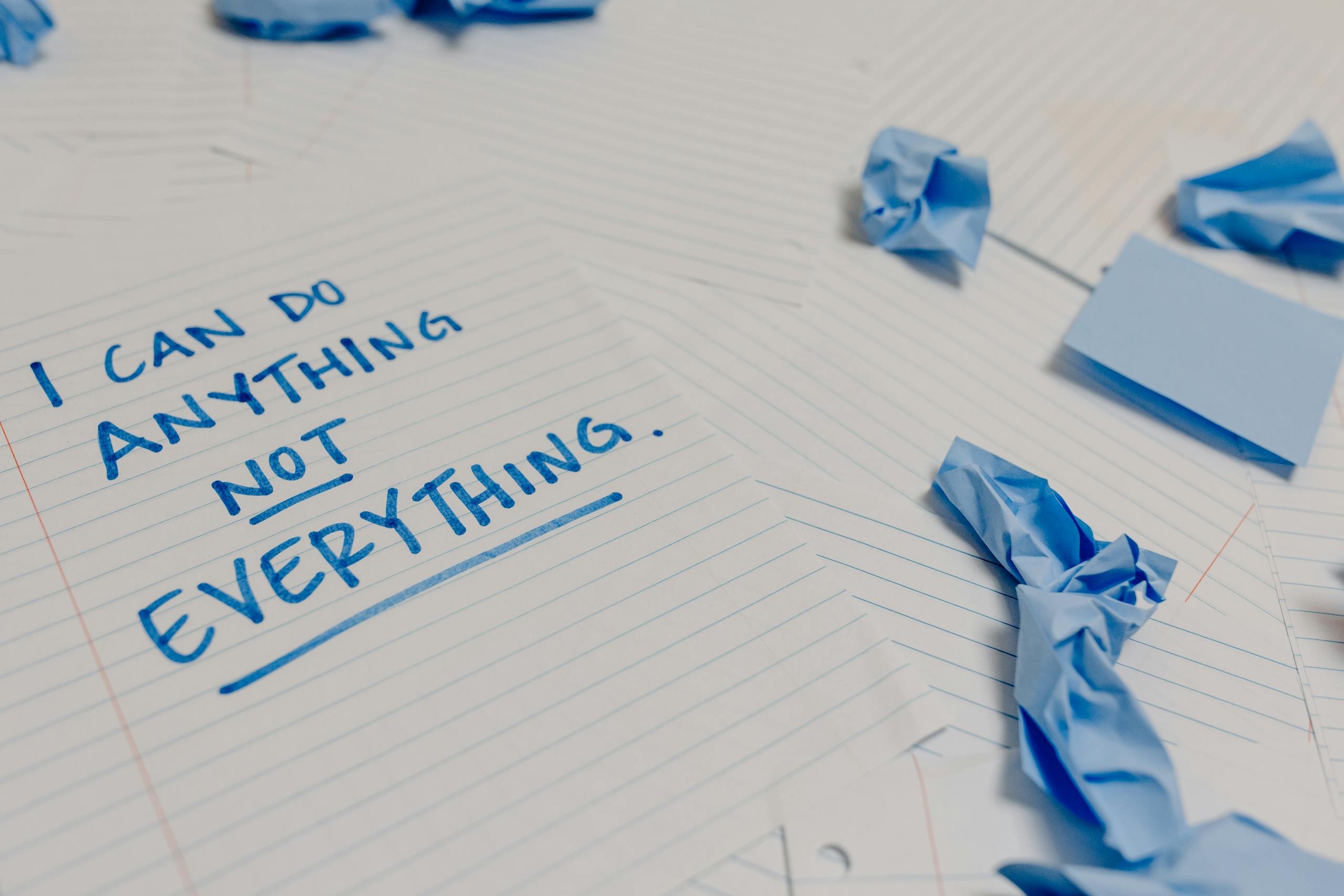
Journaling helps with this in a counterintuitive way. A journal is, by definition, a space where perfectionism has no jurisdiction. There’s no audience. There’s no standard to meet. You can write badly, incompletely, contradictorily, without consequence. For someone whose internal critic is usually running at full volume, that permission is more significant than it sounds.
The Ohio State University research on perfectionism and wellbeing points to how perfectionist tendencies, when left unmanaged, create measurable psychological strain. Journaling doesn’t cure perfectionism, but it creates a daily practice of tolerating imperfection, of producing something unpolished and letting it exist anyway. Over time, that practice has effects that extend beyond the page.
My own relationship with perfectionism in the agency world was complicated. I held high standards for creative work, for strategic thinking, for client relationships. Those standards produced good outcomes professionally. They also produced a running internal commentary about every decision I’d made, every presentation that could have been sharper, every conversation that didn’t go quite the way I’d planned. Writing, precisely because it demanded nothing of me in terms of quality, became a place where I could put down the critic for a while. Not silence it permanently. Just give it a rest.
What Role Does Journaling Play After Rejection or Criticism?
Rejection lands differently on a sensitive mind. What someone else might shake off in an afternoon can reverberate for days, not because the person is weak or dramatic, but because their processing runs deeper and their self-reflection is more thorough. They examine the rejection from every angle. They find ways it confirms existing fears. They build cases against themselves that the original rejection never intended to support.
Understanding HSP rejection and the path through it requires acknowledging that the intensity of the response is real, not manufactured, and that it needs real tools rather than dismissal. “Just let it go” is not a tool. It’s a suggestion that ignores the actual mechanism of how deep processors experience criticism.
Journaling after rejection does several things that other responses don’t. First, it gives the feeling somewhere to go rather than somewhere to spin. Second, it creates a record that can be revisited, which matters because the distorted thinking that follows rejection often looks very different in retrospect. Third, it allows for a kind of structured self-compassion that is hard to access in the immediate aftermath of criticism but becomes possible once the feeling is on paper and can be examined more gently.
A pitch we lost early in my agency’s history hit me harder than I let anyone see. We’d put significant creative energy into it, and the client’s feedback was dismissive in a way that felt personal even though it almost certainly wasn’t. I spent a few days carrying that loss in a way that affected how I showed up for my team. When I finally sat down and wrote about it, what came out wasn’t just frustration. It was a clearer picture of what had actually happened, what we’d done well, what we could have done differently, and what the client’s dismissiveness said about the fit rather than about the quality of our work. The writing didn’t erase the sting, but it replaced the story I’d been telling myself with something more accurate.
According to research from the University of Northern Iowa on expressive writing and emotional processing, writing about difficult experiences can help people construct more coherent narratives around those events, which supports psychological recovery. That coherence is exactly what rejection disrupts and what journaling can help rebuild.
How Does Journaling Build Something Durable Over Time?
Single sessions of journaling are useful. A practice sustained over months and years is something different entirely. What accumulates isn’t just a record of events. It’s a map of how your thinking has changed, a library of how you’ve handled difficulty before, and evidence that you’ve come through things you weren’t sure you’d come through.
The American Psychological Association’s work on resilience describes it as something built through experience and reflection rather than something people either have or don’t. Journaling is one of the clearest practical expressions of that building process. Every time you write through a difficult period and then look back at it from the other side, you’re adding to a body of evidence about your own capacity to handle what comes.
There’s also something that happens to self-knowledge over time with a consistent writing practice that doesn’t happen any other way. You start to notice patterns. The kinds of situations that reliably drain you. The kinds of thinking that tend to precede your best decisions. The emotional signals that indicate you’re approaching a limit before you actually hit it. This self-knowledge isn’t available in the moment. It emerges from looking across time, and a journal is what makes that looking possible.
I’ve kept some form of reflective writing practice for most of my adult life, though it’s been inconsistent and has taken different forms at different times. What I notice looking back across those years is that the periods of most significant personal growth almost always coincide with periods of more consistent writing. Not because writing caused the growth, exactly, but because writing created the conditions in which growth could be recognized, examined, and built upon rather than simply experienced and forgotten.
The clinical literature on cognitive behavioral approaches consistently points to the value of written thought records and reflective practices in building the kind of self-awareness that supports long-term psychological health. Journaling, in its various forms, is a lay version of that same principle applied daily.

What Makes Journaling Sustainable Rather Than Just a Phase?
Most people who start journaling stop within a few weeks. Not because it doesn’t work, but because the version they’ve set up for themselves doesn’t fit how they actually live. They’ve committed to a format that’s too demanding, a frequency that’s too rigid, or a standard that’s too high for a practice that is, by design, supposed to have no standards at all.
Sustainability in journaling comes from removing friction and releasing expectations. That might mean writing three sentences instead of three pages. It might mean writing on your phone during a commute instead of in a leather-bound notebook at a dedicated desk. It might mean writing every few days instead of every day. The practice that continues is the one that fits your actual life, not the idealized version of your life.
For deep processors especially, there’s a temptation to make journaling into a project. To have a system, a method, a set of prompts, a structure that ensures thoroughness. That impulse is understandable, but it often kills the practice. The most durable journaling tends to be the most shapeless. You write what’s present. You stop when it feels complete. You don’t worry about whether you covered everything.
What I’ve found personally is that the sessions I approach with no agenda produce the most useful thinking. The sessions where I sit down with a specific question or a structured prompt tend to produce answers to that question and not much else. The unstructured sessions surface things I didn’t know I was carrying. That element of surprise, of discovering what’s actually going on beneath the surface, is one of the reasons the practice stays interesting rather than becoming another obligation to manage.
Sustainability also comes from lowering the stakes of missing a day. A skipped session isn’t a failure. It’s just a skipped session. The practice is available whenever you return to it, without judgment, without needing to catch up. That’s a quality worth protecting deliberately, because the moment journaling starts to feel like something you’re behind on, it loses most of what makes it valuable.
If you want to go deeper into the mental health dimensions of introversion and sensitive processing, the full range of these topics lives in our Introvert Mental Health hub, where you’ll find connected reading across all the areas we’ve touched on here.
About the Author
Keith Lacy is an introvert who’s learned to embrace his true self later in life. After 20 years in advertising and marketing leadership, including running agencies and managing Fortune 500 accounts, Keith now channels his experience into helping fellow introverts understand their strengths and build fulfilling careers. As an INTJ, he brings analytical depth and authentic perspective to every article, drawing from both professional expertise and personal growth.
Frequently Asked Questions
Does journaling actually help with anxiety, or is it just a wellness trend?
Journaling has genuine psychological utility for anxiety, particularly for people who process internally and deeply. Writing an anxious thought down externalizes it, shifting you from being inside the thought to observing it. That shift creates enough distance to question whether the thought reflects reality or just the nervous system generating concern. It won’t replace professional support for clinical anxiety, but as a daily practice it interrupts the looping quality that makes anxiety so exhausting.
How is journaling different from just thinking about your problems?
Thinking and writing feel similar but produce different outcomes. Mental processing tends to loop because there’s no completion signal. Writing creates a record that the brain registers as finished, at least for now. It also slows the process down enough to catch things that move too fast in thought alone. And it produces something you can return to, which thinking doesn’t. Over time, a journal becomes a resource that thinking alone can’t create.
What if I don’t know what to write about?
Start with what’s present rather than what’s important. What are you aware of right now? What’s been sitting in the background today? What conversation are you still thinking about? You don’t need a topic worth writing about. You need whatever is actually there. The interesting material usually surfaces after a few sentences of something that seems mundane. Resist the urge to wait for a worthwhile subject. The practice of writing regularly is more valuable than any individual entry.
Can journaling help with the emotional weight of being highly empathetic?
Yes, and in a specific way that’s worth understanding. Journaling creates a space to acknowledge what you’ve absorbed from other people’s situations without being required to act on it or resolve it. You can write about carrying someone else’s pain without having to fix it. That acknowledgment, without the pressure of action, is often exactly what highly empathetic people need. It also helps with the separation process of identifying what’s yours and what you’ve taken on from someone else.
How long does it take before journaling starts to feel useful?
Most people notice something within the first two or three weeks of consistent practice, even if it’s subtle. The 2 AM thought loops become less persistent. The emotional residue from difficult days clears a little faster. The deeper benefits, the self-knowledge that comes from looking across patterns over time, take longer to accumulate. Give it a month before evaluating whether it’s working, and keep the sessions short enough that you’ll actually do them. Consistency matters more than length in the early stages.