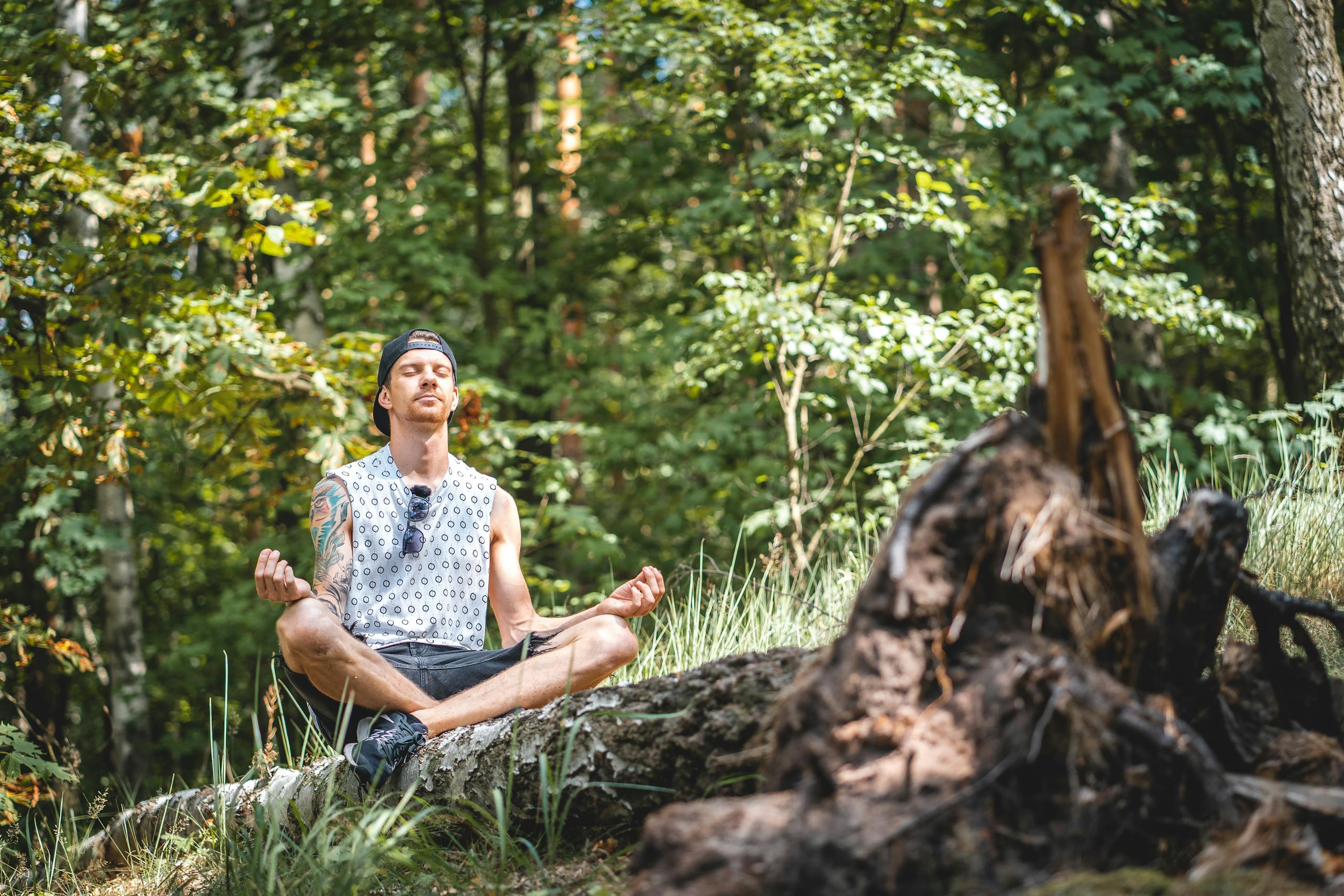
A nature meditations deck is a curated collection of prompt cards designed to guide your attention toward the natural world, slowing your thoughts and grounding your awareness in sensory observation, breath, and stillness. For introverts and highly sensitive people, these decks offer something beyond ordinary mindfulness tools: a structured invitation to do what we already do naturally, which is notice, reflect, and find meaning in quiet moments.
My own relationship with stillness took years to build intentionally. Running advertising agencies, I was surrounded by noise that felt productive but often left me hollow. Nature became the place where I could actually think. A nature meditations deck, I eventually realized, is simply a portable version of that same reset.

If you’ve been looking for a mental health practice that fits the way your mind actually works, rather than one that asks you to perform calm you don’t feel, you’re in the right place. Our Introvert Mental Health Hub covers the full landscape of tools and strategies built for minds like ours, and a nature meditations practice sits right at the center of that conversation.
Why Does a Nature Meditations Deck Work So Well for Introverted Minds?
There’s a reason introverts tend to feel most like themselves outdoors. Away from the social performance of offices and gatherings, the pressure to fill silence lifts. The natural world doesn’t demand anything from you. It just exists, and you can exist alongside it.
Career Coaching for Introverts
One-on-one career strategy sessions with Keith Lacy. 20 years of Fortune 500 leadership as an introvert, now helping others build careers that work with their wiring.
Learn More50-minute Zoom session · $175
A nature meditations deck works with this tendency rather than against it. Each card offers a single, focused prompt: observe the light on the water, notice how your breath changes in cool air, sit with the sound of wind before you name it. These prompts don’t require you to empty your mind, which is the instruction that stops most introverts cold. They give your mind something specific and sensory to do, which is actually how introverted cognition tends to find peace.
As an INTJ, I’ve always processed the world through pattern recognition and internal analysis. Meditation practices that asked me to “just be” felt like asking me to stop breathing. What finally worked was giving my mind a thread to follow, something concrete to observe and then let expand into meaning. Nature prompts do exactly that. You start with a leaf. You end somewhere much quieter inside yourself.
Many people who are drawn to nature-based mindfulness also identify as highly sensitive, and the overlap makes complete sense. If you find yourself easily overwhelmed by crowds, fluorescent lighting, or the ambient noise of modern workplaces, you may recognize some of your experience in what’s described in HSP Overwhelm: Managing Sensory Overload. Nature meditations offer a counterweight to that kind of accumulated strain.
What Should You Actually Look for in a Nature Meditations Deck?
Not all meditation card decks are created equal, and the differences matter more than you’d expect. Some decks are beautifully designed but thin on substance. Others are so abstract that the prompts feel disconnected from actual sensory experience. A good nature meditations deck for introverts should meet a few specific criteria.
Specificity Over Vagueness
The best prompts are concrete. “Notice three textures within arm’s reach” is more useful than “connect with nature.” Specificity gives your attention somewhere to land. Vague prompts leave you floating, which is fine for some minds but counterproductive for people who think in systems and layers.
Sensory Grounding
Look for decks that engage multiple senses across the card set. Sound, texture, temperature, light, and movement in the natural world are all valid anchors for attention. A deck weighted too heavily toward visual prompts misses the richness available to a sensitive, observant mind.
Flexibility of Use
The best decks work whether you’re sitting in a park, on a balcony, near a window, or even just with a single houseplant. Life doesn’t always allow for a forest. A deck that requires pristine wilderness to function isn’t practical for most people’s daily mental health practice.
Reflective Depth
Some of the most valuable nature meditation prompts include a second layer: after the observation, a gentle question. What does this remind you of? What feeling does this texture bring up? This reflective depth is where introverts tend to do their best inner work. We don’t just want to observe. We want to understand what we observe.

How Does a Nature Meditations Practice Address Anxiety Specifically?
Anxiety in introverts and highly sensitive people often has a particular texture. It’s not always the racing heart of acute panic. More often it’s a low hum of mental noise, an overactive internal monologue replaying conversations, anticipating outcomes, cataloguing what could go wrong. That kind of anxiety is exhausting precisely because it’s quiet enough to ignore until it isn’t.
Nature-based meditation interrupts this cycle at the sensory level. When your attention is genuinely occupied by something external, something real and present, the internal loop has to pause. Neuroscience has been building a case for this for years. Exposure to natural environments is associated with reduced activity in the prefrontal cortex regions linked to rumination, according to work published by researchers at Stanford and reviewed in PubMed Central. That’s not a small thing for a mind that ruminates as a default setting.
For highly sensitive people especially, anxiety can feel woven into the fabric of daily life rather than a discrete episode to manage. If that resonates, the piece on HSP Anxiety: Understanding and Coping Strategies is worth your time. A nature meditations deck won’t replace professional support when anxiety is severe, but as a daily regulation tool it can meaningfully shift the baseline.
I managed a creative director at one of my agencies who struggled with persistent anxiety that she described as “background static.” She was an excellent strategist but would sometimes disappear for an afternoon, overwhelmed by the accumulated noise of client demands and team dynamics. At her suggestion, we started keeping a small deck of nature observation prompts in the agency kitchen. She’d pull a card, step outside for ten minutes, and come back visibly reset. I started doing the same. It became one of the more quietly effective things we ever implemented, and it cost nothing.
What Role Does Emotional Processing Play in Nature Meditation?
One of the things that separates a nature meditations deck from a simple relaxation exercise is what it can do for emotional processing. Introverts don’t just think deeply. We feel deeply, even when we don’t show it. Many of us carry emotional weight for long stretches before we find a way to release it, not because we’re suppressing our feelings but because we need the right conditions to work through them.
Nature has a particular quality that makes emotional processing feel safer. There’s no social judgment in a forest. The rain doesn’t care if you’re sad. That absence of evaluation creates a kind of permission that’s hard to manufacture in any other setting. A well-designed meditation prompt can open a door into that space intentionally, giving you language and structure for what might otherwise stay wordless.
The connection between sensory observation and emotional release is something I’ve experienced more times than I can count. Some of my clearest thinking after difficult client situations happened on long walks where I was paying attention to what was around me rather than what was in my head. The external world became a kind of mirror. If you process emotions deeply and sometimes struggle with what to do with that depth, the exploration in HSP Emotional Processing: Feeling Deeply speaks directly to this experience.

Can a Nature Meditations Deck Help With Empathy Fatigue?
Empathy fatigue is real, and it hits introverts and highly sensitive people particularly hard. When you absorb the emotional states of the people around you as a matter of course, the cumulative weight becomes significant. You don’t always notice it building. You just notice one day that you feel depleted and you’re not sure why.
Nature meditation offers something specific here: a relationship that doesn’t require you to give anything. You observe. You receive. The transaction is entirely one-directional in the best possible way. A bird doesn’t need your empathy. A cloud doesn’t require your attention to be validated. Spending time in genuine observation of the natural world can restore a sense of self that gets eroded when you’re constantly attuned to others.
During the years I ran a mid-sized agency, I managed a team of people who were extraordinarily empathic, particularly the account managers who absorbed client stress as their personal responsibility. I watched capable people burn out not because they lacked skill but because they had no practice for turning the empathy dial down. Nature-based practices, even brief ones, became part of how I encouraged them to recover. The broader dynamics of empathy as both a strength and a source of strain are examined thoughtfully in HSP Empathy: The Double-Edged Sword.
A nature meditations deck works as an empathy recovery tool because it redirects your attunement toward something that can’t be hurt by your inattention and can’t burden you with its needs. That’s not avoidance. That’s genuine restoration.
Does Perfectionism Get in the Way of Meditation Practice?
This question comes up more than you’d expect, and the answer is: absolutely yes, if you let it. Many introverts, particularly those with high standards for their own performance, approach meditation with the same perfectionist lens they apply to everything else. Am I doing this right? Is my mind quiet enough? Should I be feeling something different?
A nature meditations deck sidesteps this trap elegantly. There’s no wrong way to observe a tree. There’s no correct emotional response to the sound of water. The prompts are invitations, not evaluations. You can’t fail at noticing how the light changes.
That said, perfectionism is persistent. Even with a low-stakes practice, some people find themselves grading their own presence, comparing today’s meditation to yesterday’s, wondering if they’re getting enough out of it. The relationship between high standards and self-sabotage in sensitive people is worth examining directly, and HSP Perfectionism: Breaking the High Standards Trap does exactly that.
My own perfectionism used to show up in meditation as a kind of meta-commentary. I’d be sitting quietly and then immediately start evaluating whether I was sitting quietly correctly. What helped was giving my mind a specific task, which is exactly what a nature prompt does. When I’m focused on the texture of bark or the pattern of shadows on the ground, the internal critic doesn’t have airtime. It’s occupied. That’s not cheating. That’s working with your own wiring.

How Can Nature Meditation Support Healing After Rejection or Criticism?
Rejection hits introverts differently. We tend to process it more slowly, carry it longer, and replay it more thoroughly than the average person might. That’s not weakness. It’s the same depth of processing that makes us thoughtful, perceptive, and attuned to nuance. The same capacity that makes us good at understanding people also makes us feel their disapproval more acutely.
Nature meditation can be a valuable part of recovery from rejection, not because it erases the hurt but because it provides a container for processing that doesn’t amplify the wound. When you’re in nature, genuinely attending to what’s around you, you’re in a space that has no opinion of you. The mountain doesn’t know you didn’t get the promotion. The river doesn’t care that the pitch fell apart. That neutrality is profoundly healing for a mind that has been turning a painful experience over and over.
There was a period in my agency years when I lost a significant client account after a relationship I’d built over several years. The professional loss was real, but what stung more was the sense of personal rejection, the feeling that I had failed to be enough. I spent two weeks in a low-grade fog before a long walk in the woods, without agenda, without my phone, just paying attention to what was around me, began to break it open. I don’t think that was coincidence. If you recognize that kind of sensitivity in yourself, the exploration of HSP Rejection: Processing and Healing may offer additional perspective.
A nature meditations deck can serve as a gentle re-entry into the present after rejection pulls you backward into rumination. A single prompt, “notice something in your environment that has survived a winter,” can shift your frame entirely without requiring you to force positivity you don’t feel.
How Do You Build a Consistent Nature Meditation Practice?
Consistency is where most meditation intentions quietly dissolve. The practice sounds appealing in theory, but life is full and mornings are short and the deck sits on the shelf. Building a sustainable practice requires working with your actual life rather than an idealized version of it.
Start With Two Minutes
Two minutes of genuine attention is worth more than twenty minutes of distracted sitting. Pull one card. Read the prompt. Go outside or look out a window. Set a timer if that helps. Two minutes of real presence builds the neural habit that longer sessions depend on. According to research published in PubMed Central, even brief exposures to natural environments can produce measurable reductions in physiological stress markers. Brief is not nothing.
Anchor It to Something You Already Do
The most reliable way to build a new habit is to attach it to an existing one. Morning coffee on the porch with a single card. A prompt card in your pocket for your lunch walk. One observation before you start your car in the evening. The deck becomes a cue rather than a chore when it’s connected to something already in your routine.
Keep the Deck Visible
Out of sight genuinely means out of mind for most people. Keep your deck somewhere you’ll encounter it: on your desk, beside your coffee maker, in your bag. The physical presence of the cards is a low-pressure reminder that doesn’t require willpower to notice.
Release the Idea of Doing It Right
Some days the prompt will open something meaningful. Some days you’ll observe a cloud and think about your grocery list. Both are fine. A practice that accepts imperfect days is a practice that survives. The American Psychological Association’s work on resilience consistently points to flexible, sustainable coping practices as more effective than rigid, high-standard ones. Your meditation practice doesn’t need to be impressive. It needs to be real.
What Makes Nature Meditation Different From Other Mindfulness Tools?
The mindfulness market is crowded. Apps, journals, guided recordings, breathwork courses, body scan protocols. All of them have value. What makes a nature meditations deck distinct is its relationship to the external world rather than solely to internal experience.
Most mindfulness tools direct your attention inward: to your breath, your body, your thoughts, your feelings. That’s valuable, but for introverts who already spend significant time in internal processing, more inward focus isn’t always what’s needed. Sometimes what restores us is the opposite: genuine, absorbed attention to something outside ourselves.
Nature specifically offers what psychologists call “soft fascination,” a quality of attention that is engaged but not effortful, absorbed but not strained. This is distinct from the directed attention that work and screens demand, which depletes, and also distinct from complete mental vacancy, which many introverts find uncomfortable. Soft fascination is the sweet spot, and the natural world is exceptionally good at providing it. The clinical literature on attention restoration theory, available through the National Library of Medicine, supports this distinction in meaningful ways.
A nature meditations deck is essentially a structured guide into soft fascination. The cards give you permission to attend to something that won’t make demands of you, won’t evaluate you, and won’t require you to manage anyone else’s experience of the moment. For people who spend their days doing all three of those things, that permission is significant.

Who Benefits Most From a Nature Meditations Deck?
The honest answer is: almost anyone who is willing to try. But certain profiles seem to find particular value in this kind of practice.
Introverts who feel overstimulated by social demands tend to respond well because nature meditation is fundamentally solitary and quiet. Highly sensitive people who carry accumulated sensory and emotional load find the grounding quality of natural observation genuinely restorative. People who struggle with conventional seated meditation because their minds won’t cooperate often find that a specific external prompt gives them the foothold they need.
People managing anxiety, particularly the low-grade ambient kind rather than acute episodes, often report that nature-based practices help reduce the background hum over time. The National Institute of Mental Health’s resources on generalized anxiety describe the kind of persistent, diffuse worry that many introverts recognize, and nature meditation works specifically against that pattern by offering a present-moment anchor that anxiety can’t easily follow.
People in recovery from burnout, whether professional or personal, often find that nature meditations provide a gentler re-entry into presence than more demanding practices. You don’t have to produce anything. You don’t have to perform wellness. You just have to show up and look at the world for a few minutes.
And honestly, people who are skeptical of meditation in general sometimes find this format more accessible. There’s something less intimidating about “notice three things you can hear right now” than “clear your mind completely.” The concrete, sensory nature of the prompts meets you where you are rather than asking you to be somewhere you’re not.
A Few Words on Choosing the Right Deck for You
If you’re ready to explore a nature meditations deck, a few practical notes. Physical card decks have a tactile quality that matters for sensory-oriented people. The act of drawing a card, holding it, reading it slowly, is itself a small ritual that signals transition from ordinary attention to something more intentional.
Digital versions exist and have their place, but there’s something about the screen-free quality of physical cards that aligns well with what nature meditation is trying to do. You’re already trying to get away from the pull of screens. A card in your hand rather than a prompt on your phone reinforces that intention.
Look for decks created by practitioners with genuine backgrounds in mindfulness or ecotherapy rather than purely aesthetic projects. The design matters, but the substance of the prompts matters more. A beautifully photographed deck with thin or vague prompts will lose your interest quickly. A plainer deck with prompts that genuinely engage your attention will serve you for years.
Some people create their own decks over time, writing prompts on index cards as they discover what works for them. That’s not a lesser version of the practice. For an introvert who processes through writing and reflection, creating a personal deck can deepen the practice considerably.
Whatever format you choose, the commitment is the same: show up, draw a card, and give the natural world a few minutes of your genuine attention. That’s the whole practice. Everything else is detail.
There’s more to explore on building a mental health practice that actually fits introvert wiring. Our complete Introvert Mental Health Hub brings together resources on anxiety, emotional processing, sensory sensitivity, and the specific challenges that come with living as a deeply feeling, deeply thinking person in a world that often moves too fast.
About the Author
Keith Lacy is an introvert who’s learned to embrace his true self later in life. After 20 years in advertising and marketing leadership, including running agencies and managing Fortune 500 accounts, Keith now channels his experience into helping fellow introverts understand their strengths and build fulfilling careers. As an INTJ, he brings analytical depth and authentic perspective to every article, drawing from both professional expertise and personal growth.
Frequently Asked Questions
What is a nature meditations deck and how is it used?
A nature meditations deck is a set of cards, physical or digital, each containing a prompt designed to direct your attention toward the natural world. You draw a card, read the prompt, and spend a few minutes engaging with it through observation, breath, or reflection. The practice can be done outdoors, near a window, or even with a houseplant. The goal is present-moment awareness through sensory engagement with nature rather than through internal focus alone.
Can a nature meditations deck help with anxiety?
Yes, particularly for the low-grade, persistent anxiety that many introverts and highly sensitive people experience. Nature-based attention interrupts rumination by giving the mind a concrete external anchor. Even brief time spent in genuine observation of the natural world is associated with reduced stress markers. A nature meditations deck provides structure for that attention, making the practice accessible even when motivation is low. It is a supportive tool rather than a replacement for professional care when anxiety is severe.
Do I need to be outdoors to use a nature meditations deck?
No. While outdoor use is ideal, most well-designed decks include prompts that work near a window, in a garden, on a balcony, or even with indoor plants. The practice is about quality of attention rather than physical location. A prompt asking you to notice how natural light moves across a surface works just as well indoors as outside. Flexibility of use is one of the features worth looking for when choosing a deck.
How is a nature meditations deck different from a standard mindfulness app?
The primary difference is directional. Most mindfulness apps guide your attention inward, toward breath, body, or internal states. A nature meditations deck directs your attention outward, toward the sensory qualities of the external world. For introverts who already spend significant time in internal processing, this outward redirection can be more restorative. Physical card decks also offer a screen-free experience, which reinforces the shift away from digital stimulation that many people need.
How long should a nature meditation session be?
Two to ten minutes is a realistic and effective range for most people, particularly when building a new practice. Two minutes of genuine, focused attention produces real benefit and is sustainable even on difficult days. Longer sessions, when time allows, can deepen the experience, but duration matters less than consistency and quality of presence. Starting small and building gradually is far more effective than committing to long sessions that become difficult to maintain.