Seated meditation postures are the physical foundation that determines whether your practice feels sustainable or like a constant battle with your own body. The right posture keeps your spine aligned, your breathing open, and your attention where it belongs, on the quiet space inside rather than on aching knees or a stiff lower back. Whether you sit in a chair, cross-legged on a cushion, or in a formal kneeling position, what matters most is finding a configuration that lets you stay still long enough for genuine stillness to arrive.
My relationship with meditation started later than it probably should have. After two decades running advertising agencies, managing high-pressure client relationships with Fortune 500 brands, and leading teams through impossible deadlines, I had built an entire identity around staying sharp under pressure. The idea of sitting quietly felt almost counterproductive. But the truth was, my mind had been running at full speed for so long that I had completely lost touch with the internal processing that is, as an INTJ, one of my core strengths. Meditation gave me a structured way back in.
What I did not expect was how much the physical setup mattered. Posture is not a minor detail you figure out later. It shapes everything about the quality of your practice, and getting it right is worth the time it takes.
If you are exploring meditation as part of a broader approach to mental health and emotional wellbeing, our Introvert Mental Health Hub covers a wide range of practices and perspectives designed specifically for people who process the world from the inside out.
Why Does Your Posture Actually Matter in Meditation?
There is a reason every meditation tradition, from Zen Buddhism to Vipassana to modern mindfulness-based stress reduction, places significant emphasis on how you sit. Posture is not ceremonial. It has a direct physiological effect on how your nervous system responds during practice.
Career Coaching for Introverts
One-on-one career strategy sessions with Keith Lacy. 20 years of Fortune 500 leadership as an introvert, now helping others build careers that work with their wiring.
Learn More50-minute Zoom session · $175
When your spine is aligned and your chest is open, your diaphragm can move freely. That freedom supports slower, deeper breathing, which activates the parasympathetic nervous system, the branch responsible for rest and recovery. According to the National Institutes of Health’s overview of mindfulness-based interventions, breath regulation is one of the primary mechanisms through which meditation produces measurable reductions in stress and anxiety. Your posture is what makes that breath regulation possible.
Slouching, on the other hand, compresses the diaphragm, restricts airflow, and can trigger subtle signals of physical discomfort that pull your attention away from the meditative focus. If you have ever sat down to meditate and found yourself fidgeting constantly, there is a reasonable chance your posture was working against you rather than with you.
I noticed this during my first serious attempt at building a regular practice. I was sitting on the floor with my back against the wall, legs stretched out, and wondering why I could not stay focused for more than two minutes. A colleague who had been meditating for years watched me for about thirty seconds and said, “Your chest is collapsed. You are already telling your body to shut down.” She was right. Switching to a cushion with my hips elevated above my knees changed everything about how the practice felt.
Many introverts who are also highly sensitive will recognize this dynamic from other contexts. Managing HSP overwhelm and sensory overload often involves creating the right physical environment before any mental strategy can take hold. Posture in meditation works the same way. The physical container has to be right before the internal work can begin.
What Are the Main Seated Meditation Postures to Consider?
There is no single correct posture for meditation, despite what some traditions might suggest. The goal is a position that allows alert relaxation: awake enough to maintain focus, relaxed enough to let go of tension. Here are the main options worth understanding.
Sitting in a Chair
Chair meditation is the most accessible starting point and, frankly, underrated. Sit toward the front edge of the seat rather than leaning back into the chair. Both feet flat on the floor, hip-width apart. Your thighs should be roughly parallel to the ground, which means the chair height matters. If your knees are higher than your hips, the chair is too low. Place your hands palm-down on your thighs or rest them in your lap. Let your spine rise naturally without forcing it into rigidity.
This posture works exceptionally well for people with knee issues, hip tightness, or anyone who finds floor sitting uncomfortable. It is also the most practical option for incorporating meditation into a workday, which is how I eventually made it stick. Between client calls, I would close my office door for ten minutes and sit at the edge of my chair. No cushion required, no special setup, just a deliberate shift in how I was using the space I already occupied.
Easy Pose (Sukhasana)
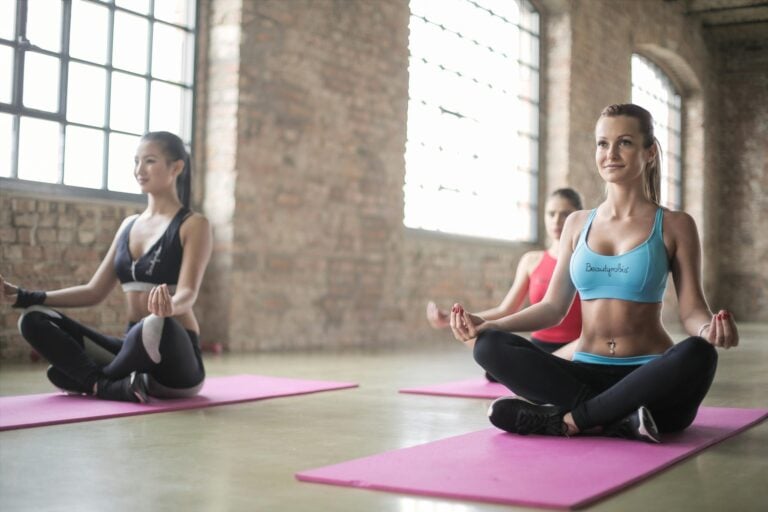
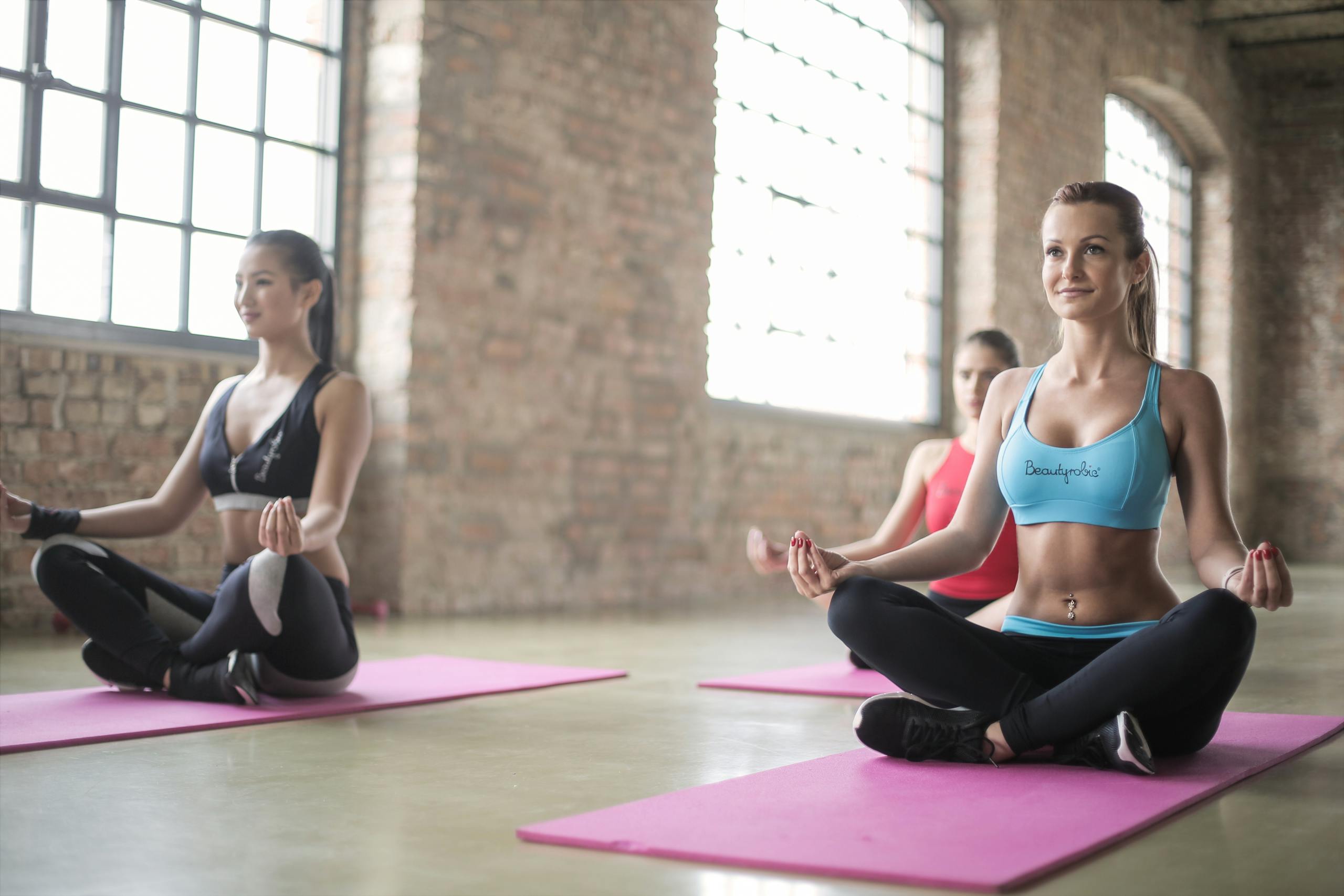
Easy pose is the classic cross-legged position most people picture when they think of meditation. Sit on a cushion or folded blanket with your legs loosely crossed, each foot resting beneath the opposite knee. The elevation is important. Raising your hips above your knees allows your pelvis to tilt slightly forward, which makes it much easier to maintain a natural spinal curve without muscular effort.
Without that elevation, most people end up with their pelvis tilting backward, which rounds the lower back and creates the kind of dull ache that derails a session within minutes. A firm meditation cushion, called a zafu, or even a folded blanket two to three inches thick, makes a genuine difference.
Burmese Position
In the Burmese position, both legs rest flat on the floor in front of you, one in front of the other rather than stacked. Both knees ideally touch the floor, creating a stable triangular base. This is often more comfortable than full cross-legged sitting because there is less rotation required at the hips. If one or both knees float above the floor, place a folded blanket or small cushion beneath them for support. Forcing your knees down creates tension that defeats the purpose entirely.
Seiza (Kneeling Posture)
Seiza involves kneeling with your shins on the floor and sitting back either on your heels or on a seiza bench placed between your legs. A seiza bench takes the weight off your ankles and knees and allows many people to sit with a naturally upright spine with very little effort. For those who find cross-legged positions uncomfortable, this can be a revelation. The posture is stable, the spine tends to align easily, and the position has a quality of quiet formality that some practitioners find conducive to focus.
Half Lotus and Full Lotus
Lotus positions are the most recognizable meditation postures in popular imagery, but they are also the most demanding in terms of hip flexibility. In half lotus, one foot rests on the opposite thigh while the other leg remains on the floor. In full lotus, both feet rest on opposite thighs. These positions create a very stable, low center of gravity, but they require genuine hip flexibility to hold without strain. Attempting them without adequate preparation can stress the knees significantly.
Many experienced meditators never use lotus positions and practice deeply without them. If you are drawn to them, approach gradually and consider working with a yoga teacher to develop the hip flexibility first. There is no meditation merit badge for sitting in full lotus while quietly suffering.
How Do You Find the Right Alignment Once You’re Seated?
Regardless of which posture you choose, certain alignment principles apply across all of them. Getting these right transforms a posture from merely adequate into genuinely supportive.
Start with your pelvis. Your sitting bones, the two bony points at the base of your pelvis, should bear your weight evenly. Rock gently forward and backward until you find the point where your spine rises most naturally above them. That is your neutral pelvic position. From there, let your spine stack upward, vertebra by vertebra, without forcing it into exaggerated straightness. Natural spinal curves are not problems to correct. They are structural features that distribute load efficiently.
Your shoulders should rest back and down, away from your ears. Many people carry chronic tension in the trapezius muscles, the large muscles running from the base of the skull across the shoulders, and that tension tends to pull the shoulders up and forward during meditation. A conscious release of those muscles at the start of each session makes a noticeable difference.
Let your chin drop very slightly, as if you are nodding yes by about five degrees. This lengthens the back of the neck and reduces the tendency to jut the chin forward, which compresses the cervical spine. Your gaze, if your eyes are open or half-open, should fall naturally to the floor about three to four feet in front of you.
Hands can rest in several positions. Palms down on thighs is grounding and simple. Palms up, resting in the lap, one hand cradled in the other, is a common mudra position associated with receptivity. Neither is superior. Choose whatever feels natural and does not create tension in your forearms or shoulders.

One thing I found genuinely helpful was treating the alignment process as the first few minutes of the meditation itself rather than a preliminary task to rush through. Scanning from the ground up, checking in with each part of the body, noticing where tension lives, that process is already a form of mindful attention. By the time I finished the alignment check, I was already present in a way that took me much longer to reach when I just dropped into position and immediately tried to meditate.
What Does Meditation Posture Have to Do With Emotional Processing?
This question gets at something I find genuinely fascinating, particularly as an INTJ who tends to live primarily in the world of ideas and analysis. There is a real relationship between how we hold our bodies and how we access emotional experience.
Embodied cognition research suggests that physical posture influences not just how we feel physically but how we process information and emotion. An upright, open posture is associated with greater access to emotional states, both positive and challenging ones. That has direct implications for anyone using meditation as a tool for deeper self-understanding.
Many introverts, especially those with high sensitivity, carry a great deal of emotional material that does not get fully processed in the normal flow of daily life. The depth of emotional processing that highly sensitive people engage in is one of their defining characteristics, and meditation can serve as a structured container for that processing. Posture affects how safely and effectively you can access that space.
A collapsed, protective posture, chest caved, shoulders rounded forward, tends to reinforce emotional closure. An open, grounded posture creates a physical sense of safety that can make it easier to let difficult emotions surface and move through without being overwhelmed by them.
I have watched this dynamic play out in my own practice. There were periods in my agency years when I was carrying significant stress around a major account we were at risk of losing, and I would notice that my meditation posture reflected that stress before I was consciously aware of it. Shoulders up, jaw clenched, breath shallow. The posture was telling me something my analytical mind had not yet registered. Learning to read those physical signals became its own form of emotional intelligence.
For people who also deal with anxiety, the physical grounding that comes from a stable, well-aligned seated posture can be particularly meaningful. The National Institute of Mental Health’s resources on anxiety emphasize the importance of somatic awareness in managing anxious states, and seated meditation directly cultivates that awareness. If you are working through anxiety alongside your meditation practice, exploring HSP anxiety coping strategies may offer complementary tools that work well alongside posture-based practices.
How Do You Handle Physical Discomfort During Seated Meditation?
Discomfort during meditation is almost universal, especially in the early stages of practice. How you relate to that discomfort matters as much as whether you experience it.
There is a distinction worth making between the dull ache of muscles adjusting to an unfamiliar position and sharp, acute pain that signals a structural problem. The first category is worth sitting with, at least briefly. Many practitioners find that observing discomfort without immediately reacting to it is itself a valuable meditation exercise. The second category is a clear signal to adjust your posture or switch positions without guilt.
Knee pain in cross-legged positions almost always means either insufficient hip flexibility or inadequate cushion height. Raise your hips further. If the pain persists, try a different posture entirely rather than pushing through. Lower back ache often signals a backward pelvic tilt, which the right cushion height usually resolves. Neck tension typically comes from the chin jutting forward or the head dropping too far down.
Props matter more than many beginners expect. A firm meditation cushion, a folded blanket, a meditation bench, a yoga block under the knees, these are not signs of inadequacy. They are practical tools that make sustainable practice possible. I resisted using props for an embarrassingly long time because I had absorbed some vague idea that real meditators just sat on the floor. Eventually I bought a proper zafu and wondered why I had waited so long.
Some discomfort is also psychological rather than physical, the restlessness that comes from sitting still when your mind is accustomed to constant stimulation. That particular discomfort tends to be more pronounced in highly sensitive people, whose nervous systems are already processing a great deal. A review published in PLOS ONE found that mindfulness practices produce meaningful reductions in psychological distress across a range of populations, though the initial period of practice often involves confronting that restlessness directly before it eases.

What Role Does Posture Play in Longer or Deeper Meditation Sessions?
For shorter sessions of ten to twenty minutes, almost any reasonably comfortable posture will serve you adequately. As sessions extend to forty-five minutes, an hour, or longer, the quality of your postural foundation becomes increasingly significant.
Longer sessions reveal compensations that shorter sessions mask. If your pelvis is slightly misaligned, you may not notice it in a fifteen-minute sit. At forty-five minutes, the cumulative strain becomes impossible to ignore. This is one reason that meditators who deepen their practice over time often invest more attention in postural refinement, not because they have become precious about it, but because the feedback loop becomes clearer.
Extended sitting also brings up more complex emotional territory. The longer you sit, the more the mind settles, and as it settles, material that was being held below the surface of ordinary consciousness can rise. For highly sensitive people, this can be both the most valuable and the most challenging aspect of deeper practice. Having a stable physical foundation becomes a kind of anchor when the internal experience gets intense.
I have noticed in my own practice that the sessions where I took extra care with my initial setup, checking the cushion height, spending a few minutes on the alignment scan, tended to be the ones where I could sustain genuine depth. The sessions where I rushed the setup and just sat down tended to be more fragmented, more dominated by physical fidgeting and mental noise.
There is also something worth noting about perfectionism in relation to posture. Some practitioners, particularly those with perfectionistic tendencies, can get stuck in endless posture adjustment, treating every minor sensation as a problem to solve rather than settling into good-enough and actually meditating. If you recognize that pattern in yourself, the work in breaking free from high standards perfectionism applies here just as much as in any other domain. Good posture serves the practice. Obsessing over perfect posture becomes its own form of avoidance.
How Does Meditation Posture Connect to the Broader Introvert Experience?
Meditation is, at its core, a practice of turning inward. That makes it a natural fit for introverts, who already tend to process experience through internal reflection rather than external expression. Seated meditation postures are the physical expression of that inward orientation, a deliberate arrangement of the body that signals to the nervous system: we are going inside now.
For introverts who also have high sensitivity, meditation can be particularly meaningful because it provides a structured context for the kind of deep processing that happens naturally but often without conscious direction. Research published in Frontiers in Psychology examining mindfulness and emotional regulation suggests that regular practice strengthens the capacity to observe emotional states without being swept away by them, a skill with obvious value for people who feel things deeply.
Meditation also provides something that introverts often struggle to create in professional environments: genuine solitude with a purpose. During my agency years, I was surrounded by people and stimulation for most of my working hours. The introvert’s need for restorative alone time was something I understood intellectually but rarely protected in practice. A seated meditation practice gave me a framework for claiming that time without having to justify it to anyone, including myself.
The empathic demands of leadership, particularly in a creative services environment where I was managing both client relationships and the emotional dynamics of a creative team, were substantial. As an INTJ, I do not experience empathy the way the INFJs and INFPs on my team did. I watched them absorb the emotional atmosphere of every room they entered, carrying home the residue of difficult client meetings in ways that visibly cost them. But I was not immune to the cumulative weight of those dynamics either. Meditation, and the physical stillness that good posture enables, became a way of setting that weight down at the end of the day.
For highly sensitive people handling the emotional demands of empathic connection, understanding empathy as both a gift and a challenge is an important part of building sustainable wellbeing. Meditation posture, in this context, is not just about the spine. It is about creating a physical and mental space where you can be with your own experience rather than everyone else’s.
There is also the question of how meditation supports recovery from social and professional rejection, which introverts and sensitive people tend to process with particular depth and duration. Processing and healing from rejection takes time and a willingness to sit with difficult feelings rather than immediately escaping them. A regular seated practice builds exactly that capacity, not by numbing the feelings but by strengthening your relationship with them.
The American Psychological Association’s framework for resilience highlights the importance of practices that build emotional regulation and self-awareness over time. Seated meditation, done consistently with good postural support, is one of the most direct ways to build both. And according to research examining mindfulness and stress reduction, even relatively brief daily practice periods produce measurable benefits when maintained consistently over weeks and months.
How Do You Build a Posture Practice That Actually Lasts?
Consistency matters far more than perfection in any meditation practice, and that applies to posture as much as to the mental aspects of the practice. A modest, sustainable approach to postural development will serve you better than an ambitious one that collapses under its own demands.
Start with what is comfortable and sustainable today. If that means a chair, use the chair. If you want to work toward floor sitting, spend five minutes a day in your chosen floor posture outside of your meditation sessions, simply sitting and reading or listening to something, to build the hip flexibility and postural endurance gradually.
Invest in one good prop. A quality meditation cushion is not a luxury. It is a tool that makes the practice physically viable for most people. Seiza benches are similarly worthwhile if kneeling positions suit you. The cost is modest compared to the value of a sustainable daily practice.
Create a consistent physical space if possible. I converted a corner of my home office into a dedicated meditation spot, just a cushion on a small rug with nothing else around it. Having that space set up and ready removed one more friction point between the intention to meditate and the actual act of sitting down. For introverts who rely on environmental cues to support mental states, a dedicated space carries real psychological weight.
Finally, treat posture as something that evolves. Your body changes, your practice deepens, and what works best will shift over time. The posture that serves you well in year one may not be the one that serves you best in year five. Stay curious about it rather than treating it as a problem to solve once and then ignore.
More resources on mental health practices that support introverts are available throughout our Introvert Mental Health Hub, where you will find connected perspectives on emotional wellbeing, sensitivity, and self-understanding.
About the Author
Keith Lacy is an introvert who’s learned to embrace his true self later in life. After 20 years in advertising and marketing leadership, including running agencies and managing Fortune 500 accounts, Keith now channels his experience into helping fellow introverts understand their strengths and build fulfilling careers. As an INTJ, he brings analytical depth and authentic perspective to every article, drawing from both professional expertise and personal growth.
Frequently Asked Questions
What is the best seated meditation posture for beginners?
Chair meditation is the most accessible starting point for most beginners. Sit toward the front edge of a firm chair with both feet flat on the floor, spine upright but not rigid, and hands resting on your thighs. This posture requires no flexibility, no special equipment, and can be practiced anywhere. As your practice develops and your body adapts, you can explore floor-based postures like easy pose or the Burmese position if you choose.
Do I need a meditation cushion to sit properly?
You do not need one to begin, but a firm meditation cushion makes a significant practical difference for floor-based postures. The primary function of a cushion is to raise your hips above your knees, which allows your pelvis to tilt forward naturally and your spine to align without muscular effort. A folded blanket or firm pillow can serve the same purpose initially. If you find floor sitting works for you and want to continue, investing in a proper zafu cushion is worthwhile.
Is it okay to meditate lying down instead of sitting?
Lying down is a valid option for certain practices, particularly body scan meditations or practices specifically designed for that position. For most seated meditation practices, though, lying down tends to promote drowsiness because the body associates that position with sleep. The upright alignment of seated postures supports alert awareness, which is what most meditation practices aim for. If physical limitations make seated postures genuinely difficult, lying down with intention and awareness is far better than not practicing at all.
How long should I sit in meditation posture as a beginner?
Starting with ten to fifteen minutes is a reasonable entry point for most people. That duration is long enough to move past the initial restlessness and experience some genuine settling, but short enough that physical discomfort rarely becomes a significant obstacle. Consistency matters more than session length in the early stages. Ten minutes every day will build more capacity than an hour once a week. As your practice develops and your postural endurance increases, extending sessions becomes natural rather than forced.
Why does my back hurt during seated meditation?
Lower back pain during seated meditation most commonly comes from a backward pelvic tilt, where the pelvis rocks back and the lower back rounds into a C-curve. The most effective solution is raising your hips higher relative to your knees, either by using a thicker cushion or by sitting on the edge of a chair. Sharp or radiating pain is a different matter and warrants attention from a healthcare provider. Dull muscular fatigue as your postural muscles adapt to an unfamiliar position is normal in early practice and typically eases as those muscles strengthen over time.