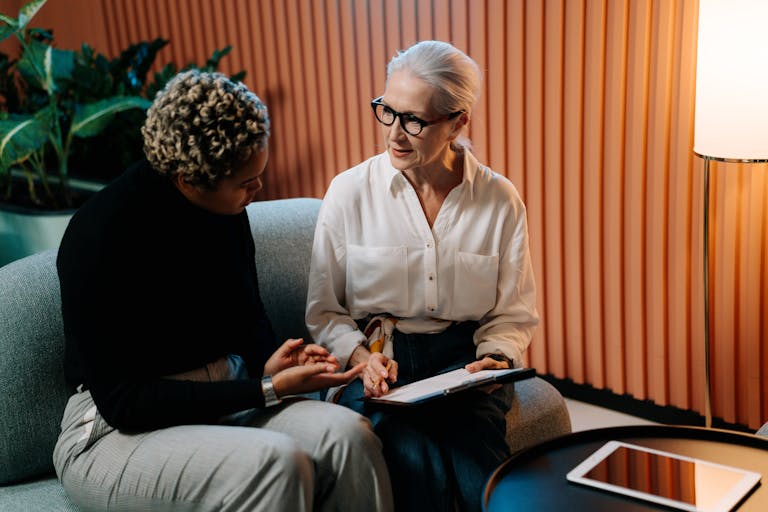
Positive body language examples are the physical signals that communicate openness, confidence, and genuine engagement: steady eye contact, relaxed shoulders, a genuine smile, an open posture, and a slight forward lean that says you’re present and interested. These aren’t performance tricks. They’re the outward expression of an internal state, and once you understand what they actually are, you can both read them in others and begin to cultivate them in yourself.
What makes this topic so interesting to me as an INTJ is that I spent years thinking body language was something extroverts just naturally had. They moved through rooms with ease, commanded space without effort, and seemed to communicate warmth before they’d said a single word. I was doing the opposite: arms crossed, eyes scanning exits, projecting a kind of closed-off intensity that I didn’t intend but couldn’t seem to stop.
Understanding positive body language isn’t about performing a version of yourself that doesn’t exist. It’s about removing the physical static that gets between who you actually are and how others receive you.

If you want to go deeper into the social dynamics that shape how introverts connect and communicate, our Introvert Social Skills and Human Behavior hub covers everything from reading people to building real confidence in social settings.
What Does Positive Body Language Actually Look Like in Practice?
Most articles on this topic give you a list. Smile more. Make eye contact. Lean in. And while those things are accurate, they miss the more important question: what does it feel like from the inside when these signals are working, and why do they work at all?
Career Coaching for Introverts
One-on-one career strategy sessions with Keith Lacy. 20 years of Fortune 500 leadership as an introvert, now helping others build careers that work with their wiring.
Learn More50-minute Zoom session · $175
Positive body language is fundamentally about signaling safety and openness. When you display it, you’re communicating to the nervous system of the person across from you that you’re not a threat, that you’re engaged, and that they matter to you. According to research published through the National Institutes of Health, nonverbal communication plays a central role in how humans establish trust and social connection, often operating below conscious awareness.
consider this positive body language actually looks like, broken down by category:
Facial Expressions
A genuine smile, sometimes called a Duchenne smile, involves both the mouth and the eyes. The corners of the eyes crinkle slightly. It looks different from a polite, social smile, and people register that difference even if they can’t articulate why. Relaxed eyebrows signal calm attentiveness. Slightly raised eyebrows during conversation indicate interest and curiosity. Nodding slowly, not rapidly, shows you’re processing what someone is saying rather than just waiting for your turn to speak.
Early in my agency career, I had a habit of listening with what my creative director once called my “thinking face.” Apparently it looked like I was calculating whether to fire someone. I wasn’t. I was genuinely engaged, but my face had gone neutral in the way INTJ faces tend to go neutral when we’re concentrating. Once I became aware of it, I started consciously softening my expression during client presentations. The shift in how people responded to me was immediate and a little humbling.
Posture and Physical Presence
Open posture means uncrossed arms, uncrossed legs, and a body that isn’t turned away from the person you’re with. It doesn’t mean sprawling or taking up excessive space. It means your physical orientation says “I’m here with you” rather than “I’m managing this interaction from behind a wall.”
A slight forward lean, maybe five to ten degrees, signals engagement and interest. Pulling back signals discomfort or disinterest. Keeping your shoulders relaxed and down, rather than raised toward your ears, communicates calm confidence. Standing or sitting with your weight evenly distributed rather than shifting constantly suggests you’re grounded and comfortable.
Many introverts default to physically protective postures without realizing it. Crossed arms aren’t always a sign of hostility. Sometimes they’re just comfortable, or a way to manage the low-level anxiety that comes with sustained social exposure. But to the person across from you, the signal reads the same way regardless of the intention behind it.

Eye Contact
Comfortable, natural eye contact is one of the most powerful positive signals you can offer. It tells someone you see them, that you’re not distracted, and that what they’re saying registers as important. The general principle is to maintain eye contact roughly sixty to seventy percent of the time during conversation, breaking it occasionally to look away thoughtfully rather than letting your gaze dart around nervously.
For many introverts, eye contact is genuinely taxing. It requires a level of sustained attention that can feel draining during longer social interactions. A useful reframe: think of eye contact not as staring but as a series of brief, warm connections. You don’t have to lock in. You just have to return.
If you want to work on the broader social skill set that surrounds these moments, the article on how to improve social skills as an introvert is a good place to start. It addresses the specific challenges that come with building these skills when your natural wiring runs quiet.
Touch and Physical Proximity
Appropriate touch, a handshake, a brief pat on the shoulder, a gentle touch on the arm during an emotional moment, communicates warmth and connection in ways that words can’t replicate. Proximity matters too. Standing or sitting at a comfortable conversational distance, close enough to feel engaged but not so close as to invade personal space, signals social intelligence.
These signals vary significantly across cultures and individual preferences. What reads as warm in one context reads as intrusive in another. Paying attention to how someone responds to your proximity tells you a great deal about where their comfort zone sits.
Why Do Introverts Often Struggle With Projecting Positive Body Language?
There’s a specific mechanism at work here that I think deserves honest examination. Introverts don’t lack warmth or social intelligence. Most of the introverts I know, and many of the people who’ve worked for me over the years, are deeply perceptive, genuinely caring, and highly attuned to the emotional undercurrents in a room. What they often struggle with is translating that internal experience into readable external signals.
Part of it is energy management. When you’re conserving cognitive and emotional resources during a social interaction, your body often goes into a kind of neutral holding pattern. The warmth is there, but it’s not broadcasting. You’re processing so much internally that the outward expression gets muted.
Part of it is also what happens when we’re in unfamiliar or high-stakes environments. As the distinction between introversion and social anxiety makes clear, these are separate phenomena, but they can overlap. When anxiety enters the picture, body language often tightens. Shoulders rise. Eye contact becomes harder to sustain. The voice loses some of its warmth. The result is that the person across from you may experience you as cold, disinterested, or even dismissive, when the reality is that you’re simply managing a lot of internal noise.
I managed a senior account director years ago, a strong INFJ, who was one of the most empathetic people I’d ever worked with. Clients loved her once they got to know her. But in new business pitches, she’d go so still and contained that prospects sometimes read her as uninterested. We worked on this together, not by changing who she was, but by helping her find small ways to let what was happening inside her show up on the outside. The results were significant.
Developing self-awareness is central to this process. The practice of meditation and self-awareness can be particularly useful for introverts because it builds the capacity to notice your own physical state in real time, which is the first step toward adjusting it intentionally.
How Does Emotional Intelligence Connect to Reading and Using Body Language?
Body language and emotional intelligence are deeply intertwined. Reading the physical signals of others accurately requires the same kind of attunement that emotional intelligence demands: the ability to notice subtle cues, interpret them in context, and respond in a way that serves the relationship rather than just the moment.
Many introverts are naturally good at this, at least in terms of reading others. What they sometimes underinvest in is the sending side, making sure their own signals are as readable and positive as their ability to receive signals from others. This asymmetry creates a gap: you’re picking up on everything around you, but the people around you may not be getting clear signals back.
The Psychology Today piece on the introvert advantage makes a compelling case for why introverts often bring unusual depth to interpersonal observation. That observational capacity is an asset. The work is in learning to make your own signals legible to others so the connection can actually form.
If you want to develop the emotional intelligence dimension of this more fully, exploring what it means to operate as an emotional intelligence speaker and communicator gives you a useful framework for how these skills translate into real influence and connection.
There’s also the matter of overthinking. Many introverts, myself included, can get caught in a loop of analyzing social interactions so intensely that the body tightens up in response. You’re so busy monitoring how you’re coming across that you stop being present enough to actually come across well. Working through patterns like this, whether through therapy, coaching, or structured reflection, can make a real difference. The resources around overthinking therapy address exactly this kind of cycle.
What Are the Most Powerful Positive Body Language Signals in Professional Settings?
Running advertising agencies for two decades gave me a front-row seat to how body language shapes professional outcomes. Pitches were won and lost not just on the quality of the work, but on how the room felt during the presentation. Clients made decisions about whether to trust you in the first few minutes, long before you’d gotten to the strategic rationale or the creative concepts.
consider this I observed, and what I had to deliberately learn, about positive body language in professional contexts:
The Handshake and Initial Greeting
A firm, confident handshake with brief but genuine eye contact sets the tone for everything that follows. It communicates that you’re present and that you regard the other person as worth your full attention. I used to underinvest in this moment, treating it as a formality to get through on the way to the actual conversation. What I eventually understood is that for many people, the greeting is the actual conversation. Everything after it is confirmation of what they decided in those first seconds.
Active Listening Signals
Nodding at appropriate moments, brief verbal affirmations like “yes” or “I see,” leaning slightly forward, and maintaining eye contact while someone is speaking all communicate that you’re genuinely engaged rather than waiting for your turn. These signals matter enormously in client relationships, in team meetings, and in any conversation where the other person needs to feel heard before they can trust you.
One of the most valuable things I ever did for my client relationships was stop multitasking during calls. I’d close my laptop, put my phone face down, and give the conversation my complete physical attention. Clients noticed. They couldn’t always say why they felt more valued, but the feedback came back through account managers: “They feel like you really listen.”
Mirroring
Subtle mirroring, matching someone’s posture, pace, or energy at a low level, is one of the most natural rapport-building signals that exists. It happens unconsciously between people who are genuinely connecting. When you’re conscious of it, you can use it deliberately without it feeling manipulative, because the intention behind it is genuine: you’re signaling that you’re in sync with the person across from you.
A word of caution here: mirroring only works when it’s subtle. Obvious mirroring reads as mimicry and breaks trust instantly. The goal is attunement, not imitation.

Gestures That Communicate Openness
Open-palmed gestures, hands visible rather than hidden, arms open rather than crossed, all communicate honesty and accessibility. When you present with your palms facing up or outward, you’re signaling that you have nothing to hide. When you gesture naturally to illustrate a point, you’re showing engagement and enthusiasm. These aren’t tricks. They’re the physical expression of an open mind.
Becoming a better conversationalist in professional settings involves both the verbal and the physical. The article on how to be a better conversationalist as an introvert connects these dimensions in a way that’s practical and specific to how introverts actually experience social exchange.
Can You Develop Positive Body Language Without Feeling Like You’re Performing?
This is the question I get most often, and it’s the right question to ask. There’s a meaningful difference between developing authentic positive body language and putting on a show. The performance approach fails because it’s exhausting, it reads as fake, and it requires you to maintain a persona rather than simply express who you actually are with less physical interference.
The authentic approach starts from the inside. According to Harvard Health’s guidance on social engagement for introverts, working with your natural tendencies rather than against them produces more sustainable results than trying to override your wiring entirely.
What does that look like in practice? A few things that worked for me:
First, I stopped trying to fix everything at once. I picked one signal, usually eye contact, and worked on that specifically for a few weeks until it felt natural rather than effortful. Then I moved to posture. Then to facial expression. Building these habits sequentially meant each one got integrated rather than layered awkwardly on top of everything else.
Second, I started paying attention to moments when my body language was naturally positive, when I was genuinely relaxed, engaged, and open, and I noticed what that felt like from the inside. That internal reference point became something I could return to intentionally in higher-stakes situations.
Third, I got feedback. Not formal feedback, but the kind that comes from paying attention to how people respond to you. When someone leans in, relaxes, or opens up in a conversation, that’s real-time data about what’s working. When they pull back or become guarded, that’s data too.
The research on nonverbal communication patterns available through the National Institutes of Health supports the idea that body language is both learned and adaptive. You’re not stuck with the patterns you developed by default. You can change them, and those changes become genuine over time.
How Does Understanding Your Personality Type Change the Way You Approach This?
Not all positive body language looks the same on every person, and not every person needs to develop it in the same way. Your personality type shapes both the challenges you face and the specific signals that are most natural for you to develop.
As an INTJ, my natural strengths in this area are directness, steady eye contact when I’m genuinely engaged, and a kind of calm presence that can read as confident authority when I’m at my best. My challenges are the neutral face, the tendency to physically withdraw when I’m processing, and the difficulty projecting warmth in first encounters with people I don’t yet know well.
An ENFJ I worked with for several years had the opposite profile. Her warmth and expressiveness were natural and immediate. Her challenge was learning to dial back the intensity of her physical engagement in certain contexts, because what felt like enthusiasm to her sometimes read as pressure to more reserved clients.
If you haven’t yet explored how your specific type shapes your social and communication style, it’s worth taking the time to identify your type. You can take our free MBTI personality test to find your type and start connecting those insights to how you show up in the world.
The APA’s definition of introversion is a useful grounding point here too, because it clarifies that introversion is about energy orientation, not social skill or warmth. Introverts can be and often are highly skilled in positive body language. The path to getting there just looks different than it does for extroverts.
There’s also an important note about situations where reading body language becomes emotionally complicated. In high-stress personal situations, like the aftermath of a relationship rupture, the ability to interpret physical signals accurately can be compromised by the emotional weight of what you’re carrying. The resources around how to stop overthinking after being cheated on speak to this specific dynamic, where the mind becomes so activated that clear perception, of yourself and others, becomes genuinely difficult.
What Happens When You Start Paying Attention to These Signals in Everyday Life?
Something shifts when you start genuinely observing body language rather than just moving through social situations on autopilot. You begin to notice things you’d been filtering out. The way someone’s shoulders drop when they finally feel understood. The slight tightening around the eyes that precedes a genuine smile. The difference between a nod that means “I agree” and a nod that means “please stop talking.”
For introverts, this kind of observation often comes naturally. We tend to process social environments with more depth and attention than we’re given credit for. What’s sometimes missing is the framework to make sense of what we’re noticing, and the confidence to act on those observations in real time.
A framework from published research on nonverbal behavior and social cognition suggests that the ability to accurately read nonverbal cues is connected to broader social competence, and that this skill can be developed through deliberate practice and attention. That’s encouraging, because it means the work you put into this actually compounds over time.
The deeper payoff isn’t just social effectiveness. It’s the experience of genuine connection that becomes possible when you’re no longer broadcasting the wrong signals by accident. When your body is saying what your heart actually means, conversations go somewhere real. People trust you faster. Relationships build with less friction. And you stop expending energy managing the gap between who you are and how you’re being perceived.
That gap was one of the most exhausting things about my early years in leadership. I was spending enormous energy trying to project a version of confidence I didn’t feel, rather than learning to let my actual competence and warmth show up in my physical presence. Once I started working with my natural style rather than against it, the energy I’d been burning on performance became available for actual work. And the work got better.
If this topic connects to a broader interest in how introverts can build genuine social confidence, the full range of insights in our Introvert Social Skills and Human Behavior hub covers the territory from multiple angles, including conversation skills, emotional intelligence, and the specific challenges of social interaction for people wired the way we are.
About the Author
Keith Lacy is an introvert who’s learned to embrace his true self later in life. After 20 years in advertising and marketing leadership, including running agencies and managing Fortune 500 accounts, Keith now channels his experience into helping fellow introverts understand their strengths and build fulfilling careers. As an INTJ, he brings analytical depth and authentic perspective to every article, drawing from both professional expertise and personal growth.
Frequently Asked Questions
What are the most important positive body language examples to develop first?
Eye contact, open posture, and a genuine smile are the three signals that have the most immediate impact on how others perceive you. Eye contact communicates presence and respect. Open posture signals that you’re approachable and engaged. A genuine smile, one that reaches the eyes, builds warmth and trust quickly. Starting with these three, and developing them one at a time rather than all at once, gives you a foundation that everything else can build on.
Can introverts naturally display positive body language, or is it always a learned skill?
Many introverts display positive body language naturally in environments where they feel comfortable and genuinely engaged. The challenge tends to arise in unfamiliar or high-stakes situations, where the energy demands of the interaction cause the body to default to more closed or neutral signals. Developing positive body language as an introvert is less about learning something foreign and more about extending the signals that come naturally in comfortable settings into a wider range of contexts.
How do you maintain positive body language when you’re feeling drained or overwhelmed?
The most practical approach is to manage your energy before the interaction rather than trying to override exhaustion during it. Giving yourself recovery time before important social or professional engagements makes a real difference in how naturally positive body language flows. During the interaction itself, focusing on one or two specific signals, usually eye contact and posture, rather than trying to monitor everything at once, reduces the cognitive load and makes the effort more sustainable.
Is it possible to misread positive body language, and what are the risks?
Yes, body language is always interpreted in context, and the same signal can mean different things depending on cultural background, individual history, and the specific situation. Someone with arms crossed may be cold, or they may simply be comfortable that way. Someone avoiding eye contact may be disinterested, or they may be processing something deeply. Reading body language accurately requires looking at clusters of signals rather than isolated ones, and holding your interpretations loosely enough to update them when new information arrives.
How does positive body language affect professional relationships over time?
Over time, consistent positive body language builds a reputation for being approachable, trustworthy, and genuinely engaged. In professional settings, this translates into stronger client relationships, more effective team dynamics, and greater influence in meetings and presentations. The effect compounds because people who feel seen and heard by you tend to be more open, more collaborative, and more likely to extend trust, which creates the conditions for deeper professional relationships and better outcomes for everyone involved.