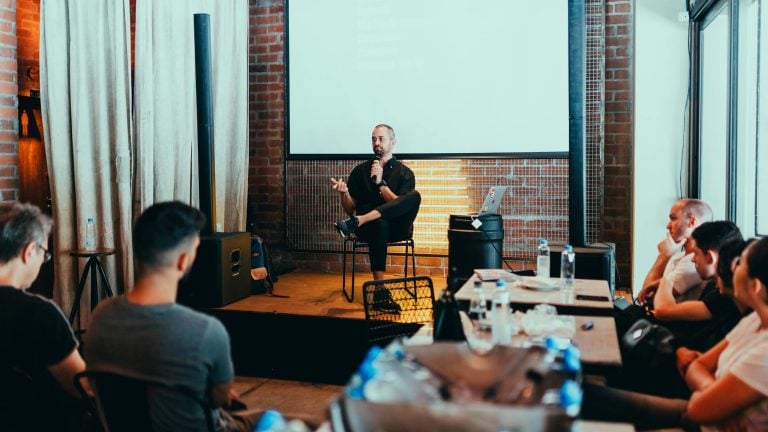
Assertive communications means expressing your thoughts, needs, and boundaries clearly and directly while respecting the other person’s perspective. For introverts, it rarely means being louder. It means being precise, intentional, and grounded enough in your own thinking that your voice lands with weight even when it’s quiet.
Most introverts I know aren’t passive by nature. They’re deliberate. They process deeply before they speak, which means when they do speak, there’s usually something worth hearing. The challenge isn’t a lack of substance. It’s learning to deliver that substance in the moment, with confidence, without abandoning the thoughtful way they’re wired.
That distinction changed everything for me. And it took an embarrassingly long time to figure out.

If you’re still figuring out where assertive communication fits alongside your other social tendencies, our Introvert Social Skills and Human Behavior hub covers the full landscape, from conversation to emotional intelligence to the quieter forms of influence that introverts often overlook in themselves.
Why Do Introverts Struggle With Assertive Communications in the First Place?
My first agency was a small shop, maybe twelve people. I was the founder, the strategist, the person everyone looked to for direction. And yet I spent the first two years softening every opinion I had, hedging every recommendation, and framing my own expertise as a suggestion rather than a position. I’d say things like “you might want to consider” when what I actually meant was “this is the right move and here’s why.”
Career Coaching for Introverts
One-on-one career strategy sessions with Keith Lacy. 20 years of Fortune 500 leadership as an introvert, now helping others build careers that work with their wiring.
Learn More50-minute Zoom session · $175
Clients didn’t know what to do with that. Some of them pushed back harder than they should have, simply because I left room for it. A few lost confidence in me entirely. Not because my thinking was wrong. Because my delivery signaled uncertainty I didn’t actually feel.
That’s the core tension for a lot of introverts. The internal clarity is there. The external expression of it gets filtered through a layer of social caution that can read as hesitation or deference, even when it’s neither.
Part of this comes from how introverts process. We tend to think before we speak, which means we’re often still mid-thought when someone expects a response. The social pressure to fill silence can push us into hedging language as a kind of verbal placeholder. Over time, that placeholder becomes a habit, and the habit becomes a communication style that undersells us.
There’s also a real discomfort with conflict that many introverts share. Not because we’re conflict-averse in a weak sense, but because we genuinely prefer depth over friction. We’d rather think something through fully and arrive at a considered position than engage in the back-and-forth that assertive communication sometimes requires. The problem is that other people can’t see inside your head. They only see the pause, the qualifier, the softened phrasing.
If you’ve been working on your social presence more broadly, the work in improving social skills as an introvert connects directly to this. Assertiveness is one of the more specific applications of that broader foundation.
What Does Assertive Communication Actually Look Like for an Introvert?
There’s a version of assertiveness that gets taught in corporate training rooms that has nothing to do with how introverts actually communicate well. It’s the “speak loudly, take up space, interrupt if you have to” model. That’s not assertiveness. That’s performance, and it tends to work against introverts rather than for them.
Real assertive communication is built on three things: clarity about what you think, willingness to say it directly, and the ability to hold your position when someone pushes back. None of those require volume. All of them require self-awareness.
At my second agency, I had a client relationship manager on my team, an ENFJ, who was extraordinarily warm and people-oriented. She could read a room in seconds and adjust her tone accordingly. But she struggled to hold her position when a client pushed back on a recommendation, not because she didn’t believe in it, but because she was so attuned to the client’s emotional state that she’d start accommodating their discomfort before the conversation was even over. She was empathetic to a fault in those moments.
What helped her wasn’t learning to be more aggressive. It was learning to separate her care for the relationship from her confidence in the recommendation. Those two things don’t have to conflict. You can deliver a clear, firm position and still be warm. You can hold your ground and still respect the other person.
For introverts specifically, assertive communication often looks like:
- Stating your position in the first sentence, not the third
- Skipping the preamble that dilutes your point before you’ve made it
- Using “I think” and “I recommend” rather than “maybe we could” or “it might be worth”
- Allowing silence after you’ve said something, rather than filling it with qualifiers
- Responding to pushback with your reasoning, not an immediate retreat
None of that is loud. All of it is direct. And directness, delivered with genuine respect for the other person, is what assertive communication actually means.

How Does Overthinking Undermine Your Ability to Speak Up?
Overthinking and assertiveness have a complicated relationship. The same depth of processing that makes introverts thoughtful communicators can also trap them in a loop of second-guessing that delays or dilutes what they’re trying to say.
I’ve sat in client presentations where I had exactly the right thing to say and talked myself out of saying it by the time I’d run through all the possible ways it might land badly. By the time I’d finished that internal simulation, the conversation had moved on. The moment was gone. And I’d walk out of the room knowing I’d left something important unsaid.
That’s not careful thinking. That’s overthinking dressed up as caution. There’s a meaningful difference between taking time to formulate a considered response and running every possible version of that response through a failure filter until you’ve convinced yourself not to say anything at all.
Understanding the patterns that drive this kind of mental looping is worth exploring. Overthinking therapy offers some useful frameworks for recognizing when your internal processing is protecting you versus when it’s holding you back. That distinction matters enormously in communication contexts, where hesitation has a cost.
The practical fix I’ve found is to set a mental threshold: if I’ve thought about something long enough to form a genuine opinion, that’s enough. I don’t need to have anticipated every possible objection before I open my mouth. Assertive communication isn’t about being bulletproof. It’s about being present and honest with what you actually think.
There’s also a physiological component worth acknowledging. When we anticipate potential conflict or criticism, our nervous systems can respond in ways that make clear thinking harder. PubMed Central’s overview of stress response is useful context here, particularly the way anticipatory anxiety can activate the same responses as actual threat, even when the stakes are relatively low. Knowing that your body is reacting to a perceived threat, not a real one, gives you a bit more agency over how you respond to it.
What Role Does Self-Awareness Play in Communicating Assertively?
You can’t communicate your needs clearly if you don’t know what they are. That sounds obvious, but for a lot of introverts, the internal landscape is rich and complex in ways that don’t always translate easily into words. We feel things deeply, notice things others miss, and carry a lot of internal information that we haven’t necessarily learned to articulate.
Self-awareness is the bridge between what you know internally and what you can say externally. And it’s genuinely a skill, not a fixed trait.
Practices like meditation and self-awareness work have made a measurable difference in my own ability to communicate clearly under pressure. Not because meditation made me more extroverted or more comfortable with conflict, but because it gave me better access to my own thinking in real time. When I’m grounded, I can identify what I actually want to say much faster. The internal noise quiets enough that the signal comes through.
Self-awareness also helps you recognize your own patterns. Do you hedge more when you’re tired? Do you go silent in groups but find your voice one-on-one? Do you communicate better in writing than in spoken conversation? Knowing your patterns lets you work with them rather than against them.
One of the most useful things I ever did was ask a trusted colleague to give me honest feedback about how I came across in client meetings. What she said surprised me. She said I often looked like I was waiting for permission to say what I already knew. That single observation changed how I prepared for high-stakes conversations. I started walking in with my position already formed, not as a way of closing off dialogue, but as a way of having something solid to start from.
If you’re not sure how your personality type shapes your communication tendencies, it’s worth taking a moment to take our free MBTI personality test. Understanding your type gives you a cleaner lens on why certain communication situations feel easy and others feel like swimming upstream.

How Does Your MBTI Type Shape Your Assertiveness Style?
Not all introverts struggle with assertiveness in the same way. Your MBTI type adds a layer of specificity that’s worth paying attention to.
As an INTJ, my default communication style is direct and analytical. I’m not naturally prone to excessive hedging when I’m confident in my thinking. My challenge has been different: I can come across as blunt or dismissive when I’m not being careful, because I tend to skip the relational framing that makes directness feel safe to the person on the receiving end. I’ve had to learn to build in warmth, not as performance, but as a genuine acknowledgment that the person I’m talking to has feelings about what I’m saying.
INFJs and INFPs tend to face a different version of the assertiveness challenge. Their sensitivity to others’ emotional states can make directness feel unkind, even when it isn’t. I’ve managed several INFJs over the years, and what I observed was that they often knew exactly what needed to be said but would spend enormous energy trying to find a version of it that wouldn’t land as criticism. Sometimes that care produced beautifully calibrated feedback. Other times it produced such a softened version of the truth that the message got lost entirely.
ISFJs and ISTJs often have strong internal convictions but communicate them through established norms and processes rather than direct personal assertion. They tend to be more comfortable saying “the process requires X” than “I think we should do X.” That’s not necessarily a problem, but it can limit their influence in situations where personal authority matters more than procedural authority.
ISTPs and INTPs, in my experience, often have the opposite issue: they’re comfortable being direct but can struggle with the interpersonal dimension of assertive communication. Stating a position clearly is one thing. Maintaining it through a charged emotional exchange is another. Truity’s breakdown of introverted thinking is a useful reference for understanding why types that lead with Ti can sometimes prioritize logical precision over relational attunement, and why that matters in communication contexts.
The point isn’t that one type is better at assertive communication than another. It’s that your type gives you a map of where your natural strengths are and where you’ll need to do more deliberate work.
Can Assertive Communication Be Learned, or Is It Just Personality?
Completely learnable. I say that from personal experience, not theory.
When I was in my late thirties, running my second agency and managing a team of about thirty people, I hired an executive coach specifically because I knew my communication style was costing me. Not in the sense of being ineffective overall, but in specific high-pressure situations, negotiations, difficult client conversations, performance reviews, I was leaving things unsaid that needed to be said. And the cost of that silence was showing up in my relationships, my team’s clarity, and in the end my business results.
What the coaching process revealed was that my hesitation wasn’t about lacking confidence in my ideas. It was about a deeply ingrained belief that being direct was the same as being unkind. That belief had been useful in some contexts and actively harmful in others. Unlearning it took time, but it was absolutely learnable.
The Harvard Business Review’s framework on authentic leadership makes a point that resonated with me during that period: effective leaders don’t adopt a single communication style. They develop range. They know how to be direct when directness serves the situation and how to be more exploratory when that’s what’s needed. That range is built, not born.
Practically speaking, assertive communication skills develop through repetition in lower-stakes situations. You practice stating your position clearly in a casual conversation before you need to do it in a high-stakes negotiation. You practice holding your ground when a friend disagrees with your restaurant choice before you need to hold it when a client pushes back on your strategy recommendation.
The muscle gets built in small moments. By the time the big moments arrive, you’ve already done the work.

How Do You Stay Assertive Without Losing Your Warmth?
This is the question I hear most from introverts who’ve started working on their assertiveness. They get more direct, and then someone tells them they seem cold, or they feel like they’ve lost something essential about how they connect with people. That feedback can send them right back to hedging.
Warmth and directness aren’t opposites. They coexist all the time in people who’ve learned to hold both. The issue is usually sequencing and tone, not the content itself.
One shift that helped me was learning to acknowledge before I assert. Not as a manipulation technique, but as a genuine recognition that the other person has a perspective I’ve heard and considered. “I understand why you’re seeing it that way, and I still think we need to go in a different direction” is both direct and warm. It doesn’t dilute the position. It just makes clear that the position was formed with the other person in mind, not despite them.
Emotional intelligence plays a significant role here. Being able to read what someone needs from an interaction, not just what they’re saying, allows you to calibrate your delivery without softening your substance. I’ve found that speakers and facilitators who work in the emotional intelligence space often make this distinction well: EQ isn’t about being nice. It’s about being accurate, about reading the room and responding to what’s actually happening rather than what you wish were happening.
There’s also something to be said for the quality of your listening. Assertive communicators aren’t just people who speak clearly. They’re people who listen well enough that when they do speak, it’s evident they’ve actually absorbed what the other person said. That quality of attention, which introverts often bring naturally, is itself a form of warmth. It signals respect. And it makes your directness land differently than it would coming from someone who clearly wasn’t listening.
Being a better conversationalist is part of this too. Developing your conversational depth as an introvert creates the relational context in which assertiveness can exist without feeling like aggression. People accept direct communication more readily from someone they feel genuinely seen by.
What Happens When Someone Uses Your Directness Against You?
This is a real thing that happens, and it’s worth naming directly.
Some people respond to assertive communication by characterizing it as aggression, particularly when it comes from someone they’re not used to hearing clearly stated positions from. If you’ve spent years being soft-spoken and accommodating and you shift toward directness, some people in your life will push back on the change itself, not the content of what you’re saying.
I’ve experienced this in professional contexts. Early in my career, when I started being more direct in client meetings, a few clients initially framed it as arrogance. What they were really reacting to was the shift from a version of me that deferred to them to a version of me that held my own expertise with more confidence. That discomfort was theirs to manage, not mine to fix by retreating.
In personal relationships, the dynamics can be more complicated. When someone consistently reframes your clear statements as attacks, or tells you that your directness is hurtful when you’ve been careful to be respectful, that’s worth examining carefully. Psychology Today’s overview of gaslighting is a useful reference for understanding how certain patterns of response can erode your confidence in your own perceptions over time. Assertive communication requires enough trust in your own read of a situation to hold your position even when someone is questioning whether you have the right to hold it.
There’s also the specific challenge that comes after a trust rupture in a relationship. If you’ve been in a situation where someone close to you violated your trust, the mental and emotional aftermath can make assertive communication feel almost impossible. The hypervigilance, the second-guessing, the tendency to over-explain yourself as a way of preempting conflict, all of that can undermine the groundedness that assertiveness requires. Working through the overthinking that follows a betrayal is its own process, and it matters for communication because you can’t speak with clarity when you’re operating from a place of unprocessed fear.
Assertiveness, in the end, requires a baseline of self-trust. Not certainty, not invulnerability, but enough confidence in your own perceptions that you can say what you think without immediately dismantling it under pressure.

How Do You Build Assertiveness as a Long-Term Practice?
The introverts I’ve seen develop genuinely strong assertive communication skills share a few things in common. They treat it as a practice rather than a performance. They’re not trying to become a different person. They’re building a more complete version of themselves.
A few things that have made a consistent difference, both in my own experience and in watching others develop this skill:
Prepare your position before high-stakes conversations. This plays directly to the introvert’s strength. We do our best thinking before the moment, not in it. Walking into a difficult conversation with your position already clear in your own mind means you’re not formulating and speaking simultaneously, which is where the hedging tends to creep in.
Practice in writing first. Many introverts communicate more assertively in writing than in speech. That’s not a weakness to overcome. It’s a starting point. Writing out what you want to say, clearly and directly, trains the part of your brain that knows how to be direct. Over time, that clarity starts to show up in spoken communication too.
Notice when you’re hedging and ask yourself why. Not to judge yourself, but to understand the pattern. Sometimes hedging is social grace. Sometimes it’s fear. Knowing the difference gives you a choice about whether to keep doing it.
Build in recovery time after demanding communication situations. Assertive communication in high-stakes contexts is genuinely draining for introverts. That’s not a sign that you’re doing it wrong. It’s a sign that you’re doing something that requires real energy. Planning for recovery means you can do it sustainably rather than burning out and retreating back into passivity.
There’s also a broader body of work on how personality and communication style interact in professional settings. The research coming out of Wharton on introvert and extrovert leadership effectiveness points to something introverts often sense but rarely hear confirmed: in the right conditions, quieter, more deliberate communication styles can be more effective than louder, more dominant ones. That’s not an excuse to stay passive. It’s a reminder that success doesn’t mean become someone else. It’s to become a more fully expressed version of who you already are.
Assertive communications, at its core, is about showing up completely. Not performing confidence you don’t feel, not shrinking to make others comfortable, but bringing your actual thinking into the room and trusting that it belongs there. For introverts, that’s both the challenge and the work. And it’s entirely worth doing.
There’s a lot more to explore in this space. Our full Introvert Social Skills and Human Behavior hub brings together everything from emotional intelligence to conversation skills to the psychology of how introverts connect and communicate.
About the Author
Keith Lacy is an introvert who’s learned to embrace his true self later in life. After 20 years in advertising and marketing leadership, including running agencies and managing Fortune 500 accounts, Keith now channels his experience into helping fellow introverts understand their strengths and build fulfilling careers. As an INTJ, he brings analytical depth and authentic perspective to every article, drawing from both professional expertise and personal growth.
Frequently Asked Questions
Is assertive communication the same as being aggressive?
No. Assertive communication means expressing your thoughts and needs clearly and directly while respecting the other person’s perspective. Aggressive communication prioritizes your position at the expense of the other person’s dignity or feelings. Assertiveness holds both: clarity about what you think and genuine regard for who you’re talking to. Introverts often conflate the two, which can lead to staying silent when speaking up would actually be the more respectful choice.
Why do introverts find assertive communication harder than extroverts do?
Introverts tend to process deeply before speaking, which can create a gap between having a clear internal position and expressing it in real time. Many introverts also have a strong sensitivity to others’ emotional states, which can make directness feel unkind even when it isn’t. These tendencies aren’t weaknesses. They’re patterns that, once understood, can be worked with rather than against.
Can your MBTI type predict how you’ll struggle with assertiveness?
Your MBTI type gives you useful clues about where your specific challenges are likely to show up. INFJs and INFPs may struggle with directness because of their empathy. ISFJs and ISTJs may default to procedural authority rather than personal assertion. INTPs and ISTPs may be comfortable with directness but less comfortable with the emotional dimensions of assertive communication. Knowing your type helps you identify which aspects of assertiveness need the most deliberate development.
How do you stay assertive without seeming cold or harsh?
Warmth and directness coexist when you acknowledge the other person’s perspective before you assert your own. Phrases like “I hear what you’re saying, and I still think we need to go a different direction” hold both. Strong listening also matters: people receive direct communication more openly from someone who has clearly paid attention to what they said. The quality of your attention is itself a form of warmth.
What’s the fastest way to start building assertive communication skills?
Start in lower-stakes situations. Practice stating your position clearly in casual conversations before you need to do it in high-pressure ones. Writing out your position before important conversations also helps, since many introverts communicate more assertively in writing and that clarity can carry over into speech. Noticing when you hedge, and asking yourself whether it’s social grace or fear, builds the self-awareness that assertive communication requires over time.