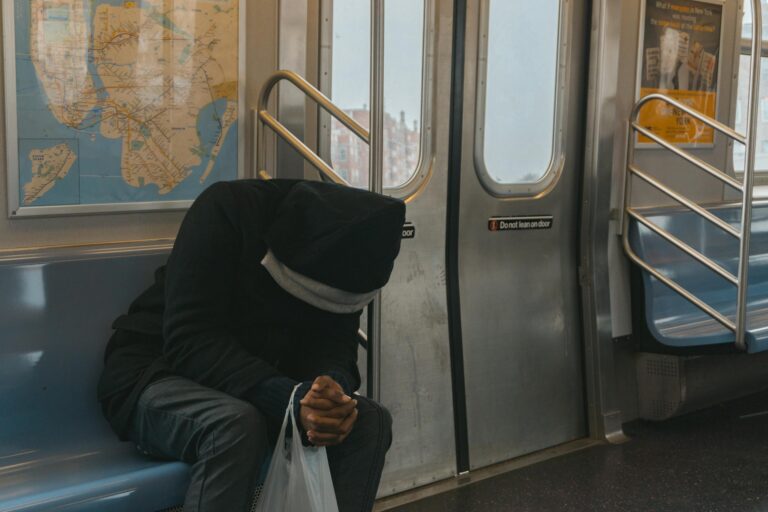

Enduring some of the hardest times alone is something many introverts know deeply, not because they push people away, but because their natural wiring pulls them inward when life gets heavy. Solitude becomes both a refuge and a crucible. The question isn’t whether you’ll face difficult seasons in isolation. It’s whether you’ll learn to hold yourself steady through them.
There’s a version of aloneness that feels like freedom, and a version that feels like being stranded. Most introverts have lived in both. What separates them isn’t the circumstances. It’s the relationship you’ve built with yourself before the hard times arrive.
If you’re working through the fuller picture of solitude, self-care, and what it means to recharge as an introvert, our Solitude, Self-Care & Recharging hub covers the complete terrain. This article focuses on one specific and often unspoken corner of that terrain: what happens when the weight gets heavy and you’re carrying it alone.

Why Do Introverts So Often Face Hard Times Without Reaching Out?
People assume introverts are private because they’re cold or guarded. That’s rarely true. Most of us are deeply feeling people who simply process emotion internally before we’re ready to share it. By the time we’ve worked through something enough to talk about it, we’ve often already resolved it alone. The reaching out happens after the storm, not during it.
What’s your personality type?
Take our free 40-question assessment and get a detailed personality profile with dimension breakdowns, context analysis, and personalised insights.
Discover Your Type8-12 minutes · 40 questions · Free
There’s also something else at play. Vulnerability in the middle of a crisis requires a particular kind of trust, and for introverts, trust is built slowly. We don’t call someone we haven’t spoken to in three months when our world is falling apart. We sit with it. We think. We feel it through layers of quiet processing before we can even articulate what’s wrong.
I’ve watched this in myself more times than I can count. During a particularly brutal agency acquisition that fell apart after months of negotiation, I didn’t call anyone. Not my wife, not my business partner, not the few people I considered genuine friends. I drove home, sat in the driveway for twenty minutes, and went inside to make dinner. I processed the whole thing alone over the next two weeks, showing up to work like nothing had fractured. That’s not strength. That’s pattern. And patterns deserve examination.
Understanding what happens to your nervous system and your sense of self when you don’t allow connection is worth taking seriously. The CDC has documented how social isolation compounds psychological strain in ways that compound over time, particularly during periods of acute stress. Choosing solitude as a processing tool is healthy. Defaulting to it as the only tool, especially during genuine crisis, is a different thing entirely.
As the CDC notes on social connectedness and risk factors, chronic isolation during difficult periods creates compounding effects on both mental and physical health. That distinction matters: chosen solitude and forced or habitual isolation are not the same thing, even when they look identical from the outside.
What Does It Actually Feel Like to Carry Grief or Crisis Quietly?
There’s a particular texture to processing hard things alone as an introvert. It isn’t dramatic. It doesn’t look like anything from the outside. You go to meetings. You answer emails. You make small talk in the hallway. And underneath all of it, something enormous is happening in your interior world that no one around you can see.
I managed a team of twelve people during one of the most personally difficult periods of my life. A close family member was seriously ill. I was running a pitch for a Fortune 500 client that would determine whether we kept our largest account. I showed up every day, ran the meetings, held the creative reviews, delivered the presentation. Nobody knew. And I don’t say that with pride. I say it because I recognize now how much energy that performance cost me, and how little I gave myself to actually grieve.
The introvert tendency to contain is both a gift and a trap. We can hold a tremendous amount internally. We can function at a high level while carrying weight that would visibly buckle someone who processes externally. Yet that capacity for containment can become a way of never fully releasing what needs to be released.
Many highly sensitive people, in particular, experience this containment as physically exhausting. If you identify as an HSP and find that hard periods leave you depleted in ways that go beyond the emotional, the practices outlined in this guide to HSP self-care and essential daily practices offer a grounded starting point for rebuilding your reserves while still honoring your need for quiet.

Is Solitude During Hard Times Healing or Harmful?
Both, depending on how you use it.
Solitude during hard times can be genuinely healing when it’s used for processing, for rest, for reconnecting with yourself beneath the noise of crisis. There’s real value in sitting quietly with difficulty rather than immediately seeking distraction or reassurance. Berkeley’s Greater Good Science Center has explored how solitude supports deeper cognitive and emotional processing, the kind that leads to genuine insight rather than surface-level coping.
Yet solitude becomes harmful when it slides into avoidance. When you’re alone not because you need to process but because reaching out feels too exposing, too uncertain, too much. When the quiet stops being restorative and starts being a place to disappear into.
One of the clearest signals I’ve learned to watch for in myself is the quality of my thinking during alone time. When I’m using solitude well, my thoughts move. They flow through the problem, circle back with new angles, and eventually land somewhere. When I’m using solitude as avoidance, my thoughts loop. The same anxieties replay without resolution. The same fears show up in slightly different clothing. That loop is a signal, not a destination.
There’s also the question of what happens when introverts are denied the alone time they genuinely need, even during hard periods. The compounding effects are real. Explore what happens when introverts don’t get alone time to understand why protecting solitude matters, even while recognizing its limits.
How Do You Build Resilience When Your Default Is to Withdraw?
Resilience for introverts doesn’t look like learning to be more extroverted. It doesn’t mean forcing yourself into support groups or calling someone every time you feel low. That framing misses the point entirely. Resilience, for someone wired the way we are, means building a set of internal and external practices that hold you steady when things get hard, practices that work with your nature rather than against it.
Sleep is foundational in a way that often gets underestimated. During periods of acute stress, the introvert tendency to stay up late in the quiet hours can become counterproductive. The stillness of late night feels like the only time that’s truly yours, but exhausted processing is distorted processing. The thoughts that spiral at 2 AM rarely reflect reality accurately. HSP sleep and recovery strategies offer practical approaches to protecting rest even when your mind is working overtime on something painful.
Nature is another resource that introverts consistently underuse during hard times. There’s something about being outside, particularly in spaces with minimal social demand, that allows the nervous system to settle in ways that indoor solitude sometimes can’t replicate. I’ve solved more intractable problems on long walks than I ever have sitting at my desk. During the worst months of a particularly difficult agency restructuring, those walks were the only thing keeping my thinking clear. The research on this is compelling. A study published in PubMed Central found meaningful connections between time in natural environments and reduced psychological distress. If you’re an HSP who finds nature particularly restorative, this exploration of HSP nature connection and the healing power of the outdoors goes much deeper into why that connection matters.
Writing is something I return to repeatedly, and not in a journaling-as-therapy sense, though that has its place. I mean the act of externalizing what’s internal. Getting the loops out of my head and onto a page where I can actually look at them. When thoughts are inside, they feel enormous. When they’re written down, they become examinable. Manageable. Sometimes even solvable.

When Does Alone Time Cross Into Isolation?
This is the question most introverts resist asking, because the answer requires honesty about our patterns.
Alone time becomes isolation when it’s no longer a choice but a default. When the idea of reaching out feels not just unappealing but genuinely impossible. When weeks pass and you realize you’ve had no real conversation with anyone who knows you. When the solitude that used to feel restorative starts feeling like a container you can’t get out of.
Harvard Health draws a useful distinction between loneliness and isolation. Loneliness is the subjective feeling of being disconnected. Isolation is the objective state of limited social contact. You can be isolated without feeling lonely, particularly if you’re an introvert who has normalized low social contact. Yet that normalization doesn’t protect you from the effects of prolonged disconnection during hard periods.
I had a team member years ago, a brilliant strategist who was deeply introverted, who went through a divorce during a particularly demanding campaign cycle. He kept showing up. He kept delivering. Nobody knew anything was wrong because he gave no external signals. Six months later, he resigned without warning. In the exit conversation, he told me he’d felt completely alone for the better part of a year, not because people weren’t around him, but because he’d never let anyone in close enough to help. He’d been isolated while surrounded.
That story stayed with me because I recognized myself in it. The capacity to function in isolation isn’t the same as thriving in it. And during genuinely hard times, the distinction matters.
There’s also something worth acknowledging about what solitude means for introverts specifically, separate from the crisis context. The need for alone time is real and legitimate. Understanding it clearly, including its limits, is part of what it means to know yourself well. This piece on HSP solitude and the essential need for alone time explores that need with nuance, without romanticizing it.
What Practices Actually Help When You’re Enduring Something Alone?
Practical support matters more than philosophy when you’re in the middle of something hard. consider this I’ve found actually works, drawn from my own experience and from watching other introverts find their way through difficult seasons.
Anchoring your days to small, predictable rituals creates a structure that holds you when everything else feels uncertain. This isn’t about productivity. It’s about continuity. Making the same coffee in the same way at the same time tells your nervous system that some things are still stable. For introverts who process internally, external anchors provide a scaffold for the internal work happening beneath the surface.
Choosing one person rather than many is something I’d advocate strongly. The introvert instinct during hard times is often all or nothing: either tell everyone or tell no one. Yet there’s a middle path that works better. One person who knows the real situation. One person who doesn’t require you to perform okay-ness. That single connection doesn’t violate your need for privacy. It just means you’re not entirely alone with something that’s genuinely heavy.
Movement, particularly solo movement outdoors, is not a cliché. It’s a genuine neurological intervention. When the body moves, the mind processes differently. The Frontiers in Psychology journal has published work on how physical activity intersects with emotional regulation and stress response in ways that support psychological resilience. For introverts, the added benefit of solo movement is that it provides processing time without social demand. You’re doing something and thinking at the same time, which is often how our best internal work happens.
Limiting the inputs that amplify distress is also worth naming. During hard periods, the introvert tendency to research, analyze, and seek information can become compulsive. We think that more information will resolve the uncertainty. It rarely does. At some point, the information-gathering has to stop and the sitting-with-it has to begin. That transition is uncomfortable, but it’s where actual processing happens.

Can Enduring Hard Times Alone Actually Make You Stronger?
Yes, with a caveat.
There’s genuine evidence that solitary processing during difficulty builds a particular kind of self-knowledge that’s hard to develop any other way. When you sit with something hard without immediately seeking external resolution, you discover what you’re actually made of. You find out which of your beliefs hold under pressure and which ones were just borrowed from other people. You develop a relationship with your own mind that becomes a resource in future hard times.
Research published in PubMed Central has examined how solitude, when experienced as chosen rather than forced, correlates with self-awareness and emotional regulation over time. The distinction between chosen and unchosen solitude runs through much of this literature, and it maps cleanly onto the introvert experience. We do best when the aloneness is ours, not imposed.
The caveat is this: enduring hard things alone doesn’t automatically produce growth. It produces growth when you’re reflective about what you’re experiencing, when you bring some degree of curiosity to your own responses, and when you eventually integrate what you’ve learned. Suffering in silence without reflection is just suffering. Suffering with awareness, even private awareness, is something different.
My friend Mac, who I’ve written about before in the context of Mac’s approach to alone time, has a way of describing this that I find useful. He says success doesn’t mean need less from the world. It’s to need more from yourself. That reframe shifts the emphasis from deprivation to capacity. Not “I’m alone because I have no one” but “I’m alone because I’m building something in here.”
That distinction is worth holding onto during the hard times. Solitude as construction rather than exile. Quiet as a workshop rather than a prison.
How Do You Know When You’ve Carried It Long Enough Alone?
There are signals worth learning to recognize.
When the internal processing has stopped moving and started looping, that’s a signal. When your sleep has been disrupted for more than a few weeks and no amount of rest is restoring you, that’s a signal. When you find yourself actively avoiding situations that used to feel neutral, not just low-energy but genuinely aversive, that’s worth paying attention to. When the narrative you’re telling yourself about your situation has become fixed and self-reinforcing, without new angles or possibilities entering the picture, that’s a signal that you need an outside perspective.
None of these signals mean you’ve failed at handling things alone. They mean you’ve reached the edge of what solo processing can do, and that’s a completely reasonable place to reach. Introverts are not infinitely self-sufficient. We’re not meant to be. The introvert preference for depth over breadth in relationships means that when we do reach out, it tends to be meaningful and substantive. That’s not a weakness in the system. It’s how the system is designed to work.
Psychology Today’s work on solitude and health makes an important point about the difference between solitude as a resource and solitude as a refuge from discomfort. The former builds capacity. The latter erodes it over time. Knowing which one you’re in requires the kind of honest self-observation that introverts are, frankly, well-equipped to do, if we’re willing to look clearly.
One of the more counterintuitive things I’ve noticed is that introverts who travel alone during hard periods often find it easier to process than those who stay in familiar environments. There’s something about being in an unfamiliar place, where your usual social obligations are suspended and you’re genuinely free to be with your thoughts, that accelerates the internal work. Psychology Today has explored solo travel as both a growing behavior and a meaningful approach to self-discovery, particularly for people who find their best thinking happens in solitude.

Hard times leave marks. The question is whether those marks become scar tissue that limits you or something more like a map, evidence of terrain you’ve crossed and know how to cross again. Introverts who learn to use solitude well during difficult seasons tend to develop a particular quality of steadiness. Not invulnerability. Steadiness. The capacity to be with hard things without being destroyed by them. That’s worth building, carefully and honestly, over time.
If this article resonates and you want to go deeper into the full range of how introverts and highly sensitive people approach solitude, rest, and self-care, the complete Solitude, Self-Care & Recharging hub is where to continue.
About the Author
Keith Lacy is an introvert who’s learned to embrace his true self later in life. After 20 years in advertising and marketing leadership, including running agencies and managing Fortune 500 accounts, Keith now channels his experience into helping fellow introverts understand their strengths and build fulfilling careers. As an INTJ, he brings analytical depth and authentic perspective to every article, drawing from both professional expertise and personal growth.
Frequently Asked Questions
Is it normal for introverts to go through hard times without telling anyone?
Yes, and it’s one of the most common patterns among introverts. Because we process emotion internally before we’re ready to articulate it, we often work through difficult experiences largely alone. By the time we feel ready to share, we’ve already moved through the worst of it. This isn’t unhealthy by default, but it becomes problematic when it’s the only mode available, particularly during extended or severe hardship where outside support would genuinely help.
How do I know if my solitude during a hard time is healthy or harmful?
The clearest indicator is whether your thinking is moving or looping. Healthy solitude produces some forward motion in how you’re processing a situation. New angles emerge. Understanding deepens. Harmful isolation tends to produce repetitive thought loops where the same fears and anxieties replay without resolution. If you’ve been alone with something for weeks and your internal narrative hasn’t shifted at all, that’s a signal that outside perspective would help.
What’s the difference between introvert solitude and isolation?
Solitude is chosen and purposeful. Isolation is a state of disconnection that may be chosen, habitual, or circumstantial, but that leaves you without meaningful human contact over an extended period. An introvert can be genuinely comfortable with low social contact while still maintaining one or two close connections that provide real support. When even those connections disappear, what remains is isolation regardless of how comfortable the quiet feels day to day.
Can going through hard times alone actually build resilience?
It can, but only when the solitude is accompanied by genuine reflection rather than avoidance. Sitting with difficulty without distraction or immediate reassurance does build a kind of self-knowledge that’s hard to develop any other way. You discover what you actually believe, what you’re capable of, and which of your coping patterns serve you. That self-knowledge becomes a resource in future hard times. Yet suffering in silence without reflection simply costs you, without the compensating growth.
What practical steps help introverts manage hard times without losing themselves?
Small daily rituals provide stability when everything else feels uncertain. Solo movement outdoors, particularly in natural settings, supports emotional processing without social demand. Writing externalizes internal loops and makes them examinable. Choosing one trusted person to be genuinely honest with, rather than performing okay-ness with everyone, provides connection without overwhelming your need for privacy. Protecting sleep is foundational. And learning to recognize when your internal processing has stalled, rather than just continuing to sit alone with something unresolved, is perhaps the most important skill of all.