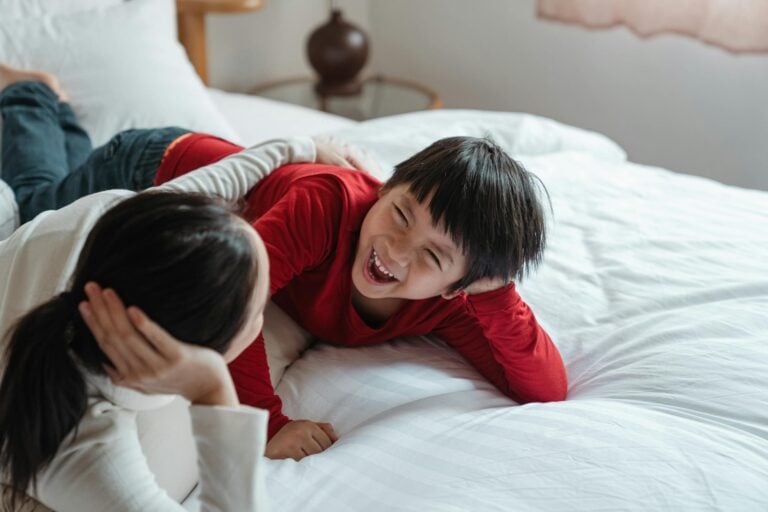

Being a homebody stay-at-home mom isn’t a consolation prize. For introverted women who thrive in quieter, more controlled environments, it can be one of the most genuinely aligned ways to structure a life. The combination of a home-centered role with an inward-facing personality isn’t a compromise, it’s a natural fit that deserves to be recognized on its own terms.
I’m not a stay-at-home parent. But I’ve spent enough time thinking about introversion, environment, and where people actually flourish to recognize something real when I see it. And what I see in the homebody SAHM experience is a woman who has, often without a roadmap or permission, built a life that works with her wiring instead of against it.
That deserves more than a quiet nod. It deserves a full conversation.
Much of what I write about on this site connects back to a broader truth: the spaces we inhabit shape how well we function. If you want to go deeper on that idea, our Introvert Home Environment hub covers everything from sensory design to the psychology of sanctuary. This article fits squarely into that conversation.

What Makes the Homebody SAHM Combination So Naturally Compatible?
There’s a version of the stay-at-home mom narrative that centers on sacrifice. She gave up her career, her ambitions, her social life. And for some women, that framing is accurate. But for the introverted homebody, something different is often happening. She isn’t retreating from a life she wanted. She’s building one that actually fits.
What’s your personality type?
Take our free 40-question assessment and get a detailed personality profile with dimension breakdowns, context analysis, and personalised insights.
Discover Your Type8-12 minutes · 40 questions · Free
Introverts, broadly speaking, draw energy from within. Solitude restores them. Deep focus satisfies them. Environments they can control comfort them. The home, when set up thoughtfully, provides all of that. It’s a contained world with familiar rhythms, meaningful relationships, and enough quiet to actually think.
I spent over two decades running advertising agencies, managing teams across open-plan offices, attending back-to-back client meetings, and performing extroversion in ways that left me genuinely depleted by Thursday afternoon. The contrast between that world and a home-centered life is stark. I’m not romanticizing it. Parenting is exhausting and relentless in its own way. But the texture of that exhaustion is different. It’s intimate rather than performative. It comes from giving, not from pretending.
That distinction matters enormously to introverts.
There’s also something worth naming about depth. Introverts tend to prefer fewer, richer connections over a wide social network. The SAHM role, at its core, is built around exactly that kind of depth. You’re not managing surface-level relationships with dozens of colleagues. You’re going deep with a small number of people who genuinely need you. For someone wired the way many introverts are, that’s not a limitation. It’s a relief.
Isn’t Staying Home All Day Lonely for an Introvert?
People ask this question with good intentions, and I understand why. From the outside, a day spent mostly at home with young children can look isolating. But loneliness and solitude aren’t the same thing, and conflating them is one of the most persistent misunderstandings about introverted people.
Loneliness is the ache of feeling disconnected from meaningful contact. Solitude is the experience of being alone without that ache. Most introverts don’t just tolerate solitude, they seek it. It’s where their thinking gets clearer and their sense of self gets replenished.
A homebody SAHM who structures her day well isn’t isolated. She’s in constant relationship with her children, managing a household that requires real cognitive effort, and choosing when and how she engages with the outside world. That kind of agency is something many introverts in traditional workplaces rarely experience. The office doesn’t ask if you’re ready to socialize. The open-plan floor doesn’t care that you need twenty minutes of quiet to finish a thought. The home, by contrast, can be shaped.
When genuine adult connection is needed, many introverted homebodies find that online spaces designed for introverts offer a form of community that feels manageable rather than overwhelming. Text-based, asynchronous, low-pressure. You can show up when you have something to say and step back when you need quiet. That kind of connection isn’t a lesser version of community. For many introverts, it’s actually a better fit.

How Does an Introverted SAHM Actually Recharge When She’s Never Alone?
This is the real challenge, and I won’t gloss over it. Young children are relentless in their need for attention and presence. Nap time is sacred. The hour after bedtime becomes precious in a way that’s hard to explain to anyone who hasn’t lived it. And the introvert’s need for genuine solitude doesn’t pause because the schedule doesn’t allow it.
What I’ve observed, both through my own experience of needing recovery time and through conversations with introverted parents, is that recharging doesn’t always require complete aloneness. It requires a reduction in demands on your attention and a shift from performing to simply being.
A child playing independently nearby while you sit quietly with a book is not the same as being alone. But it’s also not the same as being “on.” There’s a middle state, a kind of parallel presence, that many introverted parents learn to inhabit. You’re available without being activated. Present without performing.
The physical environment plays a significant role here. A comfortable, intentional couch setup isn’t a small thing. It’s a signal to your nervous system that this is a rest space. The sensory quality of a room, its light, its noise level, its visual clutter, all of it affects how quickly an introvert can downshift from activated to restored. Many introverts who are also highly sensitive find that principles from HSP minimalism apply directly here. Fewer objects, calmer surfaces, and more intentional design choices can make a home feel genuinely restorative rather than just functional.
When I finally redesigned my home office after years of working in chaotic agency environments, the difference in how I felt by the end of a workday was significant. I hadn’t realized how much ambient visual noise had been draining me until it was gone. Introverted SAHMs who pay attention to their home environment aren’t being precious. They’re being strategic.
What Does the Research Say About Introverts and Home-Based Roles?
The connection between introversion and home-centered living isn’t just anecdotal. There’s a meaningful body of thinking around how personality traits intersect with environmental preferences and wellbeing. Work in environmental psychology has long suggested that people function better in spaces that match their arousal preferences, and introverts tend to prefer lower-stimulation environments that allow for sustained focus.
A PubMed Central study on environmental stress and individual differences points to how differently people respond to sensory load, with some individuals showing significantly stronger reactions to overstimulation. For those people, having control over their environment isn’t a luxury. It’s a functional necessity.
Separately, research on wellbeing and social engagement has explored how the quality of social interaction matters more than quantity for certain personality profiles. Introverts who have fewer but more meaningful connections often report higher satisfaction than those who maintain large but shallow social networks. The SAHM role, with its emphasis on deep relational investment in a small family unit, maps onto that pattern directly.
There’s also something worth considering from Psychology Today’s writing on why introverts need deeper conversations. The premise is that small talk isn’t just unpleasant for introverts, it’s genuinely unsatisfying in a way that leaves them feeling more drained than connected. The conversations that happen between a parent and a child, particularly as that child grows, tend toward the substantive. Questions about how things work, why people behave the way they do, what fairness means. That’s not small talk. That’s exactly the kind of exchange introverts find meaningful.
How Can a Homebody SAHM Build a Life That Feels Genuinely Fulfilling?
Fulfillment in a home-centered life doesn’t happen automatically. It requires the same intentionality that any well-designed life requires. The difference is that introverted homebodies often have more capacity to design their environment than they realize, and less external pressure to do so in any particular way.
A few things I’ve seen make a real difference, both from my own experience and from what I’ve observed in others.
First, having a personal intellectual or creative pursuit that belongs entirely to you. Not a side hustle, not something monetized or optimized, just something that feeds your mind. A book chosen specifically for homebodies who want to go deeper on the psychology of home-centered living can be a starting point. Reading isn’t passive for introverts. It’s often where their most active thinking happens.
Second, structuring the day around your energy rather than against it. I did this badly for years in my agency work. I scheduled my most demanding creative thinking for afternoons, when my energy was lowest, because that’s when the meetings happened to end. Once I finally restructured my days to protect mornings for deep work, my output improved noticeably. The same principle applies at home. If your clearest thinking happens before 9 AM, that’s when you protect time for something that requires it.
Third, being deliberate about what you bring into your home. The objects, the media, the people, the rhythms. Introverts are often more affected by their surroundings than they consciously recognize. A thoughtfully chosen gift for a homebody isn’t just a nice gesture. It’s an acknowledgment that the home environment matters and that the person living in it deserves things that genuinely serve them. That same logic applies to what you choose for yourself.
There are entire guides built around this idea. A good homebody gift guide isn’t really about presents. It’s a curated philosophy of what makes a home feel like a genuine sanctuary rather than just a place where things happen. When you start thinking about your space that way, the choices you make in it start to feel more intentional and more meaningful.
What About the Identity Question? Can a Homebody SAHM Still Have a Strong Sense of Self?
This is the question that sits beneath a lot of the cultural anxiety around stay-at-home parenting. The worry isn’t really about logistics. It’s about identity. Who are you when your role is defined entirely by your relationship to others?
I think this worry, while understandable, is based on a premise that doesn’t hold up. Identity isn’t housed in a job title. It’s housed in how you think, what you value, what you notice, and how you engage with the world. Those things don’t disappear when you step away from a professional role. They just express themselves differently.
As an INTJ, I’ve always had a clear internal sense of who I am that existed independently of whatever external role I was playing. That’s actually a common feature of introverted personality structures. The inner life is rich and self-sustaining in a way that doesn’t require constant external validation to feel real. Many introverted SAHMs report that their sense of self is, if anything, clearer at home than it was in workplace environments that required constant code-switching and performance.
There’s also something worth saying about the intellectual depth of parenting itself. Raising children well requires genuine psychological sophistication. You’re managing attachment, boundaries, emotional regulation, communication, and development simultaneously. The relationship between personality and parenting approaches is an area of active interest in psychology, and what emerges consistently is that the most effective parents tend to be those who are reflective and attuned, qualities that introverts often possess in abundance.
That’s not a small thing. That’s a vocation.

How Does an Introverted SAHM Handle the Social Expectations That Come With the Role?
Playdates. School pickup conversations. Neighborhood gatherings. Parent-teacher associations. The social calendar of a stay-at-home parent can be surprisingly full, and not always in ways that feel optional.
I managed a team of about thirty people at the height of my agency years. The social demands of that role were constant and largely non-negotiable. What I eventually learned, after years of white-knuckling through networking events and team socials, was that I could be genuinely present and effective in social situations without pretending to enjoy them the way extroverts did. I just needed to be strategic about recovery time.
The same principle applies here. An introverted SAHM doesn’t need to become a social butterfly to be a good parent or a good neighbor. She needs to show up when it matters, be genuinely present in those moments, and protect the recovery time that makes that presence possible.
Conflict, when it arises in these social contexts, is worth approaching thoughtfully. Psychology Today’s framework for introvert-extrovert conflict resolution offers some useful thinking here, particularly around the introvert’s tendency to need processing time before responding. In a school parking lot conversation that turns tense, that processing time isn’t always available. Knowing this in advance, and having a few practiced responses that buy you thinking space, makes a real difference.
There’s also something freeing about accepting that you don’t have to be the most socially engaged parent at every event. Your children benefit from seeing you be authentically yourself, including the parts that prefer a quiet afternoon at home over a crowded playdate. Modeling that kind of self-awareness is genuinely valuable.
What Happens When the Homebody SAHM Is Also a Highly Sensitive Person?
A meaningful number of introverts are also highly sensitive people, meaning they process sensory and emotional information more deeply than average. The overlap isn’t total, but it’s significant enough to be worth addressing directly.
For an HSP in a SAHM role, the sensory environment of home becomes even more consequential. The noise level of a household with young children can be genuinely overwhelming. The emotional demands of parenting, absorbing a child’s distress, holding space for tantrums, staying regulated when everything around you is dysregulated, require a level of emotional energy that HSPs often feel more acutely than others.
I once managed a highly sensitive creative director at my agency who was extraordinary at her work but would visibly shut down in high-noise, high-conflict environments. We eventually restructured her role so that she had more control over her environment and fewer mandatory group sessions. Her output improved immediately. The lesson wasn’t that she was fragile. It was that her sensitivity was an asset that needed the right conditions to function.
The same logic applies at home. An HSP who is also a homebody SAHM isn’t just managing a household. She’s managing a sensory environment that directly affects her capacity to function. Taking that seriously, through intentional design, simplified spaces, and honest communication with a partner about what she needs, isn’t self-indulgent. It’s necessary.
The principles behind meaningful connection matter here too. HSPs often find that the depth of their relationships with their children is one of the most genuinely sustaining parts of the SAHM experience. When the environment is right, that depth becomes a source of energy rather than a drain on it.
Is the Homebody SAHM Life Sustainable Long Term?
Sustainability is worth taking seriously. Children grow up. Roles shift. The woman who spent a decade as a homebody SAHM will eventually face a home that feels different, quieter in some ways, emptier in others, and a question about what comes next.
What I’ve seen in people who handle that transition well is that they never entirely stopped being themselves during the SAHM years. They maintained intellectual interests. They kept some form of creative or professional engagement, even if it was modest. They built an identity that was nourished by the role without being entirely defined by it.
That’s actually easier for introverts than it might sound. The inner life of an introvert tends to be rich and self-sustaining. The INTJ in me always had a parallel track running, processing, analyzing, planning, regardless of what external role I was playing. Many introverted SAHMs describe something similar. The home-centered years weren’t a pause on their intellectual development. They were a different kind of engagement with it.
There’s also something worth saying about the skills developed in the SAHM role that translate directly to other contexts. Project management, emotional intelligence, conflict resolution, communication across different developmental stages, these are not soft skills. They are genuinely sophisticated competencies. The introverted SAHM who eventually returns to professional life, or builds something of her own, often brings a depth of interpersonal and organizational insight that her peers who never stepped away simply don’t have.
The homebody SAHM path isn’t a detour. For the right person, it’s a direct route to a kind of depth and self-knowledge that’s genuinely hard to find elsewhere.
If this article resonated with you, there’s much more to explore. Our complete Introvert Home Environment hub covers the full range of how introverts can build spaces and rhythms that actually support who they are.
About the Author
Keith Lacy is an introvert who’s learned to embrace his true self later in life. After 20 years in advertising and marketing leadership, including running agencies and managing Fortune 500 accounts, Keith now channels his experience into helping fellow introverts understand their strengths and build fulfilling careers. As an INTJ, he brings analytical depth and authentic perspective to every article, drawing from both professional expertise and personal growth.
Frequently Asked Questions
Is being a stay-at-home mom a good fit for introverts?
For many introverts, the SAHM role is a genuinely compatible fit. It offers a home-centered environment with controllable sensory input, deep relational connections with a small number of people, and significant autonomy over daily rhythms. Introverts who thrive in quieter, more intimate settings often find that the SAHM structure aligns with their natural preferences in ways that traditional office environments do not.
How does an introverted SAHM recharge when she never gets time alone?
Complete solitude isn’t always available, but introverts can find partial restoration through low-demand parallel presence, such as sitting quietly while a child plays independently. Protecting small windows of genuine quiet, during nap time or after bedtime, and designing a home environment that minimizes sensory overload both contribute meaningfully to an introvert’s ability to recover and stay regulated throughout the day.
Can a homebody SAHM maintain a strong sense of identity outside of parenting?
Yes, and introverts are often well-positioned to do this because their sense of self tends to be internally grounded rather than dependent on external roles or titles. Maintaining a personal intellectual interest, a creative practice, or even a reading habit provides an ongoing thread of identity that exists alongside the parenting role. Many introverted SAHMs report that their self-knowledge actually deepens during home-centered years rather than diminishing.
How should an introverted SAHM handle the social demands of parenting, like playdates and school events?
Strategic rather than exhaustive engagement is the approach that works best. Showing up genuinely when presence matters, rather than attempting to match the social output of more extroverted parents, is both sustainable and honest. Building in recovery time after socially demanding events, having practiced responses that create thinking space in unexpected conversations, and accepting that authentic presence is more valuable than constant availability all help introverted SAHMs manage the social side of the role without depleting themselves.
What makes a home environment genuinely restorative for an introverted stay-at-home mom?
Sensory simplicity, visual calm, and intentional design choices all contribute to a home that restores rather than drains. Reducing ambient noise where possible, minimizing visual clutter, creating at least one dedicated rest space, and choosing objects that genuinely serve the people using them are all meaningful steps. For SAHMs who are also highly sensitive, these choices become even more consequential, as the sensory environment directly affects their capacity to stay regulated and present throughout the day.