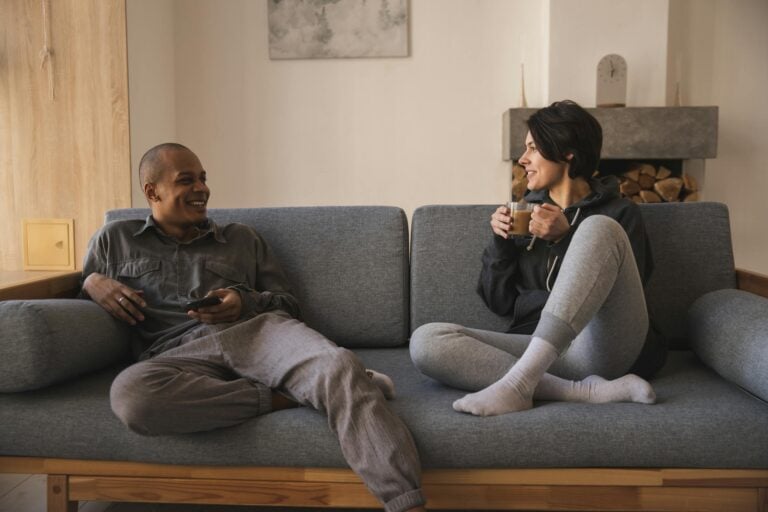

Getting along with an introvert in your home starts with one simple shift: understanding that quiet isn’t a problem to fix, it’s how they recharge. Introverts process the world internally, and shared living spaces can feel like a constant drain on their energy, especially when the people around them don’t recognize the signals. What looks like withdrawal or coldness is usually just someone managing their own limits with the tools they have.
That said, coexisting well with an introvert isn’t complicated. It mostly comes down to respecting space, communicating on their terms, and letting silence be companionable rather than awkward. The rest tends to fall into place.
I’ve spent a lot of time thinking about this, not just as someone who writes about introversion, but as someone who lived on the wrong side of these dynamics for years. Running advertising agencies meant I was surrounded by extroverted energy constantly, and I brought that noise home with me. It took a while to understand what I actually needed, and even longer to communicate it to the people I lived with.
If you’re exploring what home life looks like for introverts more broadly, our Introvert Home Environment hub covers everything from sensory design to social recovery, and it gives good context for why the home matters so much to people wired the way we are.

Why Does Shared Living Feel So Hard for Introverts?
Most introverts aren’t antisocial. That’s the first thing worth clearing up. What we are is energy-conscious. Social interaction, even with people we love, draws from a finite internal reserve. The home is supposed to be where that reserve gets replenished, not further depleted.
What’s your personality type?
Take our free 40-question assessment and get a detailed personality profile with dimension breakdowns, context analysis, and personalised insights.
Discover Your Type8-12 minutes · 40 questions · Free
When I was running my agency in the mid-2000s, I had a business partner who was as extroverted as they come. He thrived on the chaos of open offices, back-to-back client calls, and impromptu team lunches. I genuinely admired his energy. But I noticed something over time: he came home buzzing, and I came home empty. Same workday, completely different internal experience. His home was a launchpad. Mine needed to be a landing pad.
That difference matters enormously in shared living. Extroverted housemates or partners often interpret an introvert’s need for quiet as rejection. It’s not. It’s maintenance. The introvert who disappears into their room after dinner isn’t signaling that they dislike you. They’re signaling that they’ve hit their limit and need to reset before they can show up as themselves again.
What makes this harder is that introverts often don’t explain this in real time. We process internally, which means we’re frequently in the middle of managing something emotionally or mentally before anyone around us even realizes something is happening. A lot of the friction in shared living comes from this gap: the introvert is overwhelmed, the extrovert feels shut out, and neither one has the language to bridge it in the moment.
Some of the most useful reading I’ve come across on this comes from Psychology Today’s work on why introverts need deeper conversations, which captures something I’ve always felt but struggled to articulate: small talk isn’t just boring to us, it actually costs more energy than meaningful exchange does. In a home setting, that matters. The introvert who seems disengaged during surface-level banter may come alive entirely during a real conversation about something that matters.
What Does an Introvert Actually Need at Home?
Space and predictability. Those are the two things that show up again and again when I talk to introverts about what makes home life feel sustainable.
Space doesn’t always mean a separate room, though that helps. It means having stretches of time where no one needs anything from you. Where you can think without interruption, sit without performing, and exist without having to respond. For many introverts, even a corner of a room with a good chair and low foot traffic is enough. The physical setup matters more than most people realize. I’ve written before about how HSP minimalism and simplified environments can dramatically reduce the sensory load that sensitive introverts carry, and a lot of those principles apply even if you don’t identify as highly sensitive.
Predictability means knowing when you’ll have quiet and when you won’t. An introvert who knows that Sunday mornings are reliably calm can hold themselves together through a busy Saturday night. An introvert who never knows when the next social demand is coming tends to stay in a low-grade state of vigilance, which is exhausting in a way that’s hard to explain to someone who doesn’t experience it.
I had a period in my late thirties when I was managing a large team while also going through a significant personal transition at home. My schedule was entirely reactive. I had no predictable quiet time, no space that was mine, and no reliable way to recover between demands. I didn’t recognize it as an introvert problem at the time. I just thought I was bad at stress. It took years to connect those dots.
Beyond space and predictability, introverts need to feel like their withdrawal won’t be punished. This is subtle but important. If every time an introvert asks for alone time they get a guilt trip or a worried look or a long conversation about whether something is wrong, they’ll stop asking. And then they’ll start resenting. The introvert who feels safe saying “I need an hour” is a much easier person to live with than one who has learned to hide their needs.

How Do You Communicate With an Introvert Without Pushing Them Away?
Timing is almost everything. Introverts don’t process on demand. If you corner someone right when they walk in the door, or in the middle of something absorbing, or when they’ve clearly hit a wall, you’re going to get a fraction of the person you’re trying to reach.
One thing I learned, both in my agency work and at home, is that introverts tend to communicate better when they’ve had time to think. I was notoriously slow in meetings to offer opinions off the cuff. My best work always came after I’d had time to sit with something. The same is true in personal relationships. Ask an introvert something important and then give them room to come back to it. Don’t interpret silence as evasion. It’s usually preparation.
Written communication helps more than most extroverts expect. A text, a note, an email, these give introverts the chance to respond thoughtfully rather than reactively. Some of the best conversations I’ve had with people I care about started as written exchanges. There’s a reason many introverts find text-based spaces like chat rooms easier to open up in. The medium itself removes the performance pressure.
When conflict does arise, the worst thing you can do is escalate in the moment. Psychology Today’s four-step introvert-extrovert conflict resolution approach is worth reading if you share a home with someone whose communication style differs from yours. The short version: slow down, give space, then reconnect. Introverts don’t shut down because they don’t care. They shut down because they care too much and need time to process it without an audience.
One more thing on communication: don’t make the introvert’s quietness a topic of conversation in front of others. “She’s so quiet, she never talks at parties” or “he always disappears when people come over” might feel like harmless observation, but it puts the introvert in the position of defending something that isn’t a flaw. I’ve been on the receiving end of that kind of commentary, and it creates exactly the kind of social pressure that makes introverts retreat further.
What Boundaries Actually Look Like in a Shared Home
Boundaries aren’t walls. That’s something I had to work out over a long time, both personally and in how I managed teams. An introvert setting a boundary around their time or space isn’t building a fortress. They’re creating the conditions under which they can actually show up.
In a shared home, practical boundaries might look like: a closed door that means “not right now,” a morning routine that doesn’t include conversation, a designated quiet hour in the evenings, or a room that isn’t a social gathering space. None of these are unreasonable. All of them require the people in the home to agree that the introvert’s needs are legitimate, not a personality quirk to be managed.
What makes this work is reciprocity. Introverts who feel their limits are respected are generally much more willing to stretch. I’ve noticed this in myself: when I know I’ll have recovery time built in, I can engage more fully during the times that require it. When I don’t, I start rationing my energy early, which means everyone gets less of me, not more.
There’s also something worth saying about the introvert’s responsibility here. Boundaries need to be communicated, not just enforced silently and then resented when people cross them. If you’re the introvert in the house, the people around you genuinely cannot read your mind. Saying “I need about an hour before I can talk tonight” is not a burden. It’s information. And it tends to go over much better than disappearing without explanation and then feeling misunderstood.
Neuroscience has started to shed some light on why introverts respond to stimulation differently. Research published in PubMed Central points to differences in how introverts and extroverts process dopamine, which helps explain why the same environment that energizes one person can genuinely exhaust another. This isn’t about preference or willpower. It’s physiology. Knowing that can make it easier for extroverted housemates to stop taking an introvert’s need for quiet personally.

How Do You Support an Introvert Without Hovering?
Support and presence aren’t the same thing. One of the most useful things you can do for an introvert you live with is to be comfortable in the same space without demanding engagement. Parallel company, two people in the same room doing different things, is genuinely restorative for many introverts. It feels like connection without the cost of performance.
Introverts often love their homebodies, their quiet evenings, their familiar routines. The homebody couch is practically sacred territory. Sharing that space without needing it to be social is one of the kindest things you can offer. Sit nearby. Read your own book. Watch something together without the pressure to discuss it afterward. That kind of presence is deeply comfortable for introverts, and it builds the kind of trust that makes them more open over time, not less.
Gifts are another way people try to show support, and there’s actually a lot of thought that can go into this. A good homebody gift guide can point you toward things that genuinely serve an introvert’s lifestyle rather than pushing them toward more socializing. Things that enhance their home environment, support their solitary hobbies, or make their recovery time more comfortable tend to land well. The instinct to give an introvert experiences that “get them out of their shell” is usually well-meaning and usually misses the mark.
Speaking of thoughtful giving, if you’re looking for something specific, there are some genuinely great gifts for homebodies that honor rather than challenge the way introverts prefer to spend their time. A quality blanket, a good pair of headphones, a book they’ve been meaning to read, these communicate “I see you” in a way that a party invitation never will.
And on the subject of books: if you want to understand the introvert in your life more deeply, there’s a rich body of writing on this. A well-chosen homebody book can open up conversations that might otherwise never happen. Sometimes reading the same thing creates a shared language that talking around the topic never quite achieves.
What Happens When Introvert Needs Clash With Household Energy?
Households are complicated. Kids, partners, roommates, extended family, they all bring their own rhythms, and those rhythms don’t always accommodate introvert recovery patterns naturally. This is where the real negotiation happens.
I managed a large, open-plan office for years. It was the design trend at the time, and the research on whether it actually improved collaboration was, to put it charitably, mixed. What I observed was that my introverted team members consistently underperformed in that environment compared to when they had quiet time and private space. They weren’t less capable. They were less able to access their capabilities under constant stimulation. I eventually carved out quiet zones and flex-time arrangements that let people work in the conditions they needed. Output improved across the board.
The same principle applies at home. You can’t always restructure the whole household around one person’s needs, but you can carve out protected space and time. A parent who needs thirty minutes of quiet after the school run isn’t being selfish. A partner who needs to decompress before dinner isn’t being distant. These are reasonable accommodations that make the person more available, not less, over the course of a day.
Where it gets harder is when the introvert’s needs feel invisible to everyone else. Children, especially young ones, don’t have the capacity to understand why a parent needs to sit quietly. Extroverted partners sometimes interpret recovery time as a comment on the relationship. Roommates may just be oblivious. In all these cases, the introvert has to do the work of naming what they need clearly, even when that feels counterintuitive to someone who processes internally.
Broader patterns around introversion in social and professional settings are worth understanding too. Additional PubMed Central research on personality and social behavior helps illustrate that introversion isn’t a disorder or a deficit. It’s a stable trait with its own strengths and requirements. Framing it that way in household conversations tends to reduce the defensiveness on both sides.

How Do Introverts Thrive in Shared Living Over the Long Term?
Long-term coexistence with an introvert, whether as a partner, family member, or roommate, works best when it’s built on genuine understanding rather than accommodation under protest. There’s a difference between someone who tolerates an introvert’s need for quiet and someone who actually gets why it matters. Introverts can feel that difference, and it shapes how much of themselves they’re willing to bring to the relationship.
One thing that helps enormously is when the extroverted or more socially driven people in the house develop their own comfort with solitude. Not because they need to become introverts, but because a household where everyone can be comfortable alone is a household where the introvert doesn’t feel like the problem. When quiet is a shared value rather than a concession, the whole dynamic shifts.
I’ve also seen this work well when households create explicit rhythms rather than leaving everything to negotiation in the moment. A weekly check-in about the upcoming schedule. An agreed-upon signal for “I need space right now.” A shared understanding that some evenings are social and some aren’t, and that both are valid. These structures remove the guesswork and reduce the number of moments where someone feels either intruded upon or shut out.
Introverts, for their part, do better long-term when they invest in the relationship during the times they do have energy. Withdrawal isn’t sustainable as a permanent state. The introvert who only shows up when conditions are perfect tends to create a relational deficit that builds resentment over time. The goal is reciprocity: the people around you make space for your recovery, and you show up fully when you’re recovered. That’s a fair exchange, and most people will honor it when they understand that’s what’s happening.
There’s also something to be said for introverts finding community and connection in ways that work for them, which takes pressure off the household as the only source of social interaction. Whether that’s a close one-on-one friendship, an online community, or a regular solo activity that feeds something internal, having those outlets means the introvert isn’t depending entirely on household relationships to meet every need. That’s healthier for everyone.
The Harvard Program on Negotiation’s take on introverts is interesting in this context: introverts often bring patience, careful listening, and deliberate thinking to negotiations, qualities that are genuinely valuable in working out household dynamics too. The introvert in your home may be better at finding sustainable arrangements than you’d expect, if they’re given the space and time to think it through.

If you want to keep exploring what makes home life work for introverts, from physical environment to emotional recovery to daily rhythms, the Introvert Home Environment hub brings together everything we’ve written on the subject in one place. It’s worth a browse if any of this has resonated.
About the Author
Keith Lacy is an introvert who’s learned to embrace his true self later in life. After 20 years in advertising and marketing leadership, including running agencies and managing Fortune 500 accounts, Keith now channels his experience into helping fellow introverts understand their strengths and build fulfilling careers. As an INTJ, he brings analytical depth and authentic perspective to every article, drawing from both professional expertise and personal growth.
Frequently Asked Questions
How do I know if the introvert I live with needs space or is actually upset with me?
The clearest way to tell is to ask, but ask at a low-stakes moment rather than in the middle of the withdrawal. Most introverts will tell you honestly if something is wrong when they’re not in the middle of processing. If they say they just need quiet and their behavior is otherwise consistent, take them at their word. If something has shifted in the relationship more broadly, that will usually surface during a calmer conversation. The default assumption should be that quiet means recovery, not resentment.
Is it normal for an introvert to want alone time even from people they love?
Completely normal, and worth understanding as a feature rather than a flaw. Introversion isn’t about how much someone loves you. It’s about how they manage their energy. An introvert can adore their partner, their children, their housemates, and still genuinely need time away from all of them to function well. The need for solitude doesn’t diminish the quality of the relationship. Often, honoring it improves it.
What’s the best way to invite an introvert to join household activities without making them feel pressured?
Offer once, clearly and warmly, and then let it go. “We’re watching a movie if you want to join” lands very differently from “you never spend time with us anymore.” Introverts respond well to genuine invitations with no strings attached. They respond poorly to invitations that carry guilt or expectation. When they know they can say no without consequence, they’re actually more likely to say yes.
How can I help an introvert in my house feel more comfortable during social gatherings?
Give them a role, a warning, and an exit. A role (helping with food, managing music, greeting people at the door) gives introverts something to do that doesn’t require sustained small talk. A warning (telling them about the gathering well in advance) lets them mentally prepare rather than being ambushed. An exit means they know they can step away when they’ve hit their limit without it becoming a scene. These three things make social events in the home genuinely manageable for most introverts.
Can living with an extrovert and an introvert actually work long term?
Yes, and in many ways it works well. Extroverts and introverts often balance each other in shared living: the extrovert brings social energy and external connection, the introvert brings depth, calm, and a grounding influence. What makes it sustainable is mutual respect for the other person’s way of being, and a willingness to negotiate without making either style the default standard. Many of the most stable households I’ve known have been exactly this combination, when both people understood what the other needed and stopped trying to convert them.