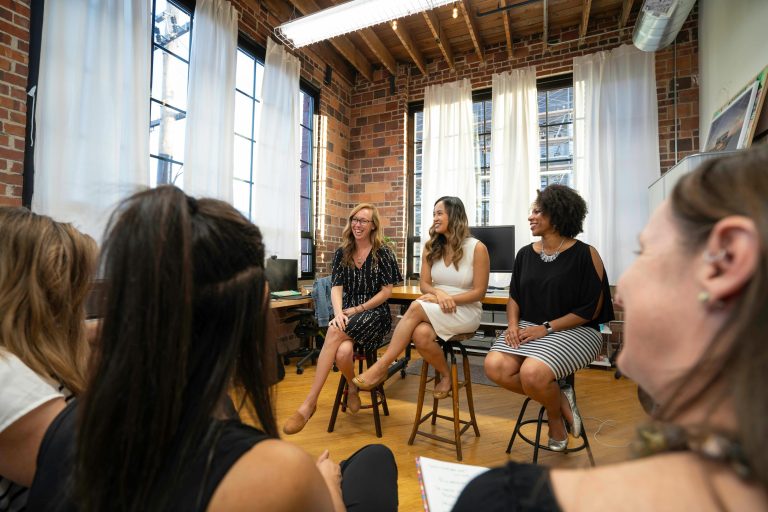

Large social spaces exhaust me in a way that’s hard to explain to someone who doesn’t experience it. It’s not shyness, and it’s not dislike of people. Something more physical happens, a slow drain that starts the moment I walk into a crowded room and doesn’t stop until I’m somewhere quiet again.
As an introvert, and more specifically as an INTJ who spent two decades running advertising agencies, I’ve stood in hundreds of those rooms. Award shows, client pitches, industry conferences, agency holiday parties with 200 people and a DJ. I showed up. I performed. And then I went home and sat in silence for an hour before I could speak to anyone again.
If that pattern sounds familiar, you’re wired the same way I am. And there’s nothing wrong with either of us.

Much of what I write about the introvert home environment connects to this exact experience. The reason so many of us are drawn to quiet, intentional spaces at home is because the outside world, especially its louder, larger gatherings, costs us something real. Our Introvert Home Environment hub explores the full range of how introverts create and protect their private spaces, and the exhaustion that large social settings produce sits right at the center of why those spaces matter so much.
What Actually Happens When Large Social Spaces Drain You?
People sometimes assume introvert exhaustion is just tiredness, the same kind anyone feels after a long evening. It isn’t. What I experience in a crowded ballroom or a packed networking event is something closer to sensory and cognitive overload running simultaneously.
What’s your personality type?
Take our free 40-question assessment and get a detailed personality profile with dimension breakdowns, context analysis, and personalised insights.
Discover Your Type8-12 minutes · 40 questions · Free
My brain is processing everything. The conversations nearby that I’m not part of. The music underneath the noise. The body language of the person across the room. The subtext in what someone just said to me. The awareness of how many people are between me and the exit. None of this is conscious decision-making. It just happens, automatically, relentlessly, and it costs energy I can’t replenish mid-event.
The American Psychological Association defines introversion as a personality orientation characterized by a preference for the inner life of the mind over the outer world of people and things. That preference isn’t a mood or a choice made on any given Tuesday. It’s how the introvert brain is oriented. Large social environments demand the opposite orientation, constantly and without pause.
At one of my agencies, we landed a major account with a consumer packaged goods brand, and the celebratory dinner they threw for us had about 80 people in a private dining room. Open bar, loud music, everyone talking over each other. My extroverted business partner was lit up all night. I remember watching him work the room and thinking he looked genuinely energized, like the crowd was charging him. I felt the opposite. By the time the entrees arrived, I was already calculating how soon I could leave without it seeming rude.
That contrast isn’t a failure on my part. It’s just a real difference in how our nervous systems respond to social stimulation. Healthline notes that introverts tend to feel drained by social interaction, particularly in large groups, while extroverts gain energy from those same situations. The difference is neurological, not a character flaw.
Is It the Size of the Space or the Number of People?
Both matter, and they interact in ways worth understanding.
A large physical space with few people in it doesn’t exhaust me at all. I’ve spent entire afternoons in empty museums, wide open parks, and quiet hotel lobbies without feeling any drain. The space itself isn’t the problem. What depletes me is the density of social demands: multiple conversations happening at once, the expectation to engage with many different people, the constant low-level monitoring of who’s nearby and what’s expected of me.
Smaller groups in tight spaces can be just as exhausting if the social pressure is high enough. A dinner party with eight people who all want to debate loudly can hollow me out faster than a conference with 500 people where I can slip into observer mode. The exhaustion tracks social demand more than square footage.
That said, genuinely large spaces add their own layer. Open floor plans at conferences, stadium-style venues, sprawling cocktail parties: these create a specific kind of disorientation. There’s no natural edge to the social environment, no obvious place where it ends and I can breathe. That boundlessness is its own drain.

I managed a team of about 30 people at the peak of my agency years, and our open-plan office was a constant low-grade challenge for me. Even on days with no meetings, the ambient social noise of that space required energy to filter. I got better at it over time, but I never stopped noticing it. The introverts on my team, and I could always identify them, tended to arrive early or stay late specifically to get time in the space before or after the social density peaked. They weren’t slacking. They were managing their own cognitive resources.
Why Do Some Introverts Handle Large Groups Better Than Others?
Not all introverts experience large social spaces the same way, and the variation is real and worth acknowledging.
Some of it comes down to where you fall on the introversion spectrum. Introversion exists on a continuum. Someone near the middle of that range might find large gatherings tiring but manageable, while someone further toward the introverted end might find them genuinely overwhelming after a short time.
Highly sensitive people, a trait that overlaps with but is distinct from introversion, often experience large social environments with particular intensity. The sensory layer on top of the social layer creates compounding exhaustion. If you’ve ever felt like you were absorbing not just the noise of a party but the emotional atmosphere of every person in the room, that sensitivity is likely part of your picture. The principles behind HSP minimalism speak directly to this: reducing environmental complexity isn’t avoidance, it’s intelligent self-management.
Experience also plays a role. Introverts who’ve spent years in client-facing or leadership roles often develop what I’d call social stamina. Not a change in wiring, but a set of strategies that extend how long they can operate in demanding environments before the tank runs dry. I built a version of this over my agency years. I learned to identify the quieter corners of any venue, to schedule recovery time after big events, and to have a few stock conversational moves that let me engage without burning through reserves too quickly.
Context matters too. A large gathering centered on something I care about deeply, a small industry conference about a topic I find genuinely interesting, costs less than a generic networking event where the only shared interest is being in the same industry. Meaning reduces the drain. Obligation amplifies it.
How Does This Connect to the Introvert Pull Toward Home?
There’s a direct line between what large social spaces take from us and why home becomes so essential.
Home isn’t just a physical location. For introverts who regularly move through demanding social environments, home is where the nervous system finally gets to exhale. It’s where you control the stimulation level, the number of people, the noise, the expectations. That control isn’t about being antisocial. It’s about having a place where you’re not spending energy just to exist in the space.
I’ve thought a lot about what makes a home genuinely restorative versus just different from work. The homebody couch is a real symbol of something: a specific spot in your home that belongs entirely to you, where no social performance is required. That kind of anchor matters more than most people realize.
After particularly demanding client events, I had a ritual. Drive home, change out of whatever I’d been wearing, make tea, and sit in one specific chair in my home office for at least 30 minutes before doing anything else. My wife learned not to ask me questions in that window. Not because I was being difficult, but because that time was genuinely necessary for me to come back to myself. Without it, I’d stay in a kind of depleted fog well into the evening.
Many introverts build versions of this without consciously naming it. The decompression ritual, the quiet re-entry, the deliberate transition from social mode back to self. Home makes that possible. Large social spaces make it necessary.

Digital spaces offer their own version of this. When the social exhaustion from in-person gatherings is real but the desire for some connection isn’t gone, chat rooms built for introverts offer a lower-stakes alternative. You get to control the pace, the depth, and the exit. That kind of calibrated connection is genuinely different from the all-or-nothing dynamic of a crowded room.
What Are the Real Costs of Ignoring This Pattern?
Pushing through social exhaustion without acknowledging it has costs that compound over time.
In the short term, the most obvious cost is performance. When my social battery was depleted, my thinking got slower and shallower. I was less creative, less patient, and less able to do the kind of strategic work that was actually my strongest contribution as an agency leader. I was physically present but cognitively somewhere else.
The longer-term costs are harder to see but more significant. Chronic overstimulation without adequate recovery can contribute to anxiety, irritability, and a general sense of being worn thin. Some research into personality and stress response suggests that introverts may be particularly sensitive to the cumulative effects of sustained social demands, though individual variation is substantial. The work published in PubMed Central on personality and stress reactivity points to real differences in how people process and recover from demanding social environments.
There’s also a subtler cost: the slow erosion of your relationship with your own preferences. Spend enough years overriding your natural responses to large social settings, telling yourself you should be fine with this, and you start to lose the ability to hear what you actually need. I spent the better part of a decade doing exactly that. It wasn’t until my mid-forties that I started treating my introversion as information rather than a problem to manage.
The shift wasn’t dramatic. It was more like finally reading the instrument panel correctly. My discomfort in large social spaces wasn’t a malfunction. It was accurate data about what those environments cost me and what I needed to do to stay functional.
What Strategies Actually Help in Large Social Environments?
Avoidance is sometimes the right answer, and I won’t pretend otherwise. Plenty of large social events simply aren’t worth the cost, and declining them is a legitimate choice. But there are situations where attendance matters, professionally or personally, and having a toolkit helps.
Anchoring to a purpose is one of the most effective things I’ve found. Before any large event, I’d identify one specific reason I was there: one person I wanted to talk to, one piece of information I wanted to gather, one relationship I wanted to strengthen. Having that concrete objective gave me something to orient toward instead of floating in the ambient social noise of the room.
Physical positioning matters more than people realize. In any large venue, there are quieter zones: the edges of the room, the area near windows, the hallway just outside the main space. Moving toward those areas when you need a moment isn’t antisocial. It’s sensible resource management. I spent a lot of time at the perimeter of conference rooms and event spaces, and I had some of my best conversations there, with other people who’d also drifted to the edges.
Time-boxing your attendance changes the math entirely. Committing to two hours instead of the full evening gives you a defined endpoint, which reduces the ambient anxiety of not knowing when it will be over. I started doing this in my late agency years and it made a genuine difference. I was more present during the time I was there because I wasn’t spending energy monitoring how much longer I had to endure.
Building in recovery time before and after is non-negotiable for me. An important evening event means a quiet afternoon beforehand. A demanding conference day means a slow morning after. Treating recovery as part of the schedule rather than something that happens if there’s time left over changes how sustainable the whole thing becomes.
Creating your home environment to support this recovery is part of the same strategy. The things you surround yourself with matter. Thoughtfully chosen gifts for homebodies often reflect exactly this understanding: items that support rest, quiet, and sensory comfort rather than stimulation. A good lamp, a weighted blanket, a quality pair of headphones. These aren’t indulgences. They’re tools for a nervous system that’s been working hard.
If you’re looking for ideas on what to bring into your space, the homebody gift guide covers a thoughtful range of options that genuinely serve the introvert need for restorative environments. And if you want to go deeper on the philosophy behind why these spaces matter, the homebody book recommendations offer some of the best thinking I’ve found on intentional domestic life.
Is There Value in Large Social Spaces for Introverts at All?
Yes, and I want to be honest about this rather than just validating avoidance.
Some of the most significant professional relationships I built came from large industry events. Not because I thrived in those rooms, but because they created proximity to people I wouldn’t have otherwise met. The value wasn’t in the event itself. It was in the one or two real conversations that emerged from it.
Large social spaces also have a way of showing you things about yourself. How you respond under social pressure, what kinds of people you naturally gravitate toward, where your limits actually are rather than where you assume they are. That self-knowledge has genuine value, even when the gathering itself is exhausting.
There’s also something to be said for the occasional voluntary stretch. Not the kind that depletes you for days, but the kind that reminds you that you’re capable of more than your comfort zone suggests. Psychology Today has noted that introverts often bring particular depth and attentiveness to their social connections, qualities that can actually shine in the right large-group context when the introvert is operating from a place of choice rather than obligation.
The difference between a large social space that’s worth attending and one that isn’t usually comes down to whether you’re there by genuine choice or by pressure. Choice changes the experience. Obligation amplifies the drain.
Understanding your own pattern with large social environments is part of the broader work of understanding personality and wellbeing, something that has real implications for how you structure your life, not just your social calendar.
What Does Accepting This About Yourself Actually Change?
Quite a lot, in my experience.
Accepting that large social spaces genuinely exhaust me didn’t make me less capable. It made me more strategic. Instead of showing up to every industry event and white-knuckling my way through it, I got selective. I chose the events that had the highest signal-to-noise ratio for my specific goals. I stopped measuring my professional worth by how comfortable I looked in a crowded room.
It also changed how I managed the introverts on my teams. Once I stopped treating my own introversion as something to overcome, I stopped unconsciously expecting the same performance from introverted team members. I had a creative director who was exceptional at her work and genuinely terrible at large client presentations, not because she lacked skill but because the format worked against her strengths. We found other ways for her to demonstrate her thinking. The work got better. She got more confident. The format had been the problem all along.
The APA’s research on personality and performance points toward something introverts often discover on their own: matching your environment to your natural orientation, rather than fighting it, tends to produce better outcomes across multiple dimensions.
Accepting the exhaustion also means you stop apologizing for the recovery. Needing a quiet evening after a big event isn’t weakness. It’s accurate accounting. You spent something real. You’re replenishing it. That’s not a character flaw. It’s responsible self-management.

Everything I write about creating a restorative home environment connects back to this acceptance. The space you come home to should be built around what you actually need, not what you think you should need. If you’re still exploring what that looks like for you, the full range of ideas in our Introvert Home Environment hub is worth spending time with.
About the Author
Keith Lacy is an introvert who’s learned to embrace his true self later in life. After 20 years in advertising and marketing leadership, including running agencies and managing Fortune 500 accounts, Keith now channels his experience into helping fellow introverts understand their strengths and build fulfilling careers. As an INTJ, he brings analytical depth and authentic perspective to every article, drawing from both professional expertise and personal growth.
Frequently Asked Questions
Why do large social spaces exhaust introverts so much?
Large social spaces require introverts to process multiple streams of information simultaneously: conversations, social cues, environmental noise, and interpersonal expectations. This kind of sustained, multidirectional processing draws heavily on the cognitive and emotional resources that introverts naturally direct inward. The exhaustion isn’t a sign of social incompetence. It’s the predictable result of operating in an environment that runs counter to how the introvert brain is oriented.
Is it possible to get better at handling large social gatherings as an introvert?
Yes, with practice and strategy. Introverts can build what might be called social stamina over time, not by changing their fundamental wiring but by developing practical approaches: anchoring to a specific purpose, positioning themselves in quieter areas of a venue, time-boxing attendance, and building in deliberate recovery before and after demanding events. The wiring doesn’t change, but the management of it can become significantly more sophisticated.
What’s the difference between introvert exhaustion and social anxiety?
Introvert exhaustion is about energy depletion from social stimulation. Social anxiety involves fear or distress about social situations and how one will be perceived. They can coexist, but they’re distinct experiences. An introvert can feel completely comfortable in a large social setting and still leave exhausted. Someone with social anxiety may feel anxious regardless of the group size. The distinction matters because the responses and supports that help with each are quite different.
How can I explain this exhaustion to extroverted friends or family members?
One approach that tends to land is framing it in terms of a resource rather than a preference. Something like: “Being in large groups uses up a kind of energy for me that quiet time replenishes. It’s not that I don’t enjoy being with people. It’s that the larger the gathering, the more it costs me, and I need time to recharge afterward.” Most people understand the concept of a finite resource even if they don’t share the same experience of social environments.
Does the type of large social event affect how exhausting it is?
Significantly. Events centered on genuine shared interest or clear purpose tend to cost less than generic social gatherings where the only commonality is attendance. Structured events with natural conversation anchors (a shared meal, a presentation, a specific activity) are typically less draining than open-ended mingling. Events attended by choice feel different from those attended out of obligation. The size of the gathering matters, but the meaning and structure around it shape the experience just as much.