
Phones don’t cause social anxiety the way a virus causes a cold, but the relationship between constant connectivity and heightened social fear is real and worth taking seriously. For people already wired toward social sensitivity, including many introverts and highly sensitive people, the patterns that smartphones reinforce can amplify existing anxiety rather than create it from scratch. What the phone does is change the conditions in which social processing happens, and for some of us, those new conditions are genuinely harder to manage.
If you’ve noticed that checking your phone before a social event makes you feel more anxious rather than less, or that you replay a text conversation the way others replay a face-to-face interaction, you’re not imagining something. That experience has a real psychological basis, and it’s worth understanding what’s actually happening beneath the surface.
Much of what I explore on this site sits at the intersection of personality, emotional depth, and mental wellbeing. If this topic resonates with you, the Introvert Mental Health Hub covers the full landscape of anxiety, sensitivity, and emotional processing from an introvert’s perspective.
What Does Constant Connectivity Actually Do to the Social Brain?
There’s a version of this conversation that gets oversimplified quickly. Phones bad, real life good. But that framing misses the texture of what’s actually happening neurologically and psychologically when we spend significant portions of our day in a state of partial social engagement.
What’s your personality type?
Take our free 40-question assessment and get a detailed personality profile with dimension breakdowns, context analysis, and personalised insights.
Discover Your Type8-12 minutes · 40 questions · Free
Social interaction has always required a kind of cognitive effort, reading cues, managing responses, processing how others perceive us. Face-to-face interaction gives us a complete signal set: tone, body language, facial expression, timing, context. Phones strip most of that away and leave us with fragments. A text message. A reaction emoji. A seen receipt with no reply.
For someone whose brain is already inclined toward careful social processing, those fragments become raw material for interpretation. And interpretation, in the absence of full information, often trends anxious. I’ve noticed this in myself more times than I’d like to admit. An unanswered email from a client would send me into a quiet spiral of analysis that a phone call would have resolved in thirty seconds. The medium itself was feeding the anxiety.
What phones do, at scale, is normalize a kind of perpetual social monitoring. Notifications pull us back into social space dozens of times a day, each one carrying a small charge of social evaluation. Did they respond? How did they respond? What does the tone mean? For people with a baseline tendency toward social anxiety, this creates a near-constant low-level activation that’s exhausting in ways that are hard to name.
The American Psychological Association describes anxiety as involving persistent worry and heightened arousal that interferes with daily functioning. When the phone becomes a vehicle for continuous social monitoring, it creates exactly those conditions, worry that doesn’t resolve because the social loop never fully closes.
Why Social Media Hits Differently Than a Phone Call
Not all phone-based interaction carries the same psychological weight. A voice call, even an uncomfortable one, has a beginning and an end. You get real-time feedback. The social loop closes. Social media, by contrast, is a performance platform where the feedback is quantified, public, and asynchronous. That combination is particularly hard on people who process social information deeply.
I ran advertising agencies for over two decades, and part of that work involved managing brand presence on social platforms before most people understood what that meant. What struck me early was how differently people responded to public feedback versus private feedback. A client could absorb a tough conversation in a private meeting and walk away energized. The same feedback posted publicly, even constructively, would flatten them for days. The audience changed everything.
Social media recreates that dynamic for ordinary social interaction. Every post is a small performance. Every comment section is a public record. For someone with social anxiety, the combination of performance pressure and public evaluation is genuinely destabilizing. And for highly sensitive people who already process social feedback with unusual depth, the effect compounds. If you recognize that pattern in yourself, the work I’ve written on HSP anxiety offers some grounding in why sensitivity amplifies these experiences and what actually helps.
There’s also something specific about the like and reaction system that deserves attention. Variable reward schedules, where you don’t know when or whether positive feedback will arrive, are among the most psychologically compelling patterns humans respond to. Social media is built on exactly that structure. The result is a feedback loop that keeps anxious people checking, hoping, and interpreting in ways that reinforce rather than resolve their anxiety.
Does Phone Use Actually Make Social Anxiety Worse Over Time?
This is where the conversation gets genuinely complicated, because the evidence points in multiple directions depending on the person, the platform, and the pattern of use.
Passive use, scrolling without posting or interacting, tends to be more consistently linked to negative outcomes than active engagement. Watching others’ social lives from a distance while contributing nothing yourself is a recipe for social comparison, and social comparison feeds anxiety almost universally. Active use, actually connecting with people you know and care about, tends to be more neutral or even positive.
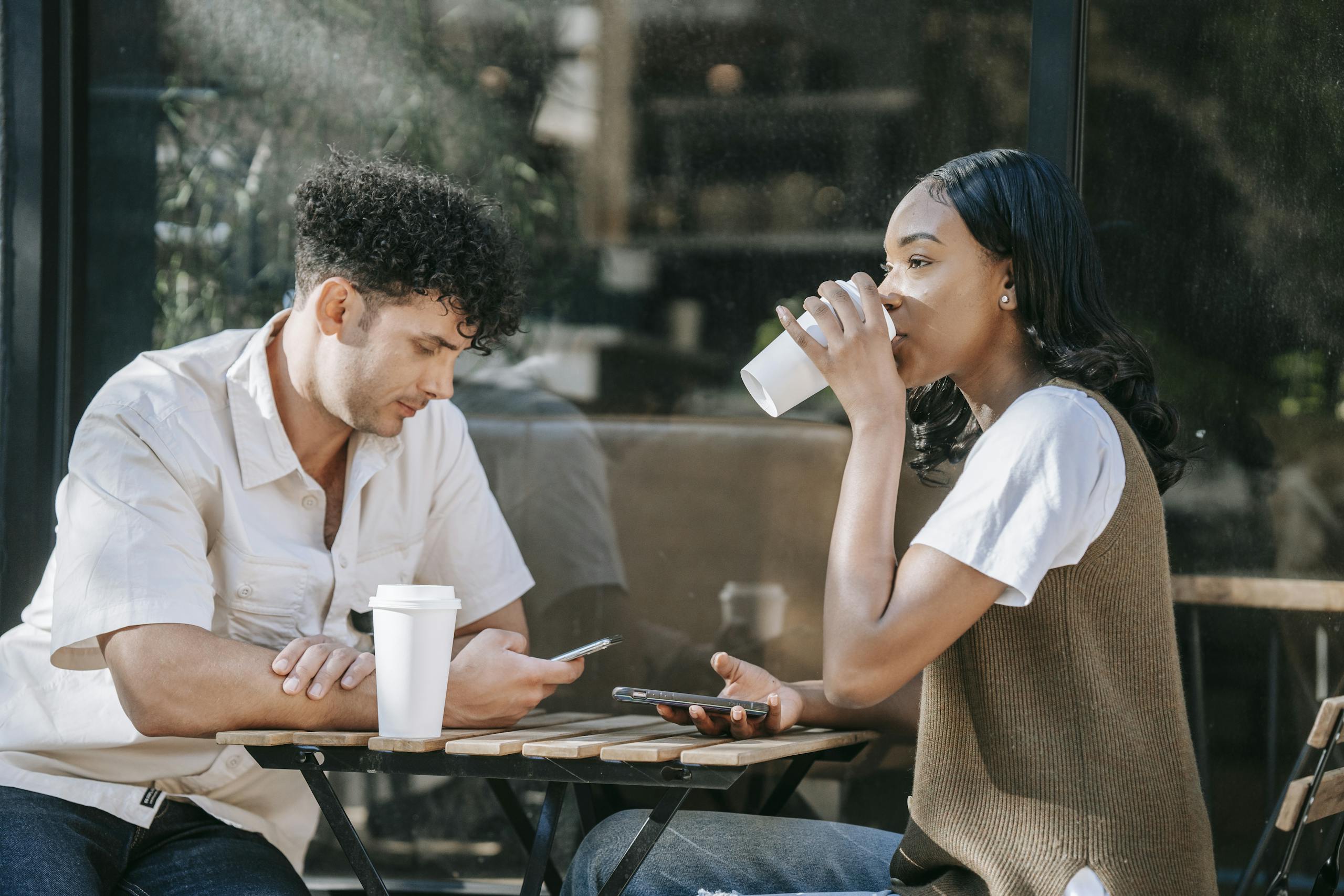
But there’s a subtler mechanism at work for people with existing social anxiety. Phones offer a way to manage social discomfort without resolving it. You can cancel plans via text instead of a call. You can avoid a conversation by staying busy on your phone. You can perform social connection without the vulnerability of actual presence. Each of these avoidance behaviors provides short-term relief while reinforcing the underlying belief that social situations are threatening.
That pattern, short-term relief through avoidance, is one of the core mechanisms that maintains anxiety over time. A published review in PubMed Central examining digital media and mental health outcomes highlights how avoidance behaviors mediated through technology can maintain and strengthen anxiety responses rather than diminishing them. The phone doesn’t create the anxiety, but it can become the mechanism through which avoidance gets practiced daily.
I saw this play out with a young account manager at one of my agencies. Brilliant at written communication, genuinely warm in one-on-one settings, but increasingly reliant on email and messaging to avoid the client calls that made her anxious. Within a year, her phone anxiety had spread to video calls, then to in-person meetings. The avoidance hadn’t protected her. It had contracted her world.
How Highly Sensitive People Experience This Differently
Highly sensitive people process sensory and emotional information more deeply than the general population. That depth is a genuine strength in many contexts, but it means that the stimulation load of modern phone use hits harder and accumulates faster.
Consider what a phone actually delivers across a typical day. News alerts carrying emotional weight. Social notifications requiring interpretation. Work messages demanding response. Personal conversations needing care. Each one is a small input that requires processing. For most people, many of these inputs pass through quickly. For highly sensitive people, they don’t. Each one gets processed more thoroughly, held longer, and felt more acutely.
The result is a form of cumulative overwhelm that can look a lot like social anxiety even when its roots are in sensory and emotional overload. If you’ve ever ended a day of heavy phone use feeling socially depleted without having had a single real conversation, that’s likely what’s happening. The stimulation itself is the drain, not the social contact. Understanding the difference matters, and the work I’ve done on HSP overwhelm and sensory overload goes deeper into why this happens and how to create the space your nervous system needs.
There’s also the emotional processing dimension. Highly sensitive people tend to process emotional content thoroughly and often replay interactions looking for meaning. A text exchange that carries any ambiguity can occupy significant mental real estate for hours. That’s not a character flaw. It’s a function of how deep processing works. But when the phone delivers dozens of ambiguous social signals per day, that processing load becomes genuinely unsustainable. The article on HSP emotional processing explores that depth in ways I find personally resonant, even as an INTJ who processes differently than most HSPs.
The Comparison Trap and What It Does to Social Confidence
Social anxiety is, at its core, a fear of negative evaluation. And social media is, at its core, a curated performance of positive evaluation. That collision is predictable in its effects.
When you scroll through a feed of social highlights, your brain doesn’t fully register the curation. It compares your unfiltered internal experience against others’ carefully selected external presentations. Your anxiety about a social situation gets measured against someone else’s confident-looking photo from a party. Your quiet weekend gets measured against a feed full of connection and celebration.
For people who already tend toward social self-doubt, this comparison process is corrosive. It doesn’t just make them feel bad in the moment. It reshapes their sense of what normal social functioning looks like, calibrating upward toward a standard that doesn’t actually exist.
There’s a perfectionism thread running through this that I recognize from my own experience. Running agencies meant being visible in ways that didn’t always feel natural to me as an INTJ. I watched colleagues post effortlessly on LinkedIn, seemingly comfortable with public self-promotion in ways I found genuinely uncomfortable. My tendency was to compare my private discomfort with their public confidence and conclude something was wrong with me. That’s a distortion, but it’s a very easy one to fall into when the medium only shows you the performance, not the preparation or the doubt behind it. The work on HSP perfectionism and high standards addresses this pattern in ways that will resonate with anyone who holds themselves to impossible social benchmarks.
The Psychology Today piece on introversion and social anxiety makes an important distinction worth holding onto here: introversion is a preference for less stimulation, while social anxiety is a fear of social evaluation. Phones can blur that line by making social comparison so constant that introverts begin to mistake their preference for quiet with a fear of people. Those aren’t the same thing, and treating them as such leads to the wrong conclusions about yourself.
Rejection Sensitivity, Read Receipts, and the Anxiety of Waiting
Few features of modern messaging have generated more low-level social anxiety than the read receipt. The knowledge that someone has seen your message and chosen not to respond is a form of social information that our brains were never designed to process at scale.
In face-to-face interaction, silence has context. You can see whether someone is distracted, engaged, comfortable, or processing. In messaging, silence after a read receipt has no context at all. What fills that vacuum is interpretation, and for people with any degree of rejection sensitivity, that interpretation trends toward the worst available explanation.
Rejection sensitivity is particularly pronounced in highly sensitive people, who tend to process social feedback deeply and feel its emotional weight acutely. An unreturned message isn’t just an inconvenience. It’s a data point that gets woven into a larger narrative about belonging, worthiness, and social acceptance. If that sounds familiar, the piece on HSP rejection and healing offers a thoughtful framework for understanding why rejection lands so hard and how to process it without letting it define your social self-concept.
What phones do is multiply the opportunities for this kind of ambiguous social feedback. Before smartphones, you might encounter one or two situations per week where you felt uncertain about how someone received you. Now that number is potentially dozens per day. Each one is small, but the cumulative effect on someone with rejection sensitivity is significant.
There’s also something worth noting about the way phones have changed the tempo of social expectation. Response time has become a social signal in itself. A quick reply means engagement. A delayed reply means something. What it means is almost always ambiguous, but that ambiguity doesn’t stop anxious minds from assigning meaning to it.

Empathy Overload: When the Phone Brings Too Much of Other People’s Pain
There’s a dimension of phone-related social anxiety that doesn’t get discussed enough, and that’s the emotional labor of absorbing other people’s distress through a screen.
For empathic people, and many introverts and highly sensitive people carry significant empathic capacity, the content that flows through a phone isn’t neutral. News feeds carry suffering. Social feeds carry other people’s anxiety, grief, conflict, and fear. Group chats carry interpersonal tension. Each of these is a small emotional transfer, and for people who absorb emotional content readily, the accumulation is real.
What I’ve noticed in myself is that heavy phone use on high-news days leaves me feeling socially withdrawn in ways that don’t match my actual desire for connection. It’s not that I don’t want to be around people. It’s that I’ve already processed so much emotional content that I have nothing left. The phone has pre-spent my social energy before I’ve had a single real interaction. That’s a specific and underrecognized form of depletion, and the piece on HSP empathy as a double-edged sword captures exactly why this capacity, which is genuinely valuable, can become a source of exhaustion when the input never stops.
The research published in PubMed Central on social media use and emotional outcomes points toward passive consumption of emotionally charged content as a consistent predictor of increased anxiety and reduced social wellbeing. For highly empathic people, that effect is likely amplified because the emotional content doesn’t just pass through. It stays.
What Actually Helps: Practical Approaches That Respect Your Wiring
There’s a version of advice here that’s unhelpfully simple: just use your phone less. That’s true in the same way that “just worry less” is true about anxiety. Correct in principle, useless in practice without a structure to support it.
What actually works tends to be more specific and more honest about the role phones play in our lives. Phones aren’t going away, and pretending otherwise doesn’t help. What can change is the relationship, particularly around the patterns that most reliably feed anxiety.
Notification management is more powerful than most people realize. Every notification is a micro-interruption that pulls you into social space without your consent. Turning off non-essential notifications doesn’t just reduce distraction. It restores a sense of agency over when you engage socially, which is particularly important for introverts who need to manage their social energy deliberately.
Separating consumption from creation on social media is worth trying as a deliberate experiment. Passive scrolling tends to amplify anxiety. Active posting, commenting, and connecting tends to be more neutral or positive. Paying attention to which activities leave you feeling more anxious and which leave you feeling more connected gives you real information to work with.
For people whose phone anxiety has developed into something more persistent, the Harvard Health overview of social anxiety treatments is a useful starting point for understanding what evidence-based approaches look like. Cognitive behavioral therapy remains one of the most consistently effective approaches, and many of its core techniques, like challenging distorted interpretations and gradually approaching avoided situations, apply directly to the patterns that phone use reinforces.
One practical shift that helped me significantly was creating what I started calling “closed time,” periods during the workday and evenings where the phone was physically in another room. Not because I was trying to be virtuous about screen time, but because I noticed that my capacity for genuine presence in conversations, my ability to actually listen rather than half-listen while monitoring my phone peripherally, improved dramatically when I wasn’t managing two social environments at once.
The APA’s framework on shyness and social anxiety is worth reading alongside this because it makes clear that social anxiety exists on a spectrum and that many people experience subclinical levels that don’t require formal treatment but do respond to deliberate behavioral changes. Understanding where you sit on that spectrum helps you calibrate the response appropriately.

Knowing Yourself Well Enough to Set the Right Boundaries
The deeper question underneath all of this is really about self-knowledge. Phones don’t affect everyone equally, and the people most affected are usually those with specific sensitivities: to social evaluation, to rejection, to emotional content, to stimulation overload. Knowing which of those sensitivities apply to you is more useful than any generic advice about screen time.
As an INTJ, my relationship with phones is shaped by a specific tension. I process information systematically and prefer depth over breadth in social engagement. The shallow, rapid-fire social environment that phones create is genuinely at odds with how I’m wired. That’s not a pathology. It’s a mismatch between the medium and the person, and recognizing it as such changes how you approach the problem.
What I’ve found most useful over the years is treating phone use the way I treat any other resource that requires management: with intentionality about input and output, with awareness of what depletes and what restores, and with enough self-honesty to notice when a pattern is working against me rather than for me.
Social anxiety, whether phone-amplified or otherwise, tends to shrink in the presence of that kind of self-knowledge. Not because understanding it makes it disappear, but because understanding it gives you something real to work with instead of a vague sense that something is wrong with you socially. There’s almost never anything wrong with you. There’s usually just a mismatch worth examining.
If this piece has touched on patterns you’re still working through, there’s much more on anxiety, sensitivity, and emotional wellbeing in the Introvert Mental Health Hub, where these topics are explored with the depth they deserve.
About the Author
Keith Lacy is an introvert who’s learned to embrace his true self later in life. After 20 years in advertising and marketing leadership, including running agencies and managing Fortune 500 accounts, Keith now channels his experience into helping fellow introverts understand their strengths and build fulfilling careers. As an INTJ, he brings analytical depth and authentic perspective to every article, drawing from both professional expertise and personal growth.
Frequently Asked Questions
Do phones actually cause social anxiety, or do they just make it worse?
Phones don’t cause social anxiety from scratch in people who have no underlying tendency toward it. What they do is create conditions that amplify existing anxiety, through constant social monitoring, ambiguous feedback, avoidance behaviors, and comparison. For people already inclined toward social fear, phone use can significantly intensify those patterns over time.
Why does checking my phone before a social event make me more anxious?
Pre-event phone checking tends to activate social monitoring and comparison at exactly the moment when you need to feel grounded. Seeing others’ social content, processing notifications, or anticipating messages keeps your nervous system in an alert state rather than allowing it to settle. Many people find that a phone-free period before social events reduces anticipatory anxiety noticeably.
Is social media use linked to social anxiety?
Passive social media use, meaning scrolling without actively engaging, is more consistently linked to anxiety and reduced wellbeing than active use. The comparison dynamic, where you measure your internal experience against others’ curated external presentations, is a particular driver. Active connection with people you know tends to be more neutral or positive in its effects.
How does phone use affect highly sensitive people differently?
Highly sensitive people process sensory and emotional information more deeply and thoroughly than average. This means the stimulation load of constant notifications, emotionally charged content, and ambiguous social signals accumulates faster and depletes social energy more quickly. What registers as background noise for others can become genuinely overwhelming for someone with high sensitivity.
What’s the most effective way to reduce phone-related social anxiety?
The most effective approaches combine behavioral changes with genuine self-knowledge. Turning off non-essential notifications restores agency over social engagement. Creating phone-free periods, especially before sleep and before social events, reduces chronic activation. Distinguishing between passive scrolling and active connection helps you identify which behaviors are feeding anxiety. For persistent or significant social anxiety, cognitive behavioral therapy remains one of the most evidence-based approaches available.