
Social media doesn’t create imposter syndrome from nothing, but it reliably feeds it. When you spend time scrolling through curated wins, polished personal brands, and confident declarations from peers, your brain quietly starts measuring your private doubts against their public certainty. That gap, between what you see online and what you feel inside, is where imposter syndrome grows fastest.
What makes this especially complicated for introverts and highly sensitive people is that we don’t just glance at those feeds and move on. We process them. We sit with them. We turn them over in our minds long after the phone is face-down on the desk.
If you’ve ever closed an app feeling smaller than when you opened it, you’re in good company. And if you’ve ever wondered whether that feeling has a name, or a cause, or a way out, that’s exactly what I want to talk through here. Our Introvert Mental Health Hub covers a wide range of challenges that quietly shape how we move through the world, and this one sits at the intersection of all of them.
What Is Imposter Syndrome, Really?
Imposter syndrome is the persistent internal experience of feeling like a fraud, despite clear evidence that you’re competent. It’s the quiet voice that says “they’re going to figure out I don’t belong here” even when you’ve been doing the job well for years. Psychologists Pauline Clance and Suzanne Imes first described this phenomenon in the late 1970s, and it has been studied extensively since then as a pattern that cuts across industries, education levels, and personality types.
What’s your personality type?
Take our free 40-question assessment and get a detailed personality profile with dimension breakdowns, context analysis, and personalised insights.
Discover Your Type8-12 minutes · 40 questions · Free
What it is not is a clinical diagnosis. The American Psychiatric Association’s DSM-5 doesn’t classify it as a disorder, which matters because it means imposter syndrome exists on a spectrum. Most people experience it at some point. Some people live with it as a near-constant companion. And certain personality profiles, particularly those who think deeply, feel strongly, and hold themselves to exacting standards, tend to experience it with more intensity.
I ran advertising agencies for over twenty years. I managed teams, pitched Fortune 500 brands, and sat across the table from some genuinely brilliant people. And for a significant stretch of that career, I was convinced that one of those people would eventually pull back the curtain and realize I was making it up as I went. That feeling didn’t go away when I got promoted. It didn’t disappear after a campaign won awards. It just found new material to work with.
How Does Social Media Actually Feed the Cycle?
Social media platforms are built around visibility. What gets posted is what people want others to see, which means the wins get amplified and the losses stay private. That’s not a character flaw in the people posting. It’s a completely natural response to a public environment. You don’t post about the pitch you lost or the client who quietly stopped returning your calls. You post the case study, the award, the milestone.
The problem is that your brain doesn’t automatically account for that filter when you’re consuming it. You see someone’s curated highlight reel and compare it, instinctively, to your own unedited behind-the-scenes footage. Your doubts, your stumbles, your 2 AM anxiety about whether you’re actually good enough, all of that gets measured against their polished external presentation. It’s a fundamentally unfair comparison, and it happens faster than conscious thought.
There’s also the matter of volume. Before social media, you might have compared yourself to a handful of colleagues or peers you actually knew. Now you’re exposed to thousands of people, many of them presenting idealized versions of themselves, all at once, every day. The sheer scale of that comparison pool would rattle anyone. For someone who processes information deeply and doesn’t let impressions slide off easily, it can be genuinely destabilizing.
I remember a specific period about eight years into running my first agency when LinkedIn started becoming something people took seriously. Suddenly I was watching peers announce promotions, new clients, speaking engagements. And I found myself doing something I hadn’t done before: measuring my own trajectory against theirs in real time. Not once a year at an industry conference. Every single morning, before I’d even had coffee. That’s a very different psychological experience than what previous generations of professionals faced.
Why Introverts Are Particularly Vulnerable to This
Introverts process experience internally. We don’t tend to externalize our thinking or broadcast our confidence. We work things through quietly, which means our sense of competence is often something we hold privately rather than perform publicly. That internal orientation is a genuine strength in many contexts. It produces depth, careful thinking, and considered judgment. But on social media, it creates a visibility gap.
The people who post frequently and confidently about their achievements aren’t necessarily more competent. They’re often just more comfortable with public self-promotion, or more extroverted in their processing style, or both. But when you’re an introvert watching that output, it can feel like evidence of something you lack rather than a reflection of a different personality style.
The distinction between introversion and social anxiety matters here, because they’re not the same thing, even though they can overlap. Introversion is about energy and processing style. Social anxiety involves fear and avoidance. Imposter syndrome can amplify both, but it operates differently depending on which is driving the experience. What they share is a tendency to make social media feel like a performance you’re failing to give.
Highly sensitive people, who often overlap significantly with introverts, face an additional layer of difficulty. The emotional weight of comparison doesn’t just register as a passing thought. It settles in. If you’ve ever found yourself still thinking about someone’s LinkedIn post three days after you saw it, still quietly measuring yourself against it, you understand what I mean. That depth of emotional processing is one of the most significant ways sensitivity shapes the imposter syndrome experience.
The Perfectionism Connection Nobody Talks About
Imposter syndrome and perfectionism are close relatives. They often show up together, and social media has a way of activating both simultaneously.
Perfectionism, at its core, is the belief that your worth is conditional on your performance. When you scroll through a feed full of people who appear to be performing flawlessly, that belief gets reinforced. You see what “good enough” looks like in your field, and it looks like a lot. More than you’re currently doing. More than you might ever be able to sustain.
What makes this particularly insidious is that perfectionism doesn’t protect you from imposter syndrome. It feeds it. The higher your standards for yourself, the wider the gap between where you are and where you think you should be. And social media, with its endless parade of apparent excellence, keeps raising the ceiling on what “should be” looks like. If you recognize yourself in this pattern, the work I’ve written about in HSP perfectionism and high standards speaks directly to this cycle.
In my agency years, I had a creative director who was one of the most talented people I’ve ever worked with. She would spend three times longer than necessary on any given project because she couldn’t hand something over until it felt perfect. And she was also, not coincidentally, the person on my team who most frequently expressed feeling like she didn’t belong in the room. The perfectionism and the imposter syndrome weren’t separate problems. They were the same problem wearing different faces.
When Comparison Becomes Emotional Overload
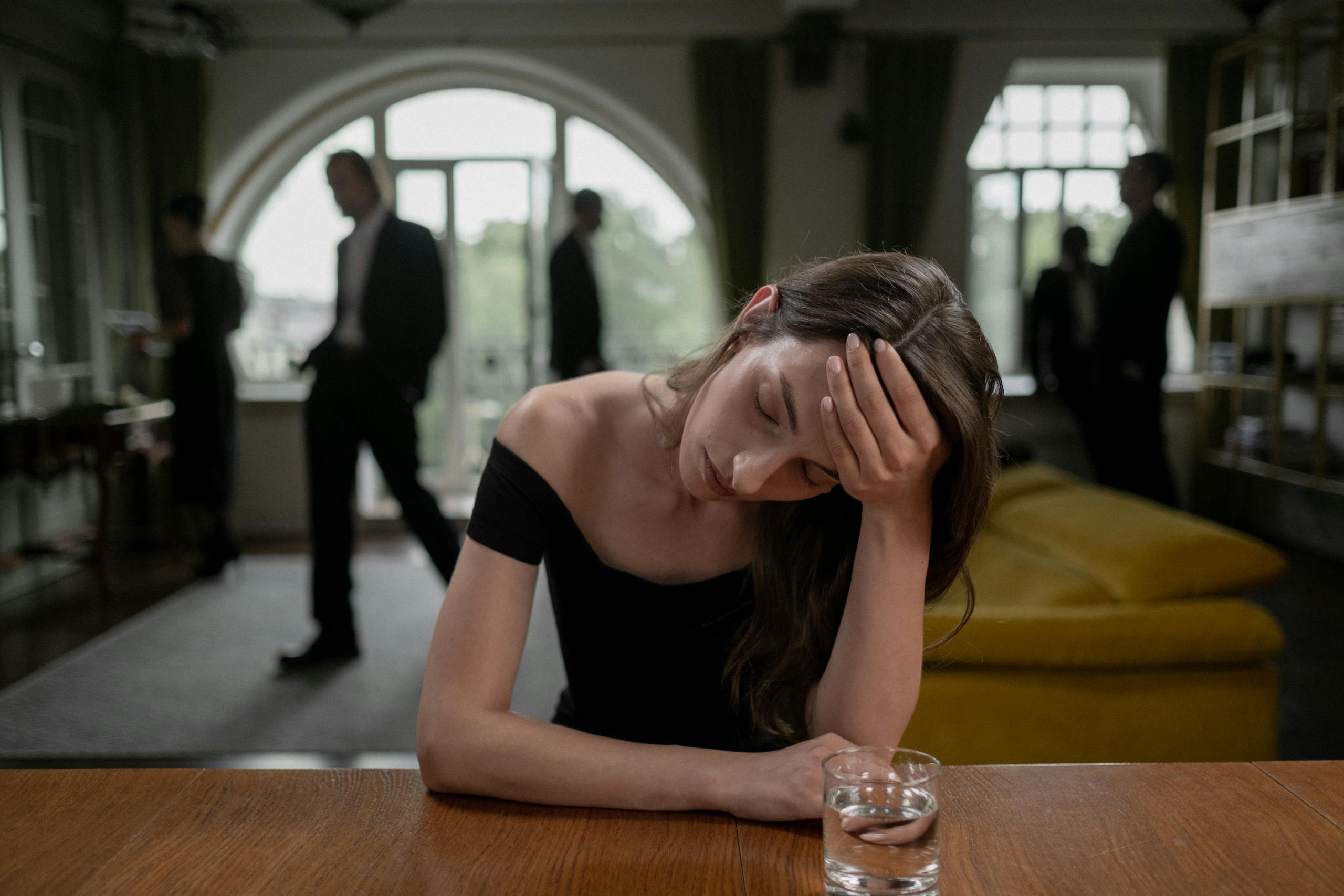
There’s a point where social media comparison stops being a mild discomfort and starts producing something closer to overwhelm. For highly sensitive people especially, the cumulative effect of repeated exposure to idealized content can tip into something that feels genuinely destabilizing.
Part of what makes this hard to recognize is that it doesn’t always feel dramatic. It can show up as a low-grade reluctance to share your own work. A subtle shrinking in professional conversations. A habit of qualifying everything you say with “I might be wrong, but…” or “This is probably obvious, but…” Those are the quieter symptoms of imposter syndrome doing its work, and they’re easy to rationalize as humility or caution rather than what they actually are.
The sensory and emotional weight of constant digital comparison is something I’ve come to think of as a specific kind of modern drain. It’s not loud. It accumulates. And for people who are already prone to sensory and emotional overwhelm, adding a daily scroll through other people’s curated successes is like adding weight to an already full pack.
There’s also the empathy dimension. Many introverts and highly sensitive people don’t just observe other people’s success, they feel something about it. Sometimes that’s genuine warmth and celebration. But when imposter syndrome is active, it can twist into something more complicated: a mix of admiration and inadequacy that’s hard to sit with cleanly. That empathy as a double-edged quality shows up in unexpected places, and social media is one of them.
Does Social Anxiety Make It Worse?
Social anxiety and imposter syndrome aren’t the same experience, but they do amplify each other in specific ways. Social anxiety involves a fear of negative evaluation, of being judged, found wanting, or embarrassed in social situations. Imposter syndrome involves the belief that you’re not actually as capable as others think you are. When both are present, social media becomes a particularly difficult environment.
The American Psychological Association notes that anxiety disorders involve persistent, excessive worry that interferes with daily functioning. Social anxiety specifically can make the ordinary act of posting something online feel fraught with risk. What if people can tell you don’t know what you’re talking about? What if you say something that reveals how out of your depth you are? Those questions, when they run underneath every potential interaction, make social media feel like a minefield rather than a tool.
For introverts who also experience social anxiety, the combination can produce a particular kind of paralysis: you don’t post because you’re afraid of being evaluated, and then you feel worse about yourself because everyone else seems to be posting confidently. The silence you chose for self-protection ends up becoming evidence, in your own mind, that you don’t belong.
The Harvard Medical School’s guidance on social anxiety emphasizes that avoidance tends to reinforce the underlying fear rather than relieve it. That’s worth sitting with in the context of social media. Avoiding the platforms entirely can feel like relief in the short term, but it doesn’t address the underlying belief that you’re somehow less than the people you’d see there.
The Rejection Sensitivity Layer
Social media has a feedback mechanism built into it: likes, comments, shares, reactions. That feedback loop is designed to be engaging, but for someone who already struggles with imposter syndrome, it introduces a very specific kind of vulnerability.
When you do work up the courage to post something, and it doesn’t land the way you hoped, the silence can feel like confirmation of your worst fears. Not enough people responded. The people who did respond were just being polite. The post that got less engagement than someone else’s similar post is proof that they’re better at this than you are. None of that logic holds up under scrutiny, but imposter syndrome doesn’t operate through scrutiny. It operates through feeling.
For highly sensitive people, the sting of perceived rejection in digital spaces can be surprisingly sharp and surprisingly lasting. The work of processing and healing from rejection is something many sensitive introverts have to do more consciously than others, and social media creates frequent low-grade opportunities for that wound to get activated.
I’ve watched this play out with people I’ve mentored. Someone shares a piece of work they’re genuinely proud of, it gets modest engagement, and they go quiet for weeks. Not because the work wasn’t good. Because the response didn’t match the internal risk it felt like to share it, and that gap felt like rejection. The platform didn’t cause the sensitivity, but it provided the trigger.

What the Research Actually Tells Us
The relationship between social media use and psychological wellbeing has been studied from several angles. A study published in PubMed Central examined how social comparison on digital platforms connects to self-evaluation and found that passive consumption, scrolling without engaging, tends to produce more negative self-comparison than active participation. That distinction matters. The habit of watching without contributing may actually be harder on your sense of self than the discomfort of putting something out there.
Additional work reviewed in another PubMed Central publication explored how social comparison processes intersect with anxiety and self-perception, particularly in environments where upward comparison (measuring yourself against people who appear to be doing better) is the default mode. The finding that stood out to me: the more someone believes others’ social media presentations are authentic and unfiltered, the more damaging the comparison tends to be.
That’s a useful reframe. Not because it makes the feeling go away, but because it gives you something concrete to work with. The person whose LinkedIn presence looks effortless is almost certainly not effortless. They’ve crafted a presentation, consciously or not, that emphasizes their strengths and edits out their uncertainty. You’re not seeing them. You’re seeing what they’ve chosen to show.
Anxiety, which often travels alongside imposter syndrome, has its own relationship with social media that’s worth understanding. The American Psychological Association’s work on shyness and social discomfort points to how perceived social evaluation, even in digital spaces, can activate the same threat responses as in-person scrutiny. Your nervous system doesn’t always distinguish between being watched in a conference room and being potentially watched by hundreds of people online.
What Actually Helps (And What Doesn’t)
A lot of advice about imposter syndrome lands in the territory of “just remember you’re good enough.” That’s well-intentioned and largely useless. Imposter syndrome isn’t a knowledge problem. You can know intellectually that your credentials are solid and still feel, in your gut, like a fraud. Telling yourself you’re competent doesn’t reliably reach the part of your brain that’s generating the feeling.
What does tend to help is changing your relationship with the comparison itself, rather than trying to eliminate the feeling through willpower or positive self-talk.
One thing that shifted things for me was getting deliberate about what I was actually doing when I opened social media. Was I there to connect with someone specific? To share something I’d made? To stay current on industry conversations? Or was I just scrolling, which almost always meant comparing? When I started being honest about that distinction, I started making different choices. Not perfect choices. But more intentional ones.
Another thing that helped was talking to people I trusted about the feeling itself. Not fishing for reassurance, but actually naming it. “I saw someone’s work this week and it sent me into a spiral about whether I know what I’m doing.” That kind of honesty, with the right person, tends to surface two things: that they’ve felt it too, and that the spiral wasn’t telling you the truth about your competence.
For highly sensitive people, managing the anxiety that social media comparison triggers often requires addressing the physiological dimension, not just the cognitive one. When comparison tips into genuine anxiety, the body is involved. The strategies for managing HSP anxiety that work in other contexts apply here too, including recognizing when you’re dysregulated and giving yourself permission to step away before the spiral deepens.
There’s also something to be said for understanding what kind of thinker and processor you are, and building your relationship with social media around that rather than against it. Carl Jung’s work on psychological types, which forms the foundation of frameworks like MBTI, offers a useful lens here. A Psychology Today exploration of Jungian typology touches on how different personality orientations relate to external validation and internal authority. For introverts, whose sense of value tends to be internally referenced rather than externally confirmed, social media’s feedback mechanisms can feel fundamentally misaligned with how we actually work.
That’s not a reason to avoid the platforms entirely. It’s a reason to be clear-eyed about what you’re using them for and what you’re getting from them, versus what they’re quietly taking from you.

Building a Healthier Relationship With Your Own Competence
Imposter syndrome, at its root, is a problem of misattribution. You’re attributing your success to luck, timing, or other people’s generosity, rather than to your own skill and effort. Social media makes that misattribution easier by constantly showing you people who appear to have succeeded without any of the uncertainty you feel. They seem to know exactly what they’re doing. You don’t always feel that way. So clearly, you’re the outlier.
Except you’re not. You’re just seeing their output without their process. You’re seeing their confidence without their doubt. And if they were watching your feed, they’d be doing the same thing in reverse.
One of the most useful things I ever did was start keeping a record of specific wins, not for anyone else’s consumption, but for my own. Not a brag file, but a reference document. Things I’d figured out, problems I’d solved, moments where my judgment had been right when others were uncertain. Not because I needed to prove anything to anyone, but because imposter syndrome has a very selective memory. It remembers every stumble and conveniently forgets every success. Having a written record gave me something to push back with when the feeling got loud.
It’s also worth sitting with the fact that depth of processing, the very quality that makes social media comparison feel so heavy, is also what makes you genuinely good at things that require careful thought. The introvert who feels like a fraud because they don’t project confidence the way extroverts do is often the same person whose work holds up longest under scrutiny, whose judgment is most reliable under pressure, whose relationships are built on something more durable than performance. Those aren’t small things. They’re worth claiming.
If you want to go deeper on the mental health dimensions of what we’ve covered here, our Introvert Mental Health Hub brings together the full range of these conversations in one place, from anxiety and emotional processing to perfectionism and sensitivity.
About the Author
Keith Lacy is an introvert who’s learned to embrace his true self later in life. After 20 years in advertising and marketing leadership, including running agencies and managing Fortune 500 accounts, Keith now channels his experience into helping fellow introverts understand their strengths and build fulfilling careers. As an INTJ, he brings analytical depth and authentic perspective to every article, drawing from both professional expertise and personal growth.
Frequently Asked Questions
Does social media actually cause imposter syndrome, or does it just make existing feelings worse?
Social media doesn’t generate imposter syndrome from scratch, but it reliably intensifies it. The underlying patterns, attributing success to luck, feeling undeserving of your position, fearing exposure as a fraud, tend to exist before someone ever opens an app. What social media does is provide a constant stream of curated achievement that activates those patterns more frequently and more intensely than most offline environments would. For people already prone to deep self-comparison, that daily exposure can make imposter syndrome feel like a permanent state rather than an occasional visitor.
Are introverts more likely to experience imposter syndrome than extroverts?
There’s no definitive evidence that introversion alone predicts imposter syndrome. What does seem to matter is how someone processes self-evaluation and external feedback. Introverts tend to hold their sense of competence internally and are less likely to seek or perform external validation, which can make the gap between private doubt and public presentation feel wider. When social media rewards visible confidence and frequent self-promotion, introverts who don’t naturally operate that way may read their own quietness as inadequacy rather than a different, equally valid style.
What’s the difference between imposter syndrome and low self-esteem?
Low self-esteem is a general sense of not being valuable or worthy. Imposter syndrome is more specific: it’s the belief that your competence in a particular area is being overestimated by others, and that at some point they’ll realize it. Someone with imposter syndrome can have strong self-esteem in many areas of life while still feeling like a fraud in their professional role. That specificity is part of what makes it confusing. You can be confident as a person and still feel completely unconvincing as a leader, writer, or expert in your field.
Should introverts just avoid social media to protect their mental health?
Avoidance tends to reinforce the underlying problem rather than resolve it. Stepping away from social media for a defined period can provide genuine relief and perspective, but permanently avoiding platforms because they trigger comparison doesn’t address what’s driving the comparison. A more sustainable approach involves getting deliberate about how you use social media: what you’re there for, how long you stay, and whether you’re engaging actively or just passively consuming. Passive scrolling, watching without participating, tends to produce more negative self-comparison than purposeful, time-limited engagement.
Can highly sensitive people be especially affected by social media and imposter syndrome together?
Yes, and the mechanism is fairly specific. Highly sensitive people process emotional and sensory information more deeply than average, which means the impressions formed from social media don’t fade quickly. A single post that triggers comparison can stay active in the mind for days. When that combines with imposter syndrome’s tendency to interpret ambiguous evidence as proof of inadequacy, the cumulative effect can be significant. HSPs also tend to feel the sting of perceived rejection, including low engagement on their own posts, more sharply and for longer. Recognizing that sensitivity as a trait rather than a flaw is often the first step toward managing its interaction with digital environments more effectively.