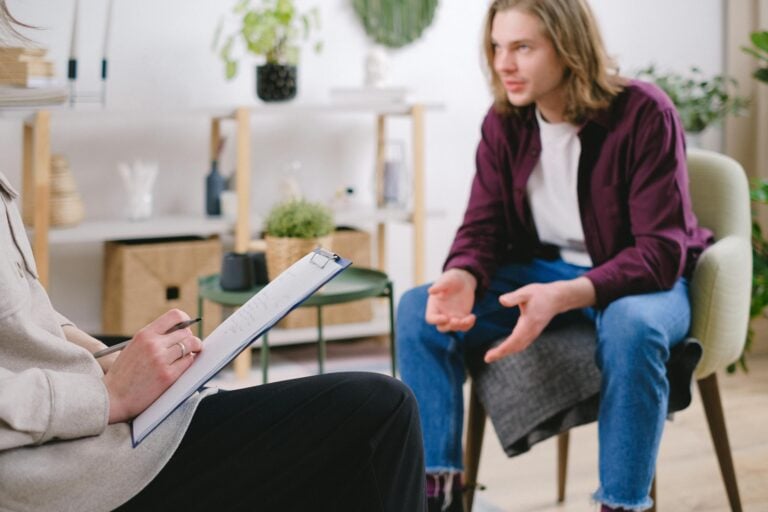

Body language walking behind someone communicates far more than most people realize. The distance you maintain, the pace you set, and even the angle of your posture all send signals that others pick up on, often without consciously registering why they feel comfortable or uneasy around you.
As an INTJ who spent decades in advertising boardrooms watching human behavior play out in real time, I became quietly fascinated by what happens in the spaces between words. The hallway after a difficult meeting. The walk from the parking garage to the client’s lobby. The moment someone falls into step behind a colleague and the whole dynamic shifts before anyone speaks a single word.
Most of us were never taught to read these cues deliberately. We absorbed them, imperfectly, from experience. And for introverts especially, whose internal processing tends to run several layers deep, understanding what our physical presence communicates can be genuinely freeing.

If you want to go deeper on how social signals, nonverbal communication, and introvert-specific behavior intersect, our Introvert Social Skills and Human Behavior hub covers the full terrain of how introverts read and respond to the social world around them.
What Does Body Language Walking Behind Someone Actually Signal?
Proximity is power. Or at least, that’s how it’s often interpreted. When you walk closely behind someone, particularly in a professional setting, you’re entering a zone of physical presence that carries weight regardless of your intentions.
The American Psychological Association has long documented how personality traits shape interpersonal behavior, and introversion in particular tends to correlate with heightened sensitivity to spatial dynamics. Many introverts instinctively maintain more physical distance from others, not out of coldness, but because their nervous systems process proximity differently.
There are several distinct signals that body language while walking behind someone can communicate, depending on context:
Respect and deference. Walking at a comfortable distance, slightly behind and to the side, often reads as respectful. You’re not crowding. You’re not rushing. You’re giving the person in front space to lead, which in many professional and cultural contexts signals that you recognize their authority or comfort.
Dominance or pressure. Walking closely behind someone, especially in a narrow corridor or when they have nowhere to step aside, creates a subtle pressure. It can feel like pursuit even when that’s not the intent. I noticed this firsthand during agency pitches when a pushy vendor would follow too closely through our open-plan office. Nobody said anything, but the discomfort was palpable in the room.
Disengagement or avoidance. Lagging far behind, looking at your phone, or angling your body away while walking behind someone signals that you’d rather not be in this interaction at all. Sometimes that’s honest. Other times it reads as passive hostility, even when it’s simply introvert recharging in motion.
Attentiveness and interest. Matching pace, keeping a natural distance, and orienting your body slightly toward the person you’re following signals engagement. You’re present. You’re tracking the conversation or the moment. This is the body language of someone who’s genuinely paying attention.
Why Introverts Often Struggle With the Unspoken Rules of Physical Space
There’s a particular challenge that many introverts face, and it took me years to name it clearly. We tend to be acutely aware of our own internal experience, but we don’t always translate that awareness outward into how we’re physically presenting ourselves to others.
I can remember walking behind a senior client after a tense quarterly review, lost so completely in my own analysis of what had just happened in the meeting room that I had no idea how I was moving through the hallway. My posture was probably closed. My pace was probably uneven. I was physically present but mentally three rooms back.
That kind of internal absorption is genuinely one of our strengths. But it can send confusing signals to the people around us. The client later mentioned to my account director that I seemed “distracted” after the meeting. I wasn’t distracted. I was processing deeply. But my body hadn’t communicated that distinction.
For introverts who want to work on exactly this kind of gap, the resources on how to improve social skills as an introvert offer practical starting points that don’t require you to become someone you’re not.
Part of what makes nonverbal communication so tricky is that it operates beneath the level of conscious conversation. Research published through PubMed Central has explored how nonverbal cues form a significant portion of the emotional information we exchange with others, often more than we consciously intend to send or receive. For introverts who are already managing a rich internal world, adding a deliberate layer of physical self-awareness can feel like a lot.
But it doesn’t have to be exhausting. It can actually become something you find interesting, the way a good puzzle is interesting.
How Personality Type Shapes the Way We Move Through Space
Not everyone experiences walking behind someone the same way, and personality type plays a more significant role in this than most people acknowledge.
As an INTJ, my natural tendency is to observe before I act. I’m not going to close the gap between myself and someone else unless I’ve assessed the situation and determined it makes sense. That deliberateness can read as standoffish to someone who’s more spontaneous or expressive in their physical presence. If you haven’t figured out your own type yet, taking our free MBTI personality test can give you a clearer picture of how your wiring shapes the way you show up in social spaces, including the ones between words.
I once managed a creative director on my team who was an ENFP. She moved through the office like she owned the airspace around her, closing distances, touching shoulders, falling into step beside people with the ease of someone who’d never considered that physical proximity might be complicated. Watching her, I was struck by how effortless it seemed. For her, it was effortless. Her type is wired to connect through presence.
Contrast that with an INFJ account planner I worked with for years. He was perceptive in ways that sometimes unsettled people. He’d walk behind a client and somehow already know, from the tension in their shoulders or the pace of their steps, exactly what kind of conversation we were about to have. His body language was careful, measured, almost ceremonial in its precision. Clients trusted him deeply, and I think part of that trust was built in these small, unspoken moments.
According to Psychology Today’s coverage of introvert strengths in leadership, introverts often bring a quality of attentiveness to interpersonal dynamics that extroverts can overlook. That attentiveness, when applied to physical presence, becomes a genuine social asset.
The Specific Signals Hidden in Your Pace, Distance, and Posture
Let’s get specific, because this is where the real value lives. Body language while walking behind someone breaks down into three primary channels: pace, distance, and posture. Each one sends distinct information.
Pace: Are You Chasing or Flowing?
Matching someone’s walking pace is one of the most powerful and underused rapport-building tools available to us. When you naturally fall into sync with another person’s rhythm, it signals attunement. You’re not rushing them. You’re not dragging behind. You’re present with them in the same moment.
Mismatched pace creates friction. Walking significantly faster than the person in front of you creates pressure, even if you’re not consciously trying to overtake them. Walking significantly slower signals disinterest or reluctance. Neither is a neutral message.
In my agency days, I used to watch how our business development team moved through client offices during tours. The ones who naturally paced themselves to match the client’s stride tended to close more business. I don’t think that was coincidental. Pace synchrony communicates something that no amount of polished pitch language can replicate.
Distance: The Invisible Boundary Everyone Feels
Most people have an intuitive sense of personal space, even if they’ve never thought about it formally. Edward Hall’s concept of proxemics, which maps the zones of physical distance humans maintain in different relationship contexts, gives us a useful framework here.
Social distance, roughly four to twelve feet, is the comfortable range for professional interactions. Intimate distance, under eighteen inches, is reserved for close relationships. Walking behind someone at intimate distance in a professional context triggers an instinctive alarm, even if the person can’t articulate why they feel uneasy.
For introverts, maintaining appropriate distance often comes naturally. We tend to respect others’ space because we’re acutely aware of how much we value our own. Harvard Health’s guidance on introvert social engagement notes that introverts often prefer meaningful connection over constant proximity, which maps directly onto how they manage physical space in social settings.
Posture: What Your Spine Is Saying Without Permission
Posture while walking behind someone communicates confidence, deference, tension, or openness, often before a single word is exchanged. Rounded shoulders and a forward head position can read as submissive or anxious. An upright spine with relaxed shoulders signals calm confidence.
There’s also the question of where your gaze is directed. Looking at the back of someone’s head while walking behind them creates a subtle intensity that can feel like surveillance. Letting your gaze rest naturally, slightly ahead or to the side, communicates ease.
I had to learn this deliberately. As an INTJ, my default walking posture when I’m thinking is head slightly down, gaze internal, pace purposeful. It reads as unapproachable to people who don’t know me well. A mentor pointed this out during a conference years ago, and it was one of those moments where I had to reconcile the gap between my internal experience and my external presentation.

What Happens When You Overthink Every Step You Take
Here’s where I want to be honest about a real risk. For many introverts, and especially for those of us who are already prone to self-monitoring, learning about body language can tip over into a new source of anxiety. Suddenly every step feels observed. Every posture choice feels loaded with meaning.
That’s not the goal. Awareness is meant to free you, not trap you in a new layer of self-consciousness.
If you find that reading about nonverbal cues sends you spiraling into analysis of your own behavior, that’s worth paying attention to. The kind of rumination that turns self-awareness into self-surveillance is a pattern worth addressing directly. Exploring overthinking therapy approaches can help you build the kind of grounded awareness that informs rather than paralyzes.
The goal is embodied presence, not performance. You want to be genuinely attentive to the physical signals you’re sending, not choreographing every movement with anxious precision. There’s a meaningful difference between those two states, and most people can feel it in you even when they can’t name it.
One practice that’s helped me find that balance is building a more consistent self-awareness practice outside of high-stakes social situations. Meditation and self-awareness work together in ways that are genuinely useful here, not because meditation makes you more performatively calm, but because it trains you to notice your own physical state without immediately reacting to it.
Cultural Context Changes Everything About These Signals
One thing that often gets overlooked in body language discussions is how profoundly cultural context shapes the meaning of physical behavior. What reads as respectful distance in one culture reads as cold disengagement in another. What signals confident presence in one professional context signals aggression in another.
During my agency years, we worked with clients across multiple continents. I learned quickly that the body language rules I’d absorbed growing up in the American professional world didn’t always translate. A Japanese client’s deference in physical space was not the same as disinterest. A Brazilian client’s closer physical proximity was not the same as aggression. Both required me to recalibrate my interpretations.
The PubMed Central literature on interpersonal communication reflects this complexity, noting that nonverbal signals are deeply embedded in cultural norms and cannot be reliably decoded without that context.
For introverts who are already doing a lot of internal processing during social interactions, adding cultural calibration to the mix can feel overwhelming. My honest advice is to start with curiosity rather than certainty. Observe more. Conclude less. Ask questions when you have the relationship to do so. Your natural introvert tendency toward observation is actually well-suited to this kind of cross-cultural reading, as long as you hold your interpretations lightly.
Reading the Body Language of Someone Walking Behind You
The other side of this equation matters just as much. What can you read from someone who’s walking behind you? And how do you process that information without either ignoring it completely or catastrophizing it?
Many introverts are highly attuned to the physical presence of others, sometimes to a degree that feels overwhelming. You can sense when someone is walking too closely before you’ve consciously registered why you feel tense. You can feel the energy of someone who’s distracted or someone who’s intensely focused on you, even from behind.
That sensitivity is real and worth trusting. Healthline’s coverage of introversion and social anxiety makes an important distinction between the heightened social awareness many introverts experience and clinical anxiety, noting that sensitivity to social cues is not inherently problematic, even when it feels intense.
What you’re picking up from someone walking behind you is real data. The question is how to interpret it accurately without projecting meaning onto ambiguous signals. Someone walking closely behind you in a crowded conference center is probably just handling the crowd. Someone doing the same in an empty hallway is sending a different message.
Context, always context.

Using Body Language Awareness to Build Genuine Connection
None of this knowledge is worth much if it stays purely analytical. The point of understanding body language while walking behind someone isn’t to become a more effective manipulator of social situations. It’s to become a more genuinely present and connected person in the spaces you already inhabit.
For introverts, that’s actually a natural fit. We tend to prefer depth over breadth in our connections. We’d rather have one real conversation than ten surface interactions. Learning to use our physical presence more intentionally is one way of honoring that preference, of showing up in our bodies as fully as we already show up in our minds.
One area where this translates directly is conversation. The transition from walking behind someone to walking beside them, or stopping to face them, is itself a body language signal. It says: I want to engage with you as an equal in this moment. Knowing how to make that shift naturally, and when to make it, is part of being a better conversationalist as an introvert. The conversation often starts before the words do.
I’ve also found that emotional intelligence plays a significant role in how effectively we read and use these nonverbal signals. The more attuned you are to your own emotional state, the more accurately you can interpret what you’re picking up from others. If you’re curious about developing this capacity more formally, the work of an emotional intelligence speaker can offer frameworks that make these instincts more deliberate and applicable.
And for those who’ve experienced relational ruptures, betrayal, or situations that have made physical trust feel complicated, it’s worth acknowledging that body language awareness doesn’t exist in an emotional vacuum. If you’re carrying wounds that make social proximity feel fraught, addressing those wounds directly matters. Patterns of hypervigilance around physical space often have emotional roots, and resources on how to stop overthinking after being cheated on speak to exactly that kind of emotional residue and how to work through it.
Practical Ways to Become More Intentional About Your Physical Presence
Awareness without application doesn’t move the needle. Here are the shifts that have actually made a difference for me and for introverts I’ve worked alongside over the years.
Anchor to your breath before entering a social space. Taking two or three deliberate breaths before walking into a meeting, a conference, or any situation where you’ll be moving through space with others helps settle your nervous system. A settled nervous system produces more natural, less contracted body language.
Practice pace-matching in low-stakes situations. When you’re walking behind a stranger in a grocery store or a colleague in a hallway, notice whether you’re naturally matching their pace or fighting it. You don’t have to do anything with that observation at first. Just notice.
Use the “two arm lengths” rule as a starting default. When you’re unsure how close is appropriate in a professional walking context, roughly two arm lengths behind and slightly to the side tends to read as respectful and engaged without being intrusive. Adjust based on the specific relationship and cultural context.
Lift your gaze. This is the single most impactful physical adjustment I’ve made over the years. When I’m processing internally, my gaze drops. When I consciously lift it to the horizon or to the person I’m with, my entire posture changes. I become more present in my body, and others register that presence.
Notice what you’re broadcasting, not just receiving. Introverts are often excellent at reading others and less practiced at tracking what we ourselves are putting out. Periodically check in with your own physical state during social interactions. Are your shoulders up around your ears? Is your jaw clenched? Are you walking like someone who wants to be invisible? These are all signals with consequences.
Peer-reviewed research on nonverbal communication and social perception consistently supports the idea that physical self-awareness, when practiced without excessive self-criticism, genuinely improves interpersonal outcomes. The key word there is “without excessive self-criticism.” Be curious about your body language. Don’t prosecute yourself over it.
And if you’re an introvert who’s wondering whether any of this matters given that you’d often prefer not to be in these social situations at all, I’d gently push back. You’re already in these situations. You’re already sending signals. Becoming more intentional about those signals doesn’t require you to enjoy crowds or small talk. It just means showing up more fully as yourself in the spaces you already occupy.
That’s not a performance. That’s presence.

There’s much more to explore about how introverts read, respond to, and shape the social environments around them. Our complete Introvert Social Skills and Human Behavior hub brings together the full range of these topics in one place, from nonverbal communication to conversation skills to the deeper psychology of how introverts connect.
About the Author
Keith Lacy is an introvert who’s learned to embrace his true self later in life. After 20 years in advertising and marketing leadership, including running agencies and managing Fortune 500 accounts, Keith now channels his experience into helping fellow introverts understand their strengths and build fulfilling careers. As an INTJ, he brings analytical depth and authentic perspective to every article, drawing from both professional expertise and personal growth.
Frequently Asked Questions
What does it mean when someone walks closely behind you?
When someone walks closely behind you, it can signal urgency, dominance, or simply a lack of spatial awareness depending on the context. In professional settings, tight proximity often creates subtle pressure and can feel intrusive even when unintentional. Cultural norms, relationship dynamics, and the specific environment all shape how close proximity should be interpreted. Trusting your instinctive response to that closeness is usually a reliable starting point.
How does body language change when walking behind someone in a professional setting?
In professional settings, body language while walking behind someone carries particular weight because it’s observed by colleagues, clients, and leadership alike. Maintaining appropriate distance, matching pace naturally, and keeping an upright posture signal respect and engagement. Lagging far behind or crowding too closely both send messages that can undermine professional relationships, even when the behavior is unconscious rather than intentional.
Are introverts more sensitive to personal space when someone walks behind them?
Many introverts do report heightened sensitivity to physical proximity, including when someone is walking behind them. This sensitivity is often connected to the deeper internal processing that characterizes introversion, where external stimuli, including physical presence, register more intensely. This isn’t a flaw. It’s useful data, as long as it’s interpreted with appropriate context rather than immediately assumed to be threatening or hostile.
What body language signals show respect when walking behind someone?
Respectful body language while walking behind someone includes maintaining a comfortable distance of roughly two arm lengths, matching the other person’s pace rather than rushing or lagging, keeping your posture open and upright, and directing your gaze naturally rather than intensely at the back of their head. These signals collectively communicate that you’re present and attentive without being intrusive or pressuring.
Can your walking body language reveal your personality type?
Walking body language does tend to reflect underlying personality patterns, though it’s never a perfect one-to-one map. Introverts often maintain more physical distance and move with more deliberate, contained energy. Extroverts may close distances more readily and move with more expansive gestures. MBTI type influences these tendencies, but individual history, cultural background, and situational context all shape how those tendencies express themselves in any given moment.