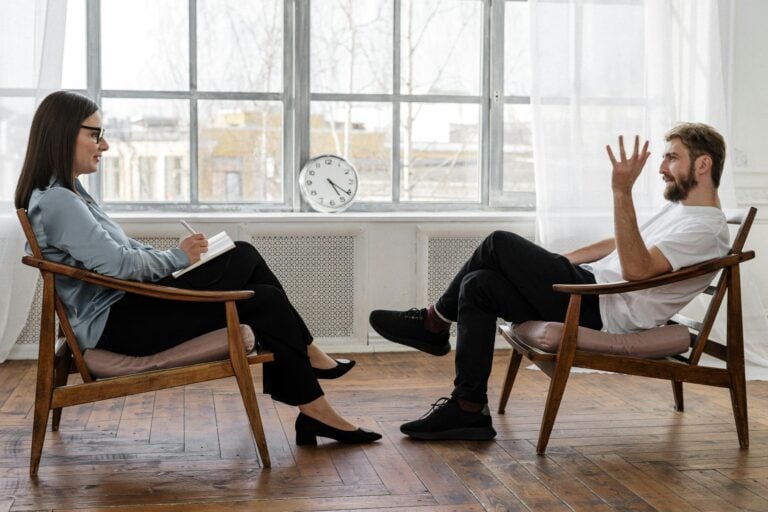

Couples meditation is a shared mindfulness practice where two partners sit together in intentional silence or guided awareness, using breath, presence, and focused attention to deepen emotional connection. For introverts, it offers something rare in most relationship advice: a path toward intimacy that doesn’t require constant talking, social performance, or emotional excavation on demand.
My wife and I stumbled into couples meditation almost by accident. We weren’t in crisis. We weren’t following a therapist’s recommendation. We were just two people who had spent twenty years building busy lives, and one evening we sat down on the back porch with no agenda and realized we’d forgotten how to simply be together without filling the silence. That quiet moment changed something between us, and I’ve been thinking about why ever since.

Much of what gets written about romantic connection assumes that closeness comes through conversation, disclosure, and shared activity. And yes, those things matter. But introverts often experience intimacy differently, processing emotion inward before expressing it outward, finding depth in stillness rather than stimulation. If you’re curious how introverts approach love and attraction more broadly, the Introvert Dating and Attraction hub covers the full landscape, from first connections to long-term partnership. Couples meditation fits squarely into that picture.
Why Do Introverts Struggle With Traditional Relationship Advice?
Most relationship guidance is written with extroverts in mind, or at least with an extroverted model of connection as the default. Talk more. Share more. Plan date nights that involve crowds, activities, and constant engagement. Be spontaneous. Be expressive. Open up.
For someone wired the way I am, that advice lands with a particular kind of exhaustion. Not because I don’t love my partner. Not because I’m emotionally unavailable. But because the extroverted model of intimacy treats silence as a problem to solve, and for introverts, silence is often where the real connection lives.
During my agency years, I sat through hundreds of client dinners and team celebrations that were supposed to build relationships. The noise, the performance, the relentless socializing. I watched extroverted colleagues thrive in those settings while I counted the minutes until I could think clearly again. What I noticed, though, was that my deepest professional relationships formed in quieter moments: a one-on-one debrief after a tough presentation, a long drive to a client meeting where we talked without an audience. Presence without performance. That’s what I was always looking for.
Couples meditation operates on the same principle. It creates presence without performance. No one has to be entertaining or articulate or emotionally ready to process something difficult. You simply show up, sit down, and share the same air for a while.
Understanding how introverts fall in love and the relationship patterns that emerge helps explain why this matters so much. Introverts don’t warm up quickly. They test the waters carefully, build trust through repeated small moments of safety, and often feel most connected during low-stimulation experiences. Meditation, in its quietest form, is exactly that kind of experience.
What Actually Happens During Couples Meditation?
There’s a version of couples meditation that looks like a yoga studio advertisement: two people in matching linen, sitting lotus-style on a pristine white rug, looking serene. That’s not what most people experience, and it’s not what makes the practice valuable.
What actually happens is messier and more interesting. One person fidgets. Someone’s knee hurts. A thought about a work email surfaces and refuses to leave. The dog walks through the room. And yet, despite all of that, something shifts when two people commit to sitting in the same space with the same intention.

Couples meditation can take several forms. Synchronized breathing, where both partners match their inhale and exhale rhythms, creates a physical sense of attunement that bypasses the need for words. Loving-kindness meditation, where each partner silently directs warmth and compassion toward the other, builds emotional generosity in a way that feels sustainable rather than forced. Simple side-by-side silent sitting, with no guided audio and no agenda, can be surprisingly powerful for introverts who already know how to inhabit their inner world comfortably.
The science behind why shared contemplative practice affects relationships is genuinely interesting. Physiological synchrony, the phenomenon where people’s heart rates and breathing patterns align during shared experiences, has been observed in a range of contexts. A body of research published through PubMed Central has examined how shared physiological states influence emotional bonding and relational satisfaction. Couples who breathe together, even briefly, tend to feel more connected afterward. That’s not mystical. It’s biology.
Additional work on mindfulness and relationship quality, available through PubMed Central, points toward a consistent pattern: people who practice mindfulness regularly tend to respond to their partners with greater patience, less reactivity, and more emotional attunement. When two partners practice together, those effects compound.
How Does Couples Meditation Serve Introvert-Specific Needs?
Introverts often carry a particular tension in relationships. On one side, a genuine desire for deep connection. On the other, a real need for solitude and internal processing time. These two things can feel like they’re pulling in opposite directions, and partners who don’t understand introversion sometimes interpret the need for quiet as withdrawal or disinterest.
Couples meditation addresses that tension directly. It creates a shared experience that doesn’t drain introvert energy reserves. It honors the need for internal processing while still building togetherness. And it communicates something important to a partner: I want to be with you, and I want to be with you in a way that doesn’t cost me everything.
I managed a creative director at my agency for several years who was in a relationship with a highly extroverted partner. She’d come in on Monday mornings visibly depleted after weekends full of social plans she’d agreed to out of love and guilt. What she needed wasn’t a better social calendar. She needed a shared language with her partner for what connection could look like on her terms. Couples meditation, when she eventually tried it, gave her that language. Not because it solved everything, but because it created a ritual that was genuinely hers as much as it was theirs.
The way introverts express and receive love is worth understanding in this context. How introverts show affection through their love language often involves quality presence over quantity of interaction, which is exactly what a regular meditation practice provides. Showing up, sitting down, being there, fully, without distraction or agenda, is a profound act of love for someone who processes the world from the inside out.

What Does Couples Meditation Look Like When Both Partners Are Introverts?
Two introverts in a relationship share certain advantages: a mutual appreciation for quiet, a lower threshold for overstimulation, and a shared understanding that not every silence needs to be filled. They also share certain blind spots, particularly around emotional expression and conflict avoidance.
When both partners are introverts, couples meditation can become almost too easy to retreat into as a substitute for the harder conversations that still need to happen. Sitting in comfortable silence together is wonderful. Sitting in comfortable silence to avoid addressing something uncomfortable is a different thing entirely.
The dynamics of two introverts falling in love and the relationship patterns that develop are nuanced in this way. There’s a warmth and ease that comes from being with someone who doesn’t require constant performance. There’s also a risk of two people retreating so deeply into their own inner worlds that the relationship itself becomes a parallel experience rather than a shared one.
Couples meditation, practiced with intention, can be a bridge between those two poles. The key, if I can use that word carefully, is to follow the silence with at least a brief moment of verbal connection. Not a full emotional processing session. Just a few words. How are you feeling? What came up for you? Even a simple “that was good” creates a thread between inner experience and shared reality.
16Personalities has written thoughtfully about the hidden dynamics of introvert-introvert relationships, including the tendency to mistake comfortable coexistence for genuine intimacy. Couples meditation, done well, pushes gently against that tendency by creating a shared moment that’s intentional rather than incidental.
How Should Highly Sensitive Partners Approach Shared Meditation?
Highly sensitive people bring a particular quality to any shared practice. Their nervous systems register more, process more deeply, and respond more intensely to both positive and negative stimuli. In meditation, this can be a genuine gift: HSPs often drop into a state of presence more readily than others, and their capacity for empathy can make synchronized breathing feel profoundly connecting.
It can also create challenges. An HSP partner may absorb the emotional state of their partner during meditation in ways that feel overwhelming rather than intimate. If one partner is carrying anxiety or tension, the HSP may find themselves holding that energy long after the session ends.
I’ve observed this pattern in people I’ve worked with over the years. One account manager on my team was clearly highly sensitive, though neither of us had that language at the time. She’d walk into a room and immediately register every interpersonal tension in it. After a difficult client call, she’d need an hour to decompress from emotions that weren’t even hers. In a couples meditation context, that same sensitivity would need to be honored rather than ignored.
If you or your partner identifies as an HSP, this complete guide to HSP relationships and dating offers a fuller picture of how high sensitivity shapes romantic connection. For meditation specifically, HSP partners may benefit from beginning with brief sessions, using a gentle guided audio rather than open silence, and building in a clear transition ritual afterward, perhaps a few minutes of journaling or a short walk, to help the nervous system land back in individual experience.
Conflict is another area where HSP sensitivity intersects with couples meditation in important ways. Handling conflict peacefully as an HSP often involves slowing the nervous system down before engaging with difficult content. A short couples meditation before a hard conversation can serve exactly that function, creating a physiological baseline of calm before emotion escalates.

How Do You Start a Couples Meditation Practice Without It Feeling Forced?
Almost every introvert I know has had the experience of someone suggesting a “bonding activity” that felt more like an obligation than an invitation. The suggestion of couples meditation can land the same way if it’s framed as a fix for something broken rather than an addition to something already good.
Starting small matters more than starting perfectly. Five minutes is enough. Sitting side by side on a couch, both with eyes closed, both breathing without talking, both agreeing to stay present for five minutes: that’s a complete couples meditation practice. It doesn’t require cushions, incense, or an app subscription.
Consistency matters more than duration. A five-minute practice that happens three times a week builds something more meaningful than a forty-minute session that happens once and then gets abandoned. Introverts tend to thrive with rituals, and a brief daily or near-daily meditation creates a rhythm that feels stabilizing rather than demanding.
Psychology Today’s exploration of the romantic introvert touches on something I’ve noticed in my own experience: introverts often express love through the creation of shared rituals rather than grand gestures. A consistent couples meditation practice is exactly that kind of ritual. It says, without words, that this time together is worth protecting.
One practical approach: attach the practice to something that already happens. Morning coffee. The transition from work to evening. The few minutes before sleep. Linking a new behavior to an existing anchor reduces the friction of starting and makes it more likely to stick.
For couples where one partner is more skeptical, framing matters. “Sitting quietly together for five minutes” is a much easier yes than “starting a meditation practice.” Same activity, different weight. Introverts, who are often sensitive to feeling pressured into emotional performance, respond better to low-stakes invitations than to earnest proposals.
What Role Does Emotional Processing Play in Couples Meditation?
One of the things I’ve come to appreciate about my own introversion is that my emotional processing happens on a delay. Something will occur, a difficult conversation, a moment of unexpected tenderness, a disappointment, and I won’t fully know how I feel about it until hours or days later, when I’ve had time to sit with it internally.
This is not emotional unavailability. It’s a different processing timeline. And it can create real friction in relationships with partners who process out loud and in real time, who need to talk through feelings as they’re happening rather than after they’ve been sorted.
Couples meditation creates a middle ground. It’s not immediate verbal processing. It’s not avoidance either. It’s a shared container where both partners can be present with whatever is in the room, emotionally speaking, without having to name it or resolve it on the spot.
Understanding how introverts experience and express love feelings is useful here. The internal richness of introvert emotional life is real and deep. It just doesn’t always surface quickly or in the forms that relationship culture tends to reward. Meditation gives that inner life room to exist without immediately being translated into conversation.
There’s also something worth naming about what happens after a couples meditation session. The state of calm attention that meditation produces tends to make subsequent conversations more grounded. I’ve noticed this in my own marriage: we talk differently after we’ve been quiet together. There’s less defensiveness, less urgency, more willingness to hear. That’s not a minor benefit. For introverts who sometimes dread the emotional intensity of relationship conversations, having a reliable way to lower that intensity before entering it is genuinely valuable.
Psychology Today’s guide to dating an introvert makes a point that resonates here: introverts need time to decompress before they can fully engage. Couples meditation serves that function while simultaneously creating connection rather than separation. It’s decompression that includes your partner rather than excluding them.
Can Couples Meditation Help With Introvert-Extrovert Relationship Tension?
One of the most common relationship dynamics I hear about from introverts involves the introvert-extrovert pairing. Two people who genuinely love each other but have fundamentally different energy needs, different ideas about what a good weekend looks like, and different thresholds for how much social engagement feels nourishing versus depleting.
The extroverted partner often interprets the introvert’s need for quiet as rejection. The introverted partner often interprets the extrovert’s need for activity as pressure. Both interpretations are understandable and both are usually wrong. Neither person is trying to hurt the other. They’re just running on different fuel.
Couples meditation can be a genuinely neutral meeting point. It doesn’t ask the extrovert to spend the whole weekend alone. It doesn’t ask the introvert to perform sociability. It asks both people to show up, sit down, and be present for a few minutes. That’s accessible for both temperaments, and it creates a shared experience that belongs to both of them equally.

In my agency, I worked with personality pairings across the full spectrum. Some of the most effective partnerships I observed were between introverted strategists and extroverted client leads, people who brought genuinely different strengths to the same table. What made those partnerships work wasn’t pretending the differences didn’t exist. It was finding practices and rhythms that honored both sides. Couples meditation does something similar in a relationship context.
Worth noting: extroverted partners who try couples meditation often report that they find it surprisingly meaningful. Many extroverts carry their own form of internal noise, social anxiety, performance pressure, the exhaustion of always being “on,” and stillness can be as restorative for them as it is for their introverted partners, just for different reasons. Healthline’s breakdown of common myths about introverts and extroverts is useful here: the introvert-extrovert distinction is about energy, not preference for quiet, and extroverts can benefit from contemplative practice just as genuinely as introverts can.
How Does Couples Meditation Connect to Broader Introvert Relationship Health?
Couples meditation isn’t a standalone fix. It’s one practice within a larger relationship ecosystem that, for introverts, needs to be built with some intentionality. Introverts often don’t naturally advocate for their own needs in relationships. They adapt, accommodate, and absorb until they’re depleted, and then they withdraw, which their partners experience as sudden and confusing.
Building a shared meditation practice is one way of creating a structural commitment to introvert-friendly connection. It’s a standing appointment with stillness. It signals to both partners that quiet togetherness has value and deserves protected time.
Paired with other introvert-aware relationship practices, like clear communication about energy needs, honoring solitude as a relational asset rather than a threat, and understanding each other’s emotional processing styles, couples meditation becomes part of a coherent approach to partnership rather than an isolated technique.
There’s also something worth saying about the long game. Relationships change over decades. The early intensity of romantic connection eventually settles into something quieter and more sustained. Introverts, in my observation, are often better suited to that later stage than they get credit for. The depth of feeling, the preference for substance over surface, the comfort with silence: those qualities become relationship assets over time. Couples meditation, practiced consistently, builds exactly the kind of connection that sustains across years rather than just months.
A useful companion resource for anyone thinking about this more broadly: this academic work from Loyola University Chicago examines the relationship between mindfulness practice and interpersonal functioning, offering a more formal lens on what many couples discover experientially: that shared attention changes the quality of connection.
My wife and I have been meditating together, imperfectly and inconsistently, for several years now. Some weeks we manage it daily. Some weeks life intervenes and it doesn’t happen at all. What I notice is that the weeks when we do sit together, even briefly, feel different from the weeks when we don’t. Not dramatically different. Subtly different, in the way that small consistent things accumulate into something you can feel but not quite point to. That’s the quality of change that couples meditation tends to produce. Not a dramatic shift, but a gradual deepening that you only notice when you look back.
There’s a lot more to explore about how introverts build and sustain meaningful romantic connections. Our complete Introvert Dating and Attraction hub covers everything from the early stages of attraction to the long-term rhythms of introvert partnership, and it’s a good place to go deeper on any of the threads this article has touched on.
About the Author
Keith Lacy is an introvert who’s learned to embrace his true self later in life. After 20 years in advertising and marketing leadership, including running agencies and managing Fortune 500 accounts, Keith now channels his experience into helping fellow introverts understand their strengths and build fulfilling careers. As an INTJ, he brings analytical depth and authentic perspective to every article, drawing from both professional expertise and personal growth.
Frequently Asked Questions
What is couples meditation and how does it work?
Couples meditation is a shared mindfulness practice where two partners sit together with a common intention, whether that’s synchronized breathing, loving-kindness practice, or simple silent presence. It works by creating a moment of shared physiological and emotional attunement, reducing reactivity and building a felt sense of connection that doesn’t depend on conversation or activity.
Is couples meditation specifically beneficial for introverts?
Yes, particularly so. Introverts often find that traditional relationship-building activities are energetically costly, requiring social performance and constant verbal engagement. Couples meditation offers a form of intimacy that aligns with introvert strengths: depth over breadth, presence over performance, and quiet connection over stimulation-based bonding. It allows introverts to be fully present with a partner without depleting their energy reserves.
How long should a couples meditation session be for beginners?
Five minutes is a completely sufficient starting point. The value of couples meditation comes from consistency and shared intention, not duration. Beginning with five minutes and building gradually as the practice feels more natural is far more effective than attempting long sessions that feel burdensome. Attaching the practice to an existing daily ritual, such as morning coffee or the transition into evening, helps it become a sustainable habit rather than an effortful obligation.
What if one partner is resistant to trying couples meditation?
Framing matters significantly here. Proposing “five minutes of sitting quietly together” tends to generate less resistance than proposing “a meditation practice.” Starting with a single, low-stakes invitation rather than a formal commitment removes pressure from the equation. It also helps to choose a moment when both partners are already calm and unhurried, rather than introducing the idea after a stressful day. Most resistant partners find that the experience itself is far less demanding than they anticipated.
Can couples meditation help with conflict in a relationship?
Yes, though not by replacing the need for honest conversation. A brief couples meditation before a difficult discussion creates a physiological baseline of calm that reduces emotional reactivity and defensiveness. For highly sensitive partners in particular, this pre-conversation grounding can make the difference between a productive exchange and an escalating argument. Meditation after conflict can also help both partners return to a state of connection once the immediate tension has been addressed.