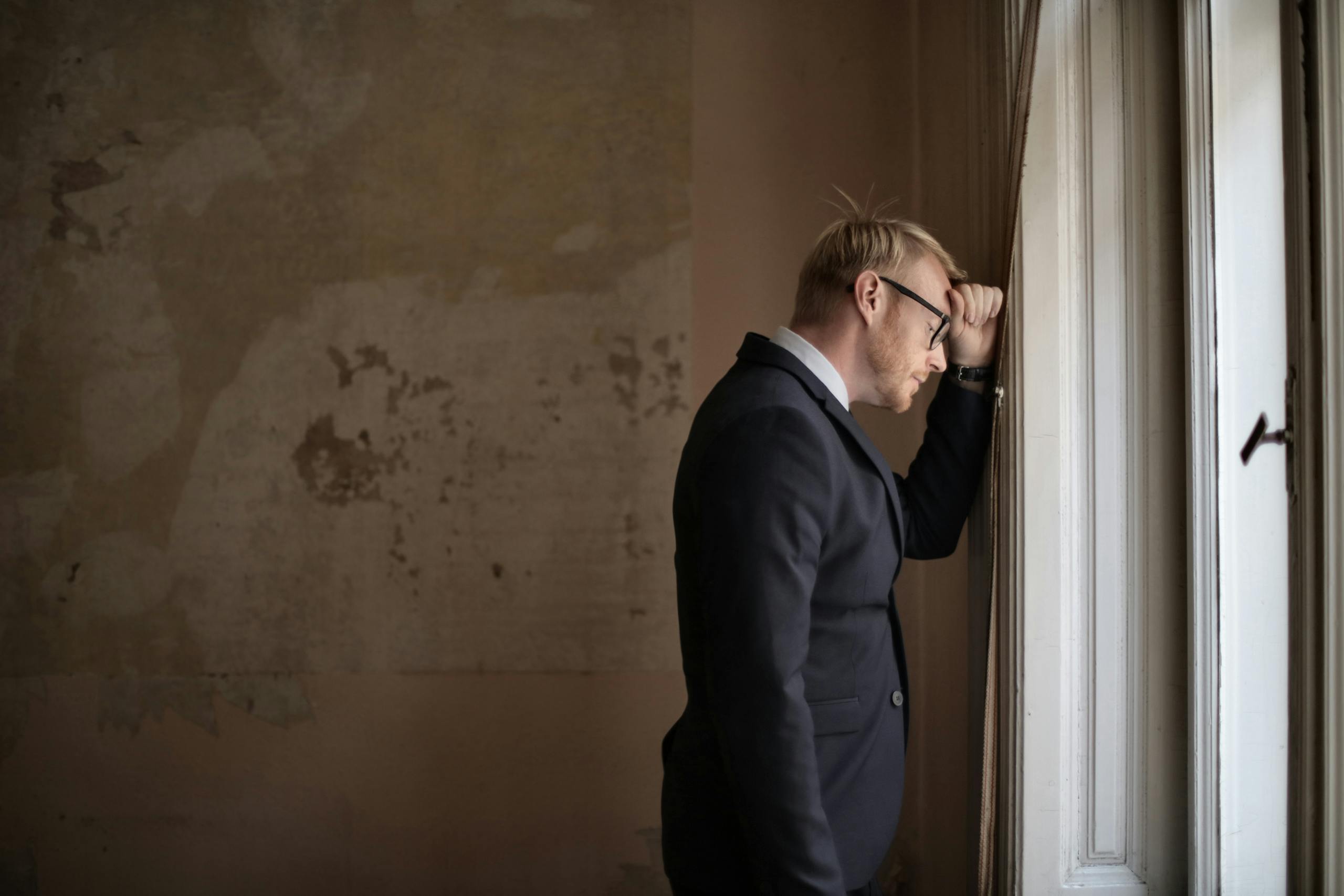

Several factors lead a person to be less self-aware, and most of them have nothing to do with intelligence or effort. Chronic stress, emotional avoidance, social environments that reward performance over honesty, and early experiences that taught someone to suppress internal signals can all quietly erode the capacity to see oneself clearly. Self-awareness isn’t a fixed trait you either have or don’t. It’s something that gets shaped, and sometimes damaged, by the conditions people live and grow inside.
What makes this topic feel personal to me is that I spent a long stretch of my career in exactly that condition. Running advertising agencies, pitching Fortune 500 clients, managing teams of creative and strategic people, I had built an entire professional identity around appearing confident and decisive. I was performing a version of leadership I thought was required. What I wasn’t doing was looking honestly at the gap between who I was performing and who I actually was. That gap cost me more than I realized at the time.
If you’re exploring how personality, family patterns, and self-understanding connect inside your closest relationships, our Introvert Family Dynamics & Parenting hub covers this terrain from multiple angles. The piece you’re reading right now goes a layer deeper, looking at the specific conditions that make honest self-reflection harder than it sounds.

What Does It Actually Mean to Lack Self-Awareness?
Self-awareness gets talked about as though it’s simply a matter of paying attention. But it’s more layered than that. There are two distinct forms of it. One is internal: knowing your own emotions, motivations, values, and patterns. The other is external: understanding how you come across to other people and how your behavior affects them. Most people have stronger access to one than the other, and some people have genuine blind spots in both directions.
What’s your personality type?
Take our free 40-question assessment and get a detailed personality profile with dimension breakdowns, context analysis, and personalised insights.
Discover Your Type8-12 minutes · 40 questions · Free
As an INTJ, I’ve always had a reasonably strong internal channel. My mind naturally turns inward. I notice my own reactions, analyze my motivations, and spend a lot of time processing experiences after the fact. What I was slower to develop was the external dimension, specifically, how my reserved, analytical style was being read by colleagues and clients who needed warmth and responsiveness from their agency leader. I thought I was being professional. Some of them experienced me as cold or disengaged. That’s a self-awareness failure, even if the internal processing was running constantly.
Low self-awareness, then, isn’t always about someone who never thinks about themselves. Sometimes it’s about someone who thinks about themselves in very narrow ways, missing entire dimensions of how they function in the world.
How Does Early Family Environment Shape This Capacity?
The family environment is where most people’s relationship with self-reflection gets established. Children who grow up in homes where emotions are named, validated, and treated as useful information tend to develop stronger internal awareness. Children who grow up in environments where certain emotions are punished, dismissed, or simply never discussed learn to stop paying attention to those signals.
This isn’t about blame. Most parents are doing the best they can with what they were given. But the patterns get passed down anyway. A parent who never learned to sit with discomfort will unconsciously teach their child to avoid it too. A family that prizes performance and achievement over emotional honesty will produce adults who are very good at managing appearances and much less practiced at examining what’s actually happening inside them.
The American Psychological Association’s research on trauma points to how early adverse experiences can fundamentally alter a person’s ability to accurately read their own internal states. When emotional expression has historically been unsafe, the nervous system learns to mute those signals. That muting doesn’t disappear in adulthood just because the environment changes.
For highly sensitive people, this dynamic can be especially pronounced. A child with a sensitive nervous system in a family that doesn’t understand or accommodate that sensitivity may learn to distrust their own perceptions entirely. If you’re raising children as a highly sensitive parent yourself, the piece on HSP parenting and raising children as a highly sensitive parent speaks directly to how to break that cycle and build environments where emotional honesty is actually possible.

Does Chronic Stress Actually Reduce Your Ability to See Yourself Clearly?
Yes, and this one matters more than most people realize. When someone is operating under sustained pressure, the cognitive and emotional resources required for genuine self-reflection get redirected toward survival and performance. You stop asking “what am I actually feeling and why” and start asking “what do I need to do to get through this.”
I saw this in myself during the years when my agency was growing fastest. We were winning accounts, expanding the team, managing complex client relationships across multiple industries. From the outside, everything looked like success. On the inside, I was running on adrenaline and habit, making decisions based on momentum rather than genuine reflection. I wasn’t lying to myself exactly. I just wasn’t checking in with myself at all. There was no space for it.
The neuroscience here is fairly well established. Chronic stress keeps the brain’s threat-detection systems active, which makes the quieter, more reflective functions harder to access. You can’t do deep internal inventory when your system is oriented toward scanning for danger. This is one reason why people who seem highly capable and even intelligent can still have significant blind spots about their own behavior and its effects on others.
Published work in PubMed Central examining self-referential processing suggests that the brain regions involved in self-reflection require a certain quality of attentional resource that stress actively depletes. It’s not a character flaw. It’s a cognitive limitation that gets worse under pressure.
How Do Social Environments Punish Honest Self-Reflection?
There’s a social dimension to self-awareness that doesn’t get discussed enough. Many environments, workplaces, families, social groups, implicitly or explicitly reward people for projecting confidence rather than expressing uncertainty. Admitting you don’t know yourself well, or that you made a mistake rooted in a blind spot, can feel professionally or socially costly.
In advertising, the culture rewarded certainty. Clients paid for conviction. Walking into a pitch and saying “we think this might work, though we’re genuinely uncertain about a few assumptions here” was not the posture that won business. So everyone performed certainty, including me. And that performance, sustained long enough, starts to affect the internal experience. You stop noticing your own doubts because expressing them has no social payoff.
Some personality structures are more vulnerable to this dynamic than others. People who score high on agreeableness in the Big Five personality traits framework may be especially prone to shaping their self-perception around social feedback rather than internal signals. If your sense of self is heavily anchored in how others see you, and the environment consistently reflects a particular image back at you, it becomes harder to access the version of yourself that exists independent of that reflection.
This is also why genuinely likeable people are sometimes the least self-aware. Social warmth and likeability can function as a kind of feedback buffer, insulating someone from the honest responses that would otherwise inform their self-image. If you’re curious about how your social presence is actually landing with others, the likeable person test offers a useful starting point for examining the gap between how you see yourself and how others might experience you.

Can Certain Mental Health Patterns Make Self-Awareness Harder to Access?
Certain psychological patterns do make it structurally harder to maintain accurate self-perception. This isn’t about labeling or pathologizing. It’s about understanding that some people are working against specific internal obstacles that others don’t face.
Anxiety, for instance, tends to produce a particular kind of self-focus that actually interferes with genuine self-awareness. Anxious self-monitoring is about threat detection, not honest inventory. Someone who is highly anxious may seem very self-aware because they’re constantly analyzing themselves, but much of that analysis is filtered through fear, which distorts the picture significantly.
Depression often produces a flattening of emotional nuance that makes it hard to distinguish between different internal states. Everything gets compressed into a general heaviness, which makes the kind of precise self-observation that genuine self-awareness requires much more difficult.
Some personality structures involve specific mechanisms that actively work against self-awareness. Certain patterns involve emotional dysregulation and unstable self-image that make consistent self-perception genuinely difficult, not as a choice but as a structural feature of how those patterns work. If you’re wondering whether any of these patterns might apply to your own experience, the borderline personality disorder test can be a useful first step toward understanding what you’re working with.
Attention-related differences also play a role. People whose attention regulation works differently may find it harder to sustain the kind of focused internal observation that self-awareness requires, not because they don’t care about understanding themselves, but because the attentional architecture needed for that kind of reflection is harder to access consistently.
Does Personality Type Influence How Self-Aware a Person Tends to Be?
Personality type shapes the style of self-awareness more than the capacity for it. Some types are naturally more oriented toward internal processing. Others are more outwardly focused and may need to be more intentional about creating space for reflection.
As an INTJ, internal analysis is almost reflexive for me. My mind defaults to examining patterns, including patterns in my own behavior and thinking. That’s a structural advantage when it comes to certain kinds of self-awareness. The blind spot for INTJs tends to be in the emotional and relational dimensions, specifically, how our internal certainty can come across as dismissiveness or rigidity to people who process things differently.
I managed a senior account director at one of my agencies who was a strong extrovert, warm and socially gifted, genuinely beloved by clients. She had almost no access to her own internal motivations. She could read a room brilliantly but couldn’t tell you why she made the decisions she made or what was actually driving her reactions in difficult conversations. Her self-awareness was entirely external, excellent at reading others, genuinely limited when it came to reading herself.
The National Institutes of Health has examined how early temperament shapes introversion over time, and some of those same temperamental patterns likely influence how naturally a person orients toward internal versus external self-monitoring. Introversion tends to correlate with stronger internal self-awareness and sometimes weaker external self-awareness, while extroversion may flip that pattern.
What’s interesting is that certain roles attract people with specific self-awareness gaps. Someone drawn to caregiving work, for instance, may have high external sensitivity to others’ needs and significantly lower awareness of their own. The personal care assistant test online touches on some of the competency dimensions that caregiving roles require, and it’s worth noticing how self-awareness, or its absence, shows up in those professional contexts.

What Role Does Feedback Play in Developing or Blocking Self-Awareness?
Feedback is the mechanism through which external self-awareness develops. Without honest feedback from people we trust, we’re essentially working with a mirror that only shows us what we already expect to see.
The problem is that honest feedback is genuinely rare. Most people soften it, avoid it, or deliver it so diplomatically that the actual message gets lost. And many people, especially those in leadership positions, create environments where honest feedback becomes socially risky for the people around them. I did this without realizing it for years. My analytical directness, which I experienced as efficiency, made some team members reluctant to tell me things I needed to hear. They weren’t hiding information out of malice. They were reading my signals accurately and responding to them.
There’s also the matter of how people receive feedback when they do get it. Someone with fragile self-esteem may deflect or dismiss honest feedback because integrating it feels too threatening. Someone who has built their identity around a particular self-image may unconsciously filter out information that contradicts that image. The capacity to receive feedback without defensiveness is itself a component of self-awareness, and it’s one that takes time and some psychological security to develop.
Psychology Today’s overview of family dynamics notes how feedback patterns established in childhood often persist into adult relationships and professional contexts. The way a family handled disagreement, criticism, and honest conversation shapes how its members relate to feedback for decades afterward.
How Does the Pressure to Perform Competence Undermine Self-Awareness?
There’s a specific dynamic that affects people in helping professions, leadership roles, and caregiving contexts that doesn’t get named often enough. When your role requires you to project competence and stability for others, the internal experience of uncertainty or confusion can start to feel like a failure of professional identity rather than a normal part of being human.
Personal trainers, for instance, are expected to model discipline and physical confidence. The role itself can make it harder to acknowledge personal struggles with motivation or body image because those admissions seem to contradict the professional persona. The certified personal trainer test measures competency in the technical dimensions of the role, but the psychological dimension, specifically, how performing expertise affects a person’s relationship with their own uncertainty, is rarely addressed in professional preparation.
I felt this acutely as an agency CEO. My job was to be the person who had answers, who inspired confidence in clients and teams. Admitting to myself that I was exhausted, uncertain, or operating from a place of insecurity felt incompatible with the role. So I stopped admitting it, even internally. The performance became the experience, at least on the surface. Underneath, there was a growing disconnect between the person I was presenting and the person I actually was.
That disconnect is, at its core, what low self-awareness feels like from the inside. Not ignorance exactly. More like a practiced looking-away from the parts of yourself that feel inconvenient or threatening.
Published work in PubMed Central examining self-concept and identity explores how the stories people construct about themselves can become resistant to revision even when new information contradicts them. The more invested someone is in a particular self-narrative, the more cognitive and emotional work is required to update it honestly.
Can Self-Awareness Be Rebuilt After It’s Been Eroded?
Yes. And in my experience, the process is less about techniques and more about conditions. Self-awareness tends to grow when people feel safe enough to be honest with themselves, when they have access to perspectives that gently challenge their existing self-narratives, and when they’re not operating in a constant state of performance pressure.
For me, the shift came gradually and mostly through the experience of stepping back from the agency environment and spending more time writing and reflecting. The introvert’s natural pull toward solitude and internal processing, which I had spent years suppressing in favor of the extroverted leadership model I thought was required, turned out to be exactly the capacity I needed to start seeing myself more honestly.
Therapy, journaling, personality frameworks used thoughtfully rather than as fixed labels, and honest relationships with people who will tell you the truth even when it’s uncomfortable are all conditions that support the development of genuine self-awareness. None of them work instantly. All of them require a willingness to sit with some discomfort.
What I’ve noticed in myself and in the people I’ve worked with is that self-awareness tends to grow in cycles rather than linearly. You gain clarity in one area, and that clarity often reveals a new blind spot you hadn’t previously noticed. That’s not failure. That’s what honest self-examination actually looks like over time.

The rarest personality types often carry particular self-awareness profiles that reflect their unusual combination of traits, and understanding your own type can be a useful entry point into seeing yourself more clearly, as long as you treat the framework as a starting point rather than a final answer.
There’s also the relational dimension to consider. 16Personalities explores how introvert-introvert relationships can create specific blind spots when both partners default to internal processing and neither naturally surfaces the things that need to be said out loud. Self-awareness in relationships requires not just internal reflection but the willingness to externalize it, which is its own skill set.
If you want to go further with these themes, the full collection of articles in our Introvert Family Dynamics & Parenting hub explores how personality, early experience, and relational patterns intersect in the contexts where self-awareness matters most.
About the Author
Keith Lacy is an introvert who’s learned to embrace his true self later in life. After 20 years in advertising and marketing leadership, including running agencies and managing Fortune 500 accounts, Keith now channels his experience into helping fellow introverts understand their strengths and build fulfilling careers. As an INTJ, he brings analytical depth and authentic perspective to every article, drawing from both professional expertise and personal growth.
Frequently Asked Questions
What are the most common factors that lead a person to be less self-aware?
The most common factors include chronic stress that depletes the attentional resources needed for honest reflection, early family environments that discouraged emotional expression, social contexts that reward performance over authenticity, certain mental health patterns that distort self-perception, and the sustained pressure to project competence in professional or caregiving roles. These factors often compound each other, and most people who struggle with self-awareness are dealing with several of them at once rather than just one isolated cause.
Can someone be intelligent and still have low self-awareness?
Absolutely, and this combination is more common than most people expect. Intelligence and self-awareness draw on different cognitive resources. High analytical intelligence can actually work against self-awareness in some cases, because the same capacity for rationalization that makes someone good at solving problems can also make them very skilled at constructing convincing explanations for their behavior that aren’t actually accurate. Some of the least self-aware people I worked with in advertising were also among the most intellectually capable.
How does introversion relate to self-awareness?
Introversion tends to correlate with stronger internal self-awareness, meaning introverts often have better access to their own emotions, motivations, and thought patterns. The potential blind spot for introverts is in external self-awareness, specifically, how they come across to others and how their behavior affects the people around them. Extroverts often have the inverse pattern, reading external social cues well while having less consistent access to their own internal states. Neither type has a structural advantage overall. The gaps just tend to fall in different places.
Why do some people seem resistant to developing self-awareness even when they have access to feedback?
Resistance to self-awareness usually comes down to psychological safety. Updating your self-image requires tolerating the discomfort of recognizing that your previous understanding of yourself was incomplete or inaccurate. For people whose sense of self is fragile, or who have built significant parts of their identity around a particular self-narrative, that process feels genuinely threatening rather than useful. The resistance isn’t irrational. It’s a protective response. What makes it possible to move through that resistance is usually a combination of feeling safe enough to be honest and having relationships that make the process feel worthwhile rather than just painful.
How do family dynamics in childhood shape adult self-awareness?
Family environments teach children whether their internal experiences, emotions, perceptions, and reactions are trustworthy and worth paying attention to. In families where emotional expression was welcomed and named, children develop the habit of internal attunement that forms the foundation of self-awareness. In families where certain emotions were punished, dismissed, or simply never discussed, children learn to suppress or ignore those internal signals. Those learned patterns persist into adulthood and often show up in how people relate to their own emotions, how they respond to feedback, and how honestly they can examine their own behavior in close relationships.