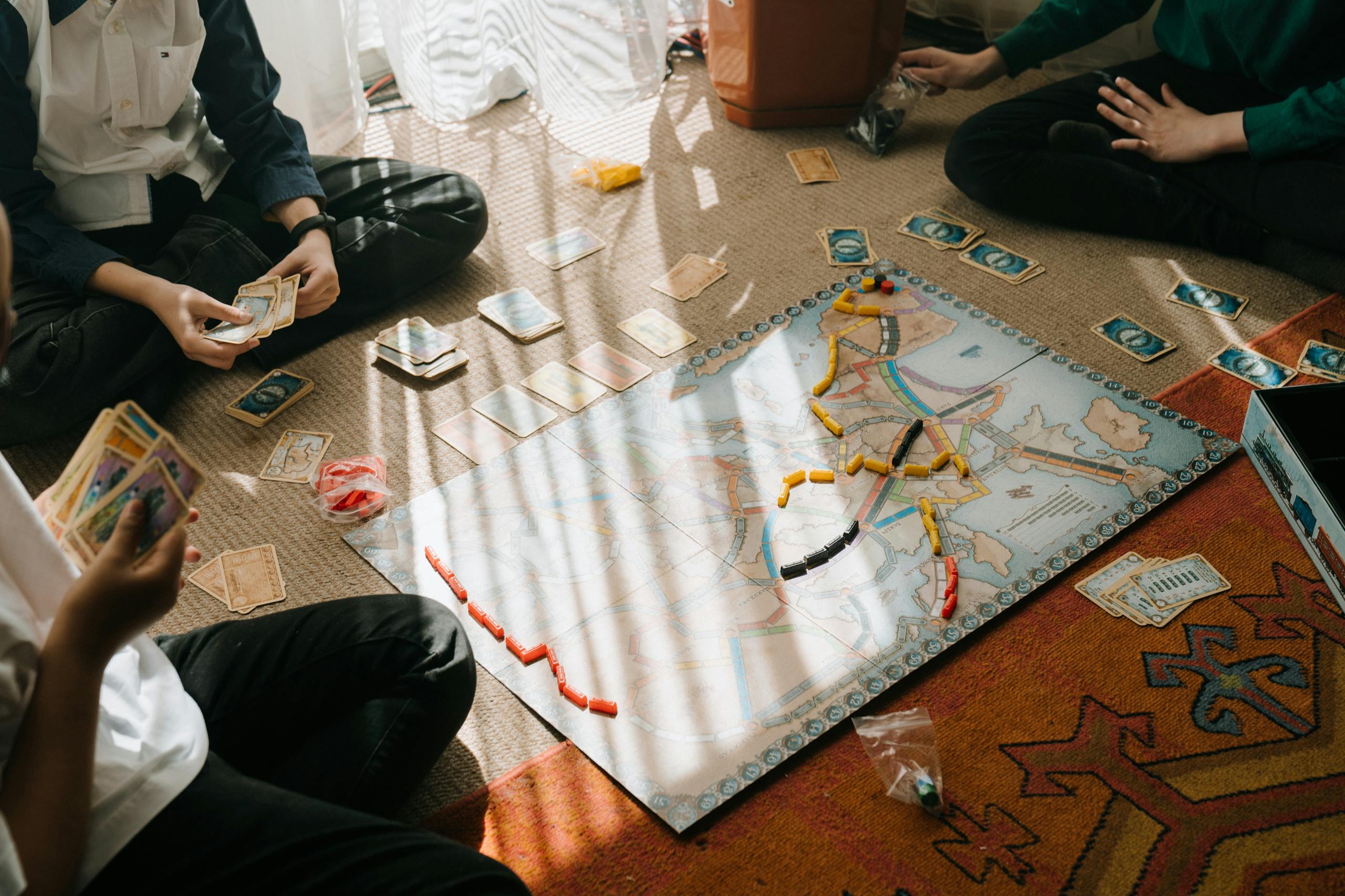
Games can be used as reinforcers for social skills instruction because they create low-stakes environments where practiced behaviors get immediate feedback, repetition feels natural rather than forced, and the emotional reward of play makes new habits stick. Whether you’re working with children, adults, or your own quiet self, structured play turns abstract social concepts into lived experience.
That’s the short answer. But there’s a lot more texture to it, especially if you’re an introvert who has spent years feeling like social skills were something other people were born with and you somehow missed the memo on.

My earliest memory of understanding this wasn’t from a textbook. It was from watching what happened to my agency teams when I introduced game-based exercises into our creative briefings. The quietest people in the room, the ones who sat back during conventional brainstorms, suddenly came alive. Something about the structure of a game gave them permission to engage in ways that open-ended socializing never did. I filed that away for years before I understood what I was actually observing.
If you’re exploring the broader landscape of how introverts build and refine their social abilities, the Introvert Social Skills and Human Behavior hub is worth bookmarking. It covers everything from conversation techniques to emotional intelligence, and this article sits squarely within that conversation.
What Does It Actually Mean to Use Games as Reinforcers?
Before we get into the how, it helps to understand the why at a psychological level. A reinforcer, in behavioral terms, is anything that increases the likelihood a behavior will be repeated. When you pair a desired behavior with something rewarding, the behavior becomes more automatic over time. Games are powerful reinforcers because they bundle together multiple reward mechanisms: novelty, competition, laughter, belonging, and the clean satisfaction of rules being followed and outcomes being clear.
Career Coaching for Introverts
One-on-one career strategy sessions with Keith Lacy. 20 years of Fortune 500 leadership as an introvert, now helping others build careers that work with their wiring.
Learn More50-minute Zoom session · $175
Social skills, by contrast, are notoriously hard to reinforce through direct instruction alone. You can tell someone to make eye contact, but telling doesn’t create the muscle memory. You can explain turn-taking, but a lecture about it won’t make it feel natural in a real conversation. Games bridge that gap because they require you to actually do the behavior, repeatedly, within a context that feels engaging rather than clinical.
According to the American Psychological Association, introversion is characterized by a preference for less stimulating environments and a tendency to direct energy inward. That’s not a deficit. But it does mean that traditional social skills training, which often assumes extroverted baselines, can feel exhausting or irrelevant. Games reframe the environment in a way that plays to how introverts actually process experience.
Worth noting: not every game works equally well for this purpose. The type of game matters, the group size matters, and the specific skills you’re targeting matter. We’ll get into all of that.
Why Do Introverts Respond Differently to Game-Based Learning?
There’s something I noticed consistently across my years running agencies. When I brought in a new team member who was clearly introverted, the standard onboarding process, group lunches, team happy hours, open-floor brainstorms, often produced the opposite of what was intended. Instead of helping them connect, it made them retreat further. They’d become quieter, more guarded, harder to read.
But put that same person in a structured game situation, even something as simple as a trivia round or a creative constraint exercise, and the dynamic shifted. The game gave them a role. It gave them a defined way to contribute. It removed the ambiguity of unstructured socializing, which is often where introverts lose the most energy.
This connects to something deeper about how introverts process social interaction. As explored in Harvard Health’s guide to social engagement for introverts, introverts tend to prefer depth over breadth in their connections, and they often need a clear reason or context to engage comfortably. Games provide exactly that context.
There’s also the overthinking factor. Many introverts, myself included, have a tendency to over-analyze social situations in real time. What should I say next? Did that land wrong? Am I talking too much or not enough? Games interrupt that loop because the rules create an external structure that the mind can follow instead of spinning. If you’ve ever found yourself paralyzed by social overthinking, it’s worth reading about overthinking therapy as a complementary approach, because games alone won’t resolve deep-seated anxiety patterns, but they can create breathing room.

Which Social Skills Do Games Target Most Effectively?
Not every social skill transfers equally well through play. Some are almost tailor-made for game-based reinforcement. Others require more deliberate practice outside of game contexts. Here’s how I’d break it down based on both observation and experience.
Turn-Taking and Active Listening
Almost every structured game requires players to wait their turn and pay attention to what others are doing. That’s active listening in its most basic form. For introverts who struggle not with listening itself but with signaling that they’re listening, games create repeated low-pressure opportunities to practice those signals, nodding, responding to what was just said, building on another player’s move.
Cooperative games are especially good here. When the goal is shared rather than competitive, players have to communicate and coordinate in ways that mirror real-world collaborative skills. I’ve seen this work in agency settings when I introduced collaborative problem-solving games into team meetings. The quietest team members started contributing more in actual meetings afterward. The game had given them a template for how to enter a group conversation.
Reading Social Cues and Emotional Tone
Games like charades, Pictionary, or any activity involving bluffing require players to read nonverbal cues intensely. You’re watching faces, body language, micro-expressions. For introverts who are often highly attuned to these signals but don’t always know how to act on them in real time, games provide a safe context to practice that translation.
Emotional intelligence plays a significant role here. The ability to read a room, to sense when someone is frustrated or excited or holding back, is a skill that games train almost incidentally. If you’re interested in how emotional intelligence intersects with social performance, exploring what an emotional intelligence speaker covers can give you a sense of the full framework these skills operate within.
Conversation Initiation and Maintenance
Some games are essentially structured conversation practice. Card games like “We’re Not Really Strangers” or question-based games like “Table Topics” give players a prompt to respond to, removing the hardest part of conversation for many introverts, which is figuring out what to say first. Over time, the patterns learned through these games start to migrate into unstructured conversation.
This is where game-based reinforcement connects directly to becoming a stronger conversationalist overall. If you’re working on that skill set more broadly, the article on how to be a better conversationalist as an introvert covers the underlying mechanics in detail.
Assertiveness and Boundary-Setting
Negotiation games, debate-style games, and even competitive card games require players to advocate for their position, push back on others, and hold their ground. For introverts who tend toward conflict avoidance, this is genuinely valuable practice. The game frame makes assertiveness feel less personally risky because it’s “just the game.”
One of my INTJ patterns is that I can be very direct in analytical contexts but tend to soften my positions in emotionally charged social ones. I noticed that certain strategy games helped me practice staying grounded in my position even when others pushed back, and that translated into more confident communication in client negotiations. Not dramatically, but measurably.
How Do Games Work as Reinforcers in Formal Instruction Settings?
The most well-documented use of games as reinforcers comes from applied behavior analysis and social skills training programs, particularly those designed for children with autism spectrum disorder, social anxiety, or developmental delays. But the underlying principles apply far more broadly.
According to research published through the National Institutes of Health, structured behavioral interventions that incorporate preferred activities as reinforcers tend to produce better skill generalization than those relying on external rewards alone. When the activity itself is rewarding, the behavior gets reinforced intrinsically, which is more durable over time.
In formal social skills instruction, games typically serve one of three functions. First, as a warm-up to reduce anxiety before direct skill practice. Second, as the primary practice environment where target behaviors are performed repeatedly within natural game interactions. Third, as a reward given after completing more effortful direct instruction, which maintains motivation across a longer session.
The most effective programs tend to use games in all three ways rather than relying on any single approach. A session might open with a familiar game to settle the group, move into structured skill practice, then close with a game that naturally elicits the target skill in a freer context.

What Happens in the Brain During Game-Based Social Practice?
There’s a reason games feel different from drills. Play activates reward pathways in the brain that direct instruction simply doesn’t reach in the same way. When you’re engaged in a game you enjoy, dopamine is involved in the motivation and reward cycle, which means the experience gets encoded differently than rote practice.
More importantly for social skill development, games create what might be called emotional safety through structure. The rules of the game define acceptable behavior, which paradoxically frees players to take social risks they wouldn’t take in unstructured settings. You can be silly in charades in ways you’d never allow yourself to be in a business meeting. You can be assertive in a negotiation game in ways that feel too vulnerable in real-life conflict.
As published in PubMed Central’s research on social behavior and play, play-based activities create conditions for practicing complex social behaviors in ways that reduce threat response and increase willingness to engage. For introverts who often experience social situations as mildly to moderately activating, that reduction in perceived threat is significant.
Self-awareness is also worth mentioning here. The more clearly you understand your own patterns, the more intentionally you can use games to target specific gaps. Meditation and self-awareness practices can sharpen that internal picture considerably, helping you notice in real time which social behaviors feel natural and which ones still require conscious effort.
Can Adults Actually Use This Approach, or Is It Just for Kids?
One of the most persistent misconceptions about game-based social skills work is that it’s primarily a tool for children. That’s understandable given where most of the formal research is concentrated. But adult applications are both valid and increasingly recognized.
Improv comedy, which is essentially a set of structured games, has been used for decades in corporate training, therapy, and personal development. The core improv principles, “yes, and,” staying present, building on what your partner offers, are direct social skills with immediate real-world application. Many of the introverts I’ve worked with over the years have found improv classes to be among the most effective social skill builders they’ve tried, precisely because the game structure removes the self-consciousness that makes direct practice so uncomfortable.
Board game cafes, escape rooms, and social gaming events have also created adult contexts where game-based social practice happens naturally. You don’t have to frame it as “social skills training” to get the benefit. The skills develop through the doing.
What matters for adults is intentionality. A child in a structured program will have a facilitator directing the skill focus. An adult using games for social development benefits from knowing what they’re working on. Are you trying to get more comfortable with assertiveness? Choose games that require it. Working on reading emotional cues? Bluffing and deduction games will give you reps. Wanting to practice conversation initiation? Question-based social games are your friend.
The broader work of improving social skills as an introvert involves multiple strategies working together, and games are one of the most sustainable because they don’t feel like work. That sustainability matters enormously. Approaches you’ll actually stick with beat theoretically superior approaches you abandon after two weeks.
What Should You Look for When Choosing Games for Social Skill Development?
Not all games are created equal for this purpose. Some qualities make a game significantly more useful as a social reinforcer than others.
Interaction Is Required, Not Optional
Games where players can succeed by playing in isolation, certain puzzle games, solo strategy games, don’t generate the social practice you’re looking for. You want games where the interaction itself is the mechanism of play. Conversation, negotiation, reading other players, and responding to their moves should be central, not peripheral.
The Group Size Matches Your Comfort Zone, Slightly Stretched
There’s a principle in skill development of working at the edge of your current comfort zone rather than far outside it. A game that requires performing in front of fifteen people when you’re still getting comfortable with three is going to produce anxiety, not learning. Start with games designed for two to four players and expand from there as the skills solidify.
The Emotional Stakes Are Manageable
Highly competitive games with significant social consequences for losing can backfire for people who are already socially anxious. Cooperative games, or games with light competitive elements and strong humor components, tend to work better as social skill reinforcers because they keep the emotional environment positive. The goal is to associate social engagement with positive feelings, not to add another context where social performance feels high-stakes.
There’s a Clear Skill Being Practiced
The more deliberately you can connect a game to a specific skill, the more transfer you’ll get. If you’re playing a deduction game, you might specifically focus on practicing the verbal skill of explaining your reasoning clearly. If you’re playing a cooperative game, you might focus on the skill of checking in with teammates before acting. The game provides the context; your intention provides the skill focus.

How Does This Connect to Deeper Social and Emotional Patterns?
Games build skills. But skills are only part of the picture. Underneath the behavioral layer of social interaction are emotional patterns, attachment styles, self-worth narratives, and past experiences that shape how we engage with others. Games can create new behavioral habits, but they work best when the emotional foundation is also being tended to.
One thing I’ve observed, both in myself and in people I’ve managed over the years, is that social skill deficits are rarely purely behavioral. More often, they’re rooted in fear. Fear of saying the wrong thing, fear of being judged, fear of rejection. Healthline’s piece on introversion versus social anxiety does a good job of distinguishing between these two, because they require different approaches. Games are excellent for the introvert who simply needs more comfortable practice contexts. They’re less sufficient on their own for someone dealing with genuine social anxiety, which often needs more direct therapeutic attention.
There’s also the question of what happens when social patterns have been disrupted by painful experiences. Someone who has experienced betrayal in a close relationship, for instance, often finds that their social instincts become hypervigilant in ways that make ordinary interaction feel loaded. If you’re working through something like that, the article on how to stop overthinking after being cheated on addresses some of the cognitive patterns that can make social re-engagement feel so difficult. Games can be part of rebuilding comfort with social risk, but the emotional processing has to happen alongside the skill practice.
As Psychology Today’s piece on the introvert advantage notes, introverts often bring depth of observation and emotional attunement to their social interactions that extroverts don’t naturally access. success doesn’t mean become someone different. It’s to give your existing strengths more room to operate.
Building a Personal Practice Around Game-Based Social Development
If you want to use this approach intentionally rather than just hoping it happens organically, a few principles will help.
First, know your type. Understanding your personality wiring gives you a clearer map of which social skills come naturally and which ones need more deliberate attention. If you haven’t already, take our free MBTI personality test to get a clearer picture of your type. An INTJ like me will have different social skill gaps than an INFP or an ESFJ. The game-based practice that’s most useful will differ accordingly.
Second, be consistent rather than intense. One game session per week with the same small group will build more durable social habits than an occasional marathon session. Consistency creates the repetition that reinforcement requires.
Third, reflect after the fact. The skill transfer from game to real life doesn’t happen automatically for everyone. Taking a few minutes after a game session to notice what came up, what felt easy, what felt hard, what you want to try differently next time, accelerates the learning considerably. This is where the self-awareness work intersects with the behavioral practice.
Fourth, don’t use games as a substitute for real social engagement. They’re a training ground, not a replacement. The goal is to build skills in the game context and then deliberately carry them into the messier, less structured world of actual relationships and professional interactions. That transfer requires intention.
According to this NIH resource on behavioral skill development, skill generalization is one of the most important and most frequently overlooked components of social skills training. Building a behavior in one context doesn’t guarantee it will appear in others. Actively practicing the transfer, by setting small real-world goals after each game session, closes that gap.

What I Wish I’d Known Earlier About All of This
Looking back on my agency years, I spent an enormous amount of energy trying to become a different kind of social person. More spontaneous. More comfortable in large groups. Better at small talk. More like the extroverted leaders I was surrounded by and quietly comparing myself to.
What I didn’t understand then was that social skills aren’t a personality trait. They’re a set of learnable behaviors. And the best way to learn behaviors is through practice that feels rewarding enough to sustain. For me, that was never the cocktail party or the networking event. It was the structured creative exercise, the strategic game, the context where there were rules and a clear way to contribute.
I had one creative director on my team, an INFP who was brilliantly perceptive but struggled enormously with client-facing interactions. She’d freeze in pitches, lose her thread in Q&A sessions, come across as disengaged when she was actually deeply engaged internally. We started doing low-stakes presentation games within the team, structured exercises where she’d pitch a fake product, field absurd questions, defend ridiculous positions. Within a few months, her actual client presentations changed noticeably. Not because she’d become extroverted, but because she’d built the behavioral vocabulary to express what was already happening inside her.
That’s what games as reinforcers actually do at their best. They don’t change who you are. They give you more ways to show it.
There’s a lot more to explore in this space. The full Introvert Social Skills and Human Behavior hub brings together resources on conversation, emotional intelligence, overthinking, and more, all through the lens of how introverts actually experience and build these skills.
About the Author
Keith Lacy is an introvert who’s learned to embrace his true self later in life. After 20 years in advertising and marketing leadership, including running agencies and managing Fortune 500 accounts, Keith now channels his experience into helping fellow introverts understand their strengths and build fulfilling careers. As an INTJ, he brings analytical depth and authentic perspective to every article, drawing from both professional expertise and personal growth.
Frequently Asked Questions
Can games really teach social skills, or is it just entertainment?
Games can genuinely build social skills when used with intention. The key difference between entertainment and skill development lies in what you’re paying attention to during and after play. When you use games deliberately, choosing types that require the specific behaviors you want to practice and reflecting on what came up afterward, the skills developed in the game context do transfer to real-world social interactions. The entertainment quality is actually an asset, not a distraction, because it makes the practice sustainable.
What types of games are best for social skills development in adults?
Cooperative games, conversation-based card games, improv exercises, and deduction games tend to be the most effective for adult social skills development. Cooperative games build communication and collaboration. Conversation games practice initiation and depth. Improv develops spontaneity and active listening. Deduction games sharpen the ability to read social cues and reason about others’ perspectives. The best choice depends on which specific skills you’re targeting and your current comfort level with group sizes and competitive pressure.
How do games help introverts specifically with social skills?
Games help introverts by providing structure that removes the ambiguity of unstructured socializing. Many introverts find open-ended social situations draining partly because the rules of engagement are unclear. Games define roles, turn order, and acceptable behavior, which reduces the cognitive and emotional load of figuring out how to participate. That freed-up mental space allows introverts to focus on the actual social behaviors rather than spending energy managing uncertainty. Games also interrupt overthinking patterns by giving the mind a clear external structure to follow.
How often should someone use game-based practice to see results?
Consistency matters more than frequency or duration. A regular weekly game session with the same small group will produce more durable skill development than occasional longer sessions. The repetition that reinforcement requires comes from showing up consistently over time. Most people start noticing meaningful changes in their social comfort and behavioral repertoire within six to eight weeks of consistent practice, though this varies considerably based on the specific skills being targeted and how much deliberate reflection accompanies the play.
Do game-based social skills transfer to real-world situations automatically?
Transfer doesn’t happen automatically for most people. It requires deliberate bridging between the game context and real-world situations. Setting a specific intention before a game session, such as practicing assertive communication, and then identifying one real-world situation in the following week where you’ll apply that same behavior, significantly increases transfer. Reflection after game sessions also helps, because noticing what felt natural and what felt effortful gives you clearer targets for continued practice. Think of the game as the training ground and real interactions as the performance context you’re training toward.