
A homebody couch isn’t just furniture. For introverts, it’s a restoration station, a thinking space, and sometimes the one place where the noise of the outside world finally quiets down enough to hear yourself think. If you’ve ever felt genuinely recharged after a long evening on your couch rather than drained by guilt about staying in, you’re not broken. You’re wired differently, and that couch might be doing more for your wellbeing than you realize.
My couch has seen more strategy sessions, more genuine reflection, and more honest self-reckoning than any conference room I ever sat in. And I sat in a lot of conference rooms.
There’s a broader conversation happening around how introverts design their lives at home, and the couch sits right at the center of it. Our Introvert Home Environment hub covers everything from choosing where to live to designing spaces that genuinely support how you’re wired. This article zooms in on one specific corner of that world: the couch, what it means, why it matters, and how to stop apologizing for loving it.
Why Do Introverts Feel So Strongly About Their Couch?
Ask an introvert to describe their ideal Saturday and a couch will almost certainly appear in the picture. Not because introverts are lazy. Not because they lack ambition. Because the couch represents something most people undervalue: a space with no performance requirements.
What drains your social battery?
Not all social exhaustion is the same. Our free quiz identifies your specific drain pattern and gives you personalised recharging strategies.
Find Your Drain PatternUnder 2 minutes · 8 questions · Free
When I was running my agency, I performed constantly. Every client meeting, every pitch, every casual hallway conversation with a team member carried some social weight. I was always reading the room, adjusting my tone, managing energy levels that didn’t come naturally. By the time I got home, I wasn’t tired from the work itself. I was tired from the constant social translation. The couch was the only place where I could stop translating and just exist.
That experience isn’t unique to me. Many introverts process the world through layers of internal observation. They notice what wasn’t said in a meeting, feel the emotional texture of a conversation long after it ends, and carry the weight of social interactions in a way that extroverts often don’t. Solitude isn’t an escape from life for these people. It’s where they actually process it.
There’s solid grounding for this in how we understand nervous system regulation. Work published in PubMed Central points to the role that environmental stimulation plays in how individuals experience arousal and recovery. Introverts tend to reach their optimal stimulation threshold faster than extroverts, which means that quiet, low-demand environments aren’t a preference so much as a physiological need. The couch, in a real sense, is medicine.
Is Being a Homebody Something to Feel Ashamed Of?
Somewhere along the way, our culture decided that staying in was a consolation prize. If you weren’t out socializing, networking, or at minimum attending something, you were missing out. The introvert who genuinely preferred a quiet evening at home got labeled shy, antisocial, or depressed. That framing has done a lot of damage.
I spent years internalizing that message. During my agency years, there was always a client dinner, a networking event, an industry gathering that I was supposed to want to attend. And I went to most of them. I got good at them. But I never stopped feeling the low hum of relief when one got canceled. I thought that relief meant something was wrong with me. It took me an embarrassingly long time to understand it just meant I was an introvert.
What I’ve come to believe, and what I try to write about honestly here, is that the shame attached to being a homebody is largely a cultural artifact, not a psychological truth. Introvert discrimination is real, and it shows up in subtle ways, including the quiet judgment that accumulates around people who simply prefer their own company. Recognizing that bias for what it is changes things. You’re not failing at social life. You’re succeeding at knowing yourself.

What Does Your Couch Actually Do for Your Mental Health?
Let’s be specific about this, because I think it matters. The couch isn’t just comfortable. For an introvert, it’s a functional tool for mental recovery. And the activities that happen on it, reading, thinking, watching something absorbing, having a slow conversation with someone you trust, are doing real work.
Solitude allows the mind to consolidate experience. When I’m processing a complicated client situation or working through a decision, I don’t do my best thinking in a meeting. I do it later, alone, often on my couch with a notebook nearby. My mind needs that unstructured time to sort through what it took in. Without it, I feel like a browser with forty tabs open and no way to close any of them.
Depth of thought is something many introverts genuinely value. Psychology Today has written about the introvert preference for depth in conversation and connection, and the same preference extends to how introverts engage with ideas and experiences. The couch creates the conditions for that depth. It’s not passive. It’s a different kind of active.
There’s also something to be said about the relationship between physical environment and psychological safety. Research indexed through PubMed Central has examined how environmental design influences stress and recovery. A space that feels genuinely safe, familiar, and low-demand creates measurable differences in how the nervous system responds. Your couch, especially if it’s positioned well in a thoughtfully arranged room, isn’t just where you sit. It’s where your system finally exhales.
That’s why the work of creating a real introvert home sanctuary matters so much. The location, the lighting, the furniture placement, all of it contributes to whether your home actually restores you or just gives you a different backdrop for the same low-grade anxiety you carry everywhere else.
How Do You Build a Couch Life That Actually Restores You?
Not every couch situation is created equal. I’ve had apartments where the couch faced a noisy street and the light was wrong and I never quite settled there. I’ve had a home office setup where the couch in the corner became the most productive thinking space I’ve ever had. The difference wasn’t the furniture. It was everything around it.
A few things I’ve learned about making a couch space genuinely restorative:
Position matters more than you think
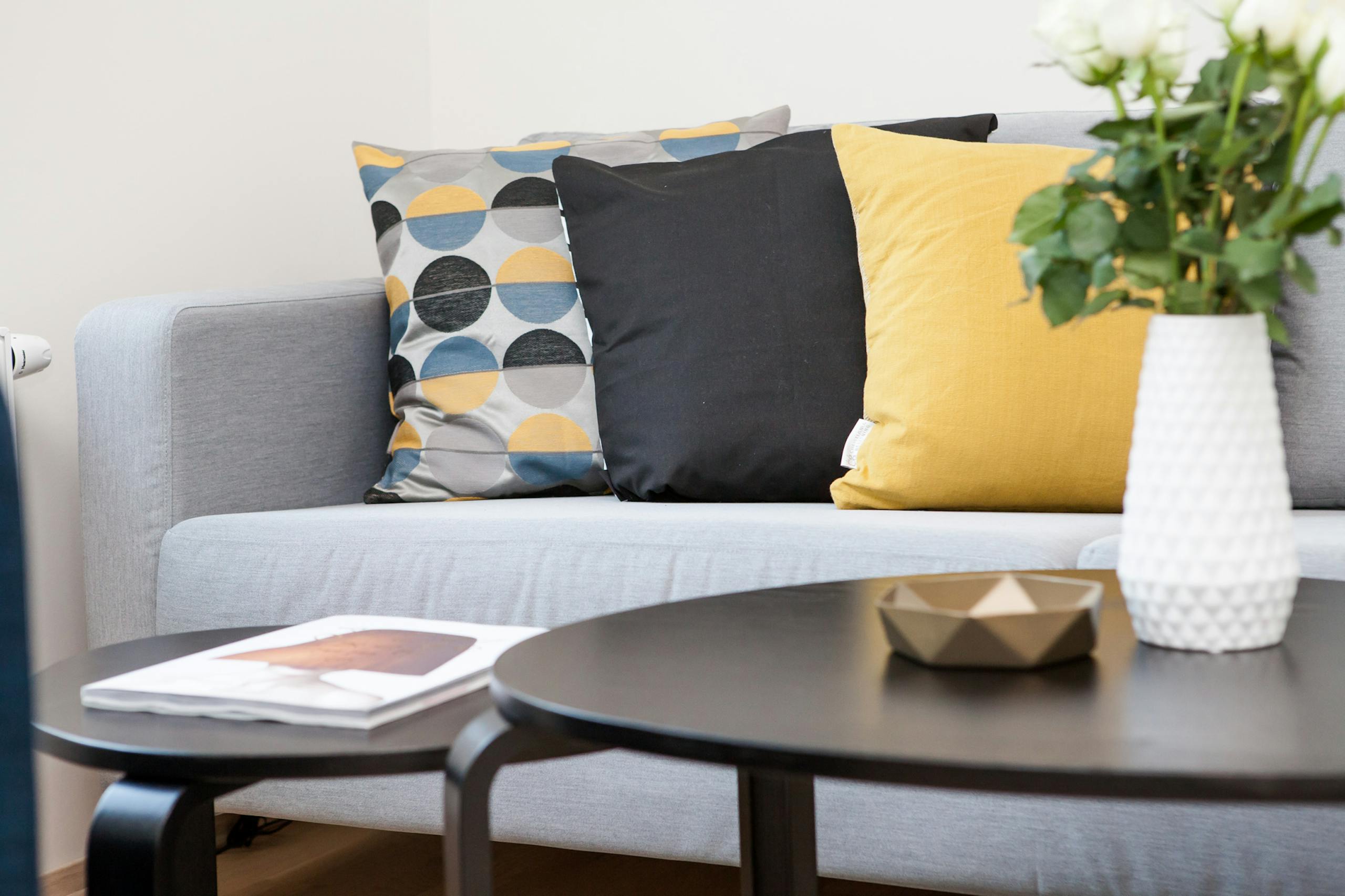
A couch facing a wall feels different from one that gives you a view of the room or a window. Many introverts feel more comfortable with their back toward a wall and a clear sightline to the space around them. It’s not paranoia. It’s a preference for environmental awareness that comes naturally to people who process their surroundings deeply.
What surrounds it shapes what happens on it
Books, a good lamp, a small table for tea or coffee, these aren’t decorating choices. They’re functional decisions about what kind of thinking and resting you want to do. When I set up my current home office, I treated the couch corner as deliberately as I would a client workspace. What do I need within reach? What should be out of sight? The intentionality changed how I used the space.
Protect the time as much as the space
A couch that you’re only allowed to sit on after everything else is done isn’t a restoration space. It’s a reward, and rewards can be taken away. Treating couch time as a scheduled, non-negotiable part of your week is part of what I’d call genuine introvert self-care. Not the candles-and-bubble-bath version. The real version, where you guard your recovery time the way you’d guard any other important commitment.
Can Being a Homebody Coexist With a Full Social Life?
Yes, and this is worth saying clearly because the either/or framing causes a lot of unnecessary guilt. Being a homebody doesn’t mean being a hermit. It means your default setting is inward, and you’re intentional about when and how you engage outward.
Some of my most meaningful professional relationships were built in small, quiet settings rather than large events. A dinner with two people where we actually talked about something real. A long phone call with a client I genuinely respected. Those interactions didn’t drain me the way a cocktail party did, because they had depth. They matched how I’m wired to connect.
When social events are unavoidable, having a strategy helps enormously. I’ve written elsewhere about what it looked like to show up to agency events as an introvert, and the short version is: I prepared, I set a time limit in my own mind, and I gave myself full permission to leave when I’d had enough. The introvert’s approach to parties isn’t about avoiding them entirely. It’s about going on your own terms.
The couch, in this context, isn’t a substitute for connection. It’s what makes connection possible. When I’ve had enough time alone to fully recharge, I’m actually present when I’m with people. I’m listening. I’m engaged. I have something to offer. The homebody couch and the meaningful social life aren’t in competition. One enables the other.
What About the Guilt That Comes With Staying In?
This is the one nobody talks about honestly enough. The guilt. The Sunday afternoon where you’ve been on your couch for three hours and your brain starts running the scorecard. You could have gone to that thing. You should have called so-and-so back. You’re wasting the day.
That voice is loud for a lot of introverts, and I think it’s worth examining where it comes from. Much of it is internalized messaging from a culture that equates productivity with visible activity. If you’re not doing something that can be reported back to someone, it doesn’t count. Rest doesn’t count. Thinking doesn’t count. Being still doesn’t count.
That framing is worth challenging directly. Some of the clearest strategic thinking I ever did for my agency happened on a couch with no agenda. Not in a meeting. Not with a whiteboard. Alone, letting my mind work through a problem without pressure. That kind of thinking has value. It produced results. It just didn’t look like productivity from the outside.
Part of what helps with the guilt is understanding that your need for solitude isn’t a character flaw. It’s a feature of how your mind works. Work published in Frontiers in Psychology has explored how introversion relates to internal processing depth, and the picture that emerges is one of a cognitive style that genuinely requires more inward time to function well. Honoring that isn’t indulgence. It’s maintenance.
How Does the Homebody Couch Fit Into Introvert Identity Growth?
Something I’ve noticed over the years is that the introverts who seem most at peace with themselves are the ones who’ve stopped fighting their own nature. They’ve found a way to build a life that accommodates how they’re wired rather than constantly apologizing for it. The couch is often part of that picture, not as a symbol of retreat, but as evidence of self-knowledge.
Identity growth, for an introvert, often happens quietly. It’s not a dramatic moment. It’s a series of small recognitions. The moment you realize you’re not going to that event because you genuinely don’t want to, not because you’re afraid. The moment you stop explaining your need for a quiet evening to someone who wouldn’t understand anyway. The moment you sit down on your couch and feel something like satisfaction rather than guilt.
That kind of growth is subtle and it accumulates slowly. My own sense of who I am as an introvert shifted over years, not weeks. A lot of that shifting happened in quiet moments, often at home, often in spaces that felt safe enough to actually think. The couch was part of that. So was the broader work of finding genuine peace as an introvert in a world that rarely makes it easy.
There’s also a connection here to how introverts learn and integrate new understanding about themselves. I’ve watched this in professional contexts too. When I managed teams at my agency, the introverts on my staff often needed time to absorb feedback before they could respond to it productively. Give them a meeting to process in, and you’d get a defensive reaction. Give them a day and a quiet space, and they’d come back with something genuinely thoughtful. That processing time wasn’t avoidance. It was how their minds actually worked. The same principle applies to personal growth. It needs room to breathe.

What If Your Home Doesn’t Feel Like a Safe Place to Recharge?
Not every introvert has a home that functions as a sanctuary. Some people share spaces with loud roommates or family members who don’t understand the need for quiet. Some live in apartments where the walls are thin and the street noise is constant. Some are in relationships where their partner’s extroversion means the home is always buzzing with activity. These are real challenges, and they deserve honest acknowledgment.
What I’ve seen work, both in my own experience and in conversations with other introverts, is the practice of carving out micro-sanctuaries within larger, less controllable spaces. A specific chair. A corner of a bedroom. A bathroom with a good lock and a candle. It sounds small because it is small, and small is sometimes what’s available. What matters is that the space is yours, that it signals something to your nervous system, and that the people around you understand its function.
That conversation, the one where you explain to a partner or roommate what you actually need from your home environment, is one of the most important ones many introverts never have. They assume the need is obvious or that asking for it is asking too much. It’s neither. Psychology Today’s framework for introvert-extrovert conflict resolution offers a practical starting point for those conversations, and it’s worth reading if you’ve been struggling to articulate why you need what you need.
For younger introverts handling shared living situations, school environments can compound the challenge. The pressure to be socially present and energetically available during school years is significant. How introverts actually thrive in school settings has a lot to do with finding those pockets of quiet within otherwise overwhelming environments, and the same skill translates directly into adult home life.
Does Loving Your Couch Mean You’re Avoiding Something?
This is a fair question, and I want to answer it honestly rather than defensively. Yes, sometimes it does. There’s a difference between restorative solitude and avoidance, and the line between them isn’t always obvious from the inside.
Restorative solitude leaves you feeling more capable, more clear, more ready. You emerge from it with energy. Avoidance tends to leave you feeling smaller. You stay on the couch because facing something feels too hard, and afterward you feel worse rather than better. The couch didn’t restore you. It just delayed something.
I’ve been in both places. During a particularly difficult stretch at my agency, when we were losing a major account and I was dealing with the fallout, I spent more time on my couch than was healthy. I told myself I was processing. Some of it was. But some of it was hiding. Knowing the difference required being honest with myself in a way that didn’t come easily.
The honest version of embracing homebody life includes being willing to ask that question periodically. Not with judgment, but with curiosity. Am I here because I need this, or am I here because something out there feels too hard right now? Both answers are valid starting points. Only one of them is the end of the conversation.
Some introverts find that working with a therapist helps them sort through this distinction. Point Loma University’s counseling resources note that introverts often make excellent therapy clients precisely because of their capacity for internal reflection. That same capacity, turned honestly inward, is what helps you tell restorative rest from avoidance.
How Do You Explain Your Homebody Nature to People Who Don’t Get It?
You’ve probably had the conversation. Someone invites you somewhere and you decline, and then comes the follow-up. Are you okay? Are you sure you don’t want to come? You really should get out more. The well-meaning concern that quietly implies something is wrong with you.
My approach evolved over the years from defensive explanation to something simpler. I stopped trying to justify it and started describing it accurately. “I recharge alone. I’m genuinely good. I’ll see you next week.” That’s usually enough, and when it isn’t, the problem isn’t mine to solve.
What helps in professional contexts is framing your introversion in terms of output rather than preference. I don’t stay in because I don’t like people. I stay in because it’s how I do my best thinking, and my best thinking is what I bring to the table. That framing resonated with clients and colleagues in ways that “I’m just an introvert” never quite did. Rasmussen University’s perspective on introvert strengths in professional settings touches on this, noting that the qualities introverts bring to focused, analytical work are genuinely valuable rather than merely acceptable.
The deeper truth is that you don’t owe anyone a complete explanation of your nervous system. Kindness and honesty are enough. “I’m someone who needs a lot of quiet time” is a complete sentence. So is “I’m having a couch night.” You don’t need to add anything to it.
If you want to go further with how your home environment shapes your wellbeing as an introvert, the full range of topics is waiting for you in our Introvert Home Environment hub, from location choices to room design to the psychology of sanctuary spaces.
Running on empty?
Five drain profiles, each with specific triggers, warning signs, and a recharging playbook.
Take the Free QuizUnder 2 minutes · 8 questions · Free
About the Author
Keith Lacy is an introvert who’s learned to embrace his true self later in life. After 20 years in advertising and marketing leadership, including running agencies and managing Fortune 500 accounts, Keith now channels his experience into helping fellow introverts understand their strengths and build fulfilling careers. As an INTJ, he brings analytical depth and authentic perspective to every article, drawing from both professional expertise and personal growth.
Frequently Asked Questions
Is being a homebody a sign of depression or social anxiety?
Not necessarily. Being a homebody is a lifestyle preference that many introverts share, rooted in how they process stimulation and recover energy. Depression and social anxiety are distinct conditions with specific symptoms that go beyond preferring time at home. If staying in brings you genuine contentment and you feel capable and engaged when you do go out, your homebody nature is likely a healthy expression of your personality. If staying in feels compulsive, leaves you feeling worse, or comes with significant distress about social situations, speaking with a mental health professional is worth considering.
How can I make my couch space more restorative as an introvert?
Start with position and light. A couch that faces a window or gives you a clear view of the room tends to feel more comfortable for introverts who like environmental awareness. Add a good lamp for evening use, keep a small table nearby for whatever you’re reading or drinking, and reduce visual clutter in the surrounding area. The goal is a space that signals safety and low demand to your nervous system. Beyond the physical setup, protect the time you spend there. Treat it as a genuine commitment rather than something you fit in after everything else is done.
Can introverts maintain strong relationships while being homebodies?
Absolutely. Strong relationships don’t require constant social activity. Many introverts build deep, lasting connections through less frequent but more meaningful interactions. A long phone call, a quiet dinner with one or two people, a shared evening at home, these can be more connecting than a dozen crowded events. What matters is being genuinely present when you do engage, and being honest with the people in your life about what you need. Most people who care about you will adapt once they understand that your need for quiet time isn’t a reflection of how you feel about them.
How do I know if I’m using my couch for healthy rest or unhealthy avoidance?
Pay attention to how you feel coming out of the time, not just going into it. Restorative couch time leaves you feeling clearer, calmer, and more capable. Avoidance tends to leave you feeling smaller, more anxious, or vaguely ashamed. Ask yourself honestly whether there’s something specific you’re not doing that you know you should be doing. If the answer is yes, the couch has shifted from sanctuary to hiding place. That doesn’t mean you have to immediately get up and do the hard thing, but it does mean being honest with yourself about what’s happening.
What do I say to people who pressure me to go out more?
Simple and direct works best. “I recharge at home and I’m genuinely doing well” covers most situations. You don’t owe anyone a detailed explanation of your personality type or nervous system. With close friends or partners who are genuinely concerned, a slightly fuller explanation helps: “I’m wired to need a lot of quiet time. It’s not about you and it’s not a problem. It’s just how I function best.” Most people will accept that once they understand it’s not rejection. For those who continue to push, a calm repetition of the same message, without escalating or defending, is usually enough.