
Social anxiety doesn’t always look like panic attacks or total avoidance. Sometimes it looks like a person who functions perfectly well in most areas of life but quietly dreads certain situations, overthinks every interaction afterward, and carries a low-level hum of dread into social settings that others seem to move through effortlessly. Self-treatment for social anxiety is genuinely possible, and for many people it becomes the foundation of lasting change, not a substitute for professional help, but a daily practice that rewires how the nervous system responds to social threat.
What works isn’t a single technique. It’s a combination of behavioral shifts, nervous system regulation, and honest self-examination that happens consistently over time.
Much of what I’ve explored on this topic connects to a broader conversation about how introverts and highly sensitive people experience mental and emotional health differently. Our Introvert Mental Health Hub pulls together the full picture, and social anxiety sits squarely at the center of it for a lot of us.

Why Does Social Anxiety Feel So Stubborn?
There’s a reason social anxiety persists even when people know, intellectually, that the situation isn’t dangerous. The brain’s threat-detection system doesn’t respond to logic. It responds to experience, pattern, and repetition. When social situations have been associated with embarrassment, rejection, or the feeling of being exposed, the nervous system starts treating those situations as genuinely threatening, regardless of what the rational mind says.
What’s your personality type?
Take our free 40-question assessment and get a detailed personality profile with dimension breakdowns, context analysis, and personalised insights.
Discover Your Type8-12 minutes · 40 questions · Free
I spent years in advertising leadership running client presentations, managing large teams, and sitting across the table from executives at some of the biggest companies in the country. From the outside, none of that looked like anxiety territory. But I can tell you with complete honesty that before certain high-stakes meetings, my mind was already running a disaster reel. Not because I wasn’t prepared. Because my nervous system had learned, somewhere along the way, that social evaluation was a threat worth preparing for at a very deep level.
What I didn’t understand for a long time was that my anxiety wasn’t a character flaw or a sign of weakness. It was a highly sensitive system doing exactly what it was designed to do. The American Psychological Association describes anxiety as the body’s natural response to perceived threat, and social anxiety specifically involves that response being triggered in social or performance situations. The problem isn’t that the system exists. The problem is when it fires too broadly, too often, and with too much intensity.
That’s exactly the pattern that self-treatment can address, not by eliminating the response, but by gradually recalibrating it.
What Does “Self-Treatment” Actually Mean Here?
Self-treatment for social anxiety doesn’t mean white-knuckling your way through situations that terrify you and hoping for the best. It also doesn’t mean reading about anxiety until you feel better informed but no less anxious. Real self-treatment involves deliberate, structured practices that change how your nervous system relates to social experience over time.
The Harvard Health Publishing team notes that cognitive behavioral approaches, which form the backbone of most evidence-based treatment for social anxiety, can be practiced independently with meaningful results. The core mechanism is the same whether you’re working with a therapist or on your own: you’re gradually changing the relationship between the trigger and the response.
For many introverts and highly sensitive people, this process is complicated by the fact that we process experience very deeply. We don’t just feel anxious in the moment and move on. We replay, analyze, and carry the emotional residue of social interactions long after they’ve ended. That depth of emotional processing is genuinely part of how we’re wired, and any self-treatment approach that ignores it is going to feel incomplete.

How Do You Start Rewiring the Anxious Response?
The single most effective starting point I’ve found, both personally and through years of observing how people change, is graduated exposure. Not the dramatic, throw-yourself-in-the-deep-end version. Slow, deliberate, intentional exposure to the situations that trigger anxiety, starting at a level that’s uncomfortable but manageable.
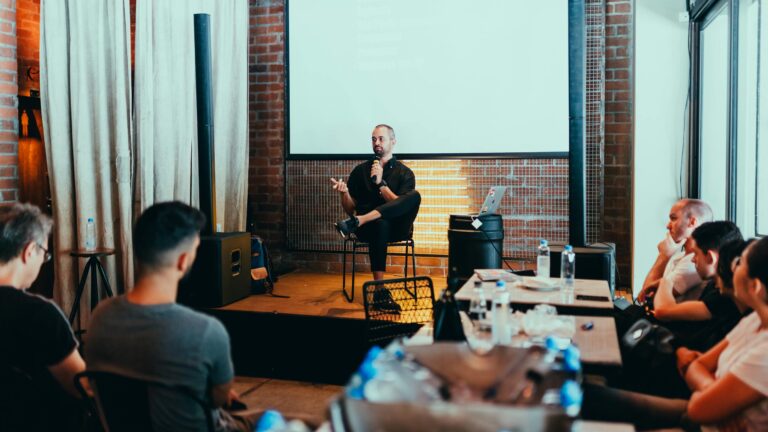
consider this that looked like for me in practice. There was a period in my agency career when I had to give a lot of public presentations to rooms full of people I didn’t know, and the anticipatory anxiety was often worse than the event itself. So I started deliberately seeking out smaller, lower-stakes versions of the same experience. I’d volunteer to speak briefly at internal team meetings before presenting externally. I’d rehearse out loud, alone, until the words felt less foreign in my mouth. I’d arrive early to events so I could get comfortable in the space before it filled with people.
None of this was dramatic. But over months, my nervous system started to update its prediction. The situation that had been coded as “high threat” gradually became “manageable challenge.” That’s how exposure works. Not by eliminating fear, but by accumulating evidence that contradicts the threat signal.
Published research in PMC supports the effectiveness of exposure-based approaches for social anxiety, with consistent evidence that gradual, repeated contact with feared situations reduces avoidance behavior and the intensity of the anxious response over time. The mechanism isn’t mysterious. It’s the brain updating its threat model based on new data.
What Role Does the Body Play in Social Anxiety?
Most people think of social anxiety as a mental experience, the racing thoughts, the catastrophic predictions, the post-event replay. And it is all of those things. But it’s also deeply physical. The racing heart, the tight chest, the shallow breathing, the sudden awareness of your own hands. These physical responses aren’t just symptoms. They’re part of the feedback loop that keeps anxiety going.
When the body signals danger, the mind interprets that signal as confirmation that something is wrong. Which makes the body signal harder. Which the mind interprets as more evidence of danger. Breaking that loop requires working at the physical level, not just the cognitive one.
Slow, diaphragmatic breathing is one of the most accessible tools available, and it works because it directly activates the parasympathetic nervous system. Breathing out longer than you breathe in, specifically, signals safety to the brain. This isn’t a metaphor. It’s physiology. Extending the exhale changes the heart rate variability pattern in a way the nervous system reads as “not a threat.”
For highly sensitive people, managing the physical dimension of anxiety is especially important because the sensory experience of anxiety can itself become overwhelming. If you recognize yourself in this, the piece I wrote on managing sensory overload goes deeper into why HSPs experience stimulation so intensely and what actually helps regulate it.
Progressive muscle relaxation is another body-level tool worth building into a regular practice. The process of deliberately tensing and releasing muscle groups teaches the body to recognize the difference between tension and relaxation, which becomes a resource you can draw on in anxious moments. It sounds almost too simple. But practiced consistently, it builds a kind of somatic vocabulary that’s genuinely useful.

How Do You Change the Thought Patterns That Feed Anxiety?
Social anxiety is sustained by specific patterns of thinking. Mind-reading (assuming you know what others are thinking, and that it’s negative). Fortune-telling (predicting that things will go badly). Catastrophizing (treating a mildly awkward moment as a social catastrophe). Spotlight effect (believing everyone noticed and remembered your stumble when most people were thinking about themselves).
Recognizing these patterns is the first step. Not to shame yourself for having them, but to create a small gap between the thought and your automatic belief in it. That gap is where change happens.
One practice that helped me considerably was what I’d call an evidence audit. After a social situation that triggered anxiety, instead of letting my mind run its usual analysis of everything that went wrong, I’d force myself to also list what went right. Not in a forced-positive way. Just as an honest accounting. Because the anxious mind has a strong negativity bias, it will reliably overlook neutral or positive data unless you deliberately go looking for it.
I remember a particularly difficult new business pitch early in my agency days. We didn’t win the account. My anxious mind immediately catalogued every moment I’d stumbled, every question I’d answered less sharply than I wanted to. But when I actually reviewed the meeting honestly, I could also see that I’d built genuine rapport with two of the decision-makers, that my creative thinking had landed well, and that the loss came down to budget, not performance. The anxious narrative and the actual evidence were telling very different stories.
The Psychology Today piece on introversion and social anxiety makes an important distinction worth holding onto: introverts prefer less social stimulation, but they don’t necessarily fear social situations. Social anxiety involves fear and avoidance. Knowing which one you’re dealing with changes how you approach it.
Cognitive restructuring, the formal name for this kind of thought pattern work, is most effective when it’s practiced regularly rather than reserved for crisis moments. A brief daily check-in where you notice what your mind is predicting, what evidence supports or contradicts that prediction, and what a more balanced interpretation might be can shift the baseline over weeks and months.
What About the Social Anxiety That Comes From Empathy Overload?
There’s a version of social anxiety that doesn’t get talked about enough: the kind that’s driven not by fear of judgment, but by the sheer weight of absorbing other people’s emotional states. For highly sensitive people and empaths, social situations can be exhausting not because they’re threatening in the conventional sense, but because they involve taking in so much emotional data that the nervous system becomes overwhelmed.
I managed several highly empathic people during my agency years, and watching them move through client-heavy environments gave me a window into how different this experience is from my own. As an INTJ, I process social information analytically. I observe, I assess, I respond. The INFJs and ENFJs on my teams were doing something qualitatively different. They were absorbing the emotional texture of every room they walked into, often without any choice in the matter. The exhaustion that followed wasn’t weakness. It was the cost of a different kind of perception.
If your social anxiety has this flavor to it, the work of understanding empathy as both a strength and a source of strain is worth spending time with. success doesn’t mean become less empathic. It’s to develop clearer boundaries around emotional absorption so you’re choosing what you take in rather than being flooded by it.
Practical tools for this include setting clear intentions before social events (“I’m going to observe without absorbing”), giving yourself explicit permission to leave when you’re at capacity, and building in decompression time afterward that isn’t negotiable. These aren’t workarounds. They’re the infrastructure that makes social participation sustainable.
Does Perfectionism Make Social Anxiety Worse?
Almost always, yes. Perfectionism and social anxiety have a tight, mutually reinforcing relationship. Perfectionism raises the stakes of every social interaction by insisting that you perform flawlessly, that you say exactly the right thing, that you come across in precisely the way you intend. Social anxiety then responds to those impossibly high standards by generating fear proportional to the perceived risk of failure.
The American Psychological Association’s overview of shyness and social anxiety points to self-focused attention as a core maintaining factor. When you’re hyperaware of your own performance in social situations, you’re simultaneously less present in the conversation and more likely to notice (and catastrophize) every imperfection.
Perfectionism in social contexts often shows up as extensive preparation for conversations that may never happen, rehearsing what you’ll say before events, and spending significant time after interactions analyzing what you should have said differently. Some preparation is useful. But when preparation becomes a way of managing anxiety rather than a genuine tool for effectiveness, it starts feeding the problem rather than solving it.
The deeper work here involves examining what’s underneath the perfectionism. Often it’s a belief that your value as a person is contingent on performing well socially. That belief deserves to be questioned directly, not just managed around. The piece on breaking free from perfectionism’s high standards trap gets into this in a way that’s particularly relevant for sensitive, introspective people who hold themselves to exhausting standards.

How Does Fear of Rejection Feed the Anxiety Loop?
Social anxiety and fear of rejection are so intertwined that it’s sometimes hard to tell where one ends and the other begins. Much of what drives avoidance behavior in social anxiety is the anticipation of rejection, whether that’s rejection in the form of disapproval, exclusion, judgment, or simply not being liked. The avoidance feels protective. In the short term, it is. In the longer term, it prevents the very experiences that would update the nervous system’s threat model.
Rejection sensitivity is particularly pronounced in highly sensitive people, and it can operate well below the level of conscious awareness. You might not consciously think “I’m afraid of being rejected.” You might just feel a vague reluctance to reach out, a hesitation before speaking up, a tendency to hold back in group settings. The underlying fear is doing its work quietly.
Processing rejection experiences, rather than suppressing them, is a significant part of reducing their power over future behavior. The work of healing from rejection as an HSP is worth engaging with seriously, because unprocessed rejection experiences tend to accumulate and shape the nervous system’s baseline threat level in social situations.
One reframe that’s been genuinely useful to me: rejection is data, not verdict. When a client chose a different agency, that was information about fit, timing, budget, and a hundred other factors. It wasn’t a verdict on my worth as a professional or a person. Training the mind to hold rejection as information rather than judgment is slow work, but it changes the stakes of social situations considerably.
What Daily Habits Actually Move the Needle?
Self-treatment for social anxiety isn’t a collection of crisis interventions. It’s a set of daily practices that gradually shift the baseline. consider this I’ve found actually moves things over time, rather than just providing temporary relief.
Regular physical movement is consistently underrated in conversations about anxiety. Exercise changes the neurochemical environment of the brain in ways that directly reduce anxiety sensitivity. It doesn’t need to be intense or elaborate. A consistent daily walk is enough to produce meaningful effects on mood and baseline anxiety over weeks.
Sleep is non-negotiable. An anxious brain on insufficient sleep is operating with significantly reduced capacity for emotional regulation. I’ve noticed this pattern in myself for years: the days when social situations feel most threatening are almost always days when I haven’t slept well. The threat feels real. The capacity to respond to it rationally is diminished. Protecting sleep is protecting mental health in a very direct way.
Limiting alcohol is worth mentioning because many people with social anxiety use it as a social lubricant, and the short-term relief it provides comes with a significant cost. Alcohol disrupts sleep architecture, increases baseline anxiety the following day, and prevents the nervous system from building genuine tolerance to social situations. Over time, it often makes social anxiety worse, not better.
Journaling, specifically the kind that processes social experiences rather than just records them, is something I’ve returned to consistently throughout my career. Not elaborate entries. Just a few minutes after a challenging social situation to write honestly about what happened, what I felt, what the evidence actually showed, and what I’d do differently. This kind of processing prevents the emotional residue from calcifying into avoidance.
For those who experience anxiety that’s also tied to heightened sensitivity, the connection between HSP anxiety and its specific coping strategies is worth understanding on its own terms. Sensitive people often need approaches that account for their particular nervous system, not just generic anxiety advice.
When Should Self-Treatment Be Combined With Professional Support?
Self-treatment is genuinely powerful, and for many people it’s sufficient. But there are situations where it works best as a complement to professional support rather than a replacement for it.
If social anxiety is significantly limiting your life, preventing you from pursuing relationships, career opportunities, or experiences that matter to you, professional support isn’t a sign of failure. It’s a resource. Cognitive behavioral therapy for social anxiety has a strong evidence base, and a skilled therapist can help you work through the specific patterns and histories that self-treatment can’t always reach.
Research published in PMC examining treatment approaches for social anxiety disorder consistently finds that combining behavioral approaches with professional guidance produces stronger outcomes than either alone for more severe presentations. That’s not an argument against self-treatment. It’s an argument for being honest about what level of support your situation actually calls for.
There’s also the question of what’s driving the anxiety. Social anxiety that’s rooted in a specific history of difficult social experiences, early rejection, bullying, or environments where authenticity wasn’t safe, often benefits from working with someone who can help you process that history directly. Self-treatment practices are excellent for managing the present. They have limits when it comes to healing the past.

What Does Progress Actually Look Like?
Progress with social anxiety rarely looks like the absence of anxiety. It looks like anxiety that’s less frequent, less intense, and less limiting. It looks like going into a social situation with some nervousness and coming out having functioned well anyway. It looks like the post-event replay getting shorter. It looks like trying something that previously felt impossible and surviving it, and then doing it again.
One of the most important shifts I’ve made in my own relationship with social anxiety is decoupling it from self-worth. Feeling anxious in social situations doesn’t mean I’m broken, inadequate, or unsuited for connection. It means I have a sensitive nervous system that learned to be cautious in certain contexts. That’s information about my history and my wiring, not a verdict on my value.
The Jungian perspective on typology and psychological wellbeing offers a useful frame here: growth doesn’t mean becoming a different person. It means becoming more fully yourself, with greater access to your own capacities and less interference from fear. That’s as true for social anxiety as it is for any other aspect of psychological development.
Progress is also not linear. There will be periods where anxiety spikes again, where situations that felt manageable suddenly feel hard again. Stress, sleep deprivation, major life transitions, all of these can temporarily raise the baseline. That’s not regression. That’s the normal texture of working with a sensitive nervous system over a lifetime.
What matters is the overall trajectory, and the fact that you’re building a set of practices and perspectives that you can return to. Self-treatment for social anxiety isn’t a course you complete. It’s a relationship you develop with your own nervous system, one that deepens and becomes more resourceful over time.
If you want to keep exploring the intersection of introversion, sensitivity, and mental health, the full collection of resources in our Introvert Mental Health Hub covers everything from anxiety to emotional processing to the specific challenges highly sensitive people face in a world that doesn’t always accommodate our wiring.
About the Author
Keith Lacy is an introvert who’s learned to embrace his true self later in life. After 20 years in advertising and marketing leadership, including running agencies and managing Fortune 500 accounts, Keith now channels his experience into helping fellow introverts understand their strengths and build fulfilling careers. As an INTJ, he brings analytical depth and authentic perspective to every article, drawing from both professional expertise and personal growth.
Frequently Asked Questions
Can social anxiety actually be treated without professional help?
For many people, yes. Self-treatment approaches including graduated exposure, cognitive restructuring, nervous system regulation practices, and consistent daily habits can produce meaningful, lasting reduction in social anxiety. The effectiveness depends on the severity of the anxiety and the consistency of the practice. Mild to moderate social anxiety often responds well to structured self-treatment. More severe presentations, particularly those that significantly limit daily functioning, generally benefit from combining self-treatment with professional support.
How long does it take for self-treatment to work?
Most people notice some shift in their anxiety within four to eight weeks of consistent practice, though meaningful change in deeply ingrained patterns typically takes several months. Progress isn’t linear. There will be periods of improvement followed by temporary spikes, particularly during stressful life periods. The goal is a gradual overall shift in the baseline, not a sudden disappearance of anxiety. Consistency matters far more than intensity. Brief daily practices produce better outcomes than occasional intensive efforts.
Is social anxiety the same thing as introversion?
No, and the distinction matters. Introversion is a preference for less social stimulation and a tendency to recharge through solitude. Social anxiety involves fear, avoidance, and distress in social situations. An introvert may prefer smaller gatherings and need recovery time afterward without experiencing any fear or avoidance. A person with social anxiety experiences dread, anticipatory worry, and often significant interference with daily functioning. The two can and do co-occur, but they’re separate experiences with different origins and different approaches to address them.
Why do highly sensitive people often experience more intense social anxiety?
Highly sensitive people process sensory and emotional information more deeply than average, which means social situations involve more data, more nuance, and more emotional texture to manage. This depth of processing can make social environments more stimulating and potentially more overwhelming. HSPs also tend to be more aware of subtle social cues, which can amplify the experience of being evaluated or observed. Additionally, the empathic absorption that many HSPs experience in social settings adds another layer of complexity that isn’t present for less sensitive people.
What’s the single most important thing someone can do to start addressing social anxiety on their own?
Begin with graduated exposure to the situations that trigger anxiety, starting at a level that’s uncomfortable but not overwhelming. Avoidance is the primary behavior that maintains social anxiety over time. Every time a feared situation is avoided, the brain’s threat model is reinforced. Every time the situation is faced and survived, even imperfectly, the threat model is updated. Start small, be consistent, and give the nervous system time to accumulate new evidence. Pair this with a daily breathing or relaxation practice to build the physiological regulation capacity that makes exposure more manageable.