
Developing a reading habit comes down to one simple shift: stop treating books as obligations and start treating them as the most reliable form of solitude you have. Once reading becomes part of how you recharge rather than another item on your to-do list, the habit builds itself. The challenge isn’t finding time. It’s finding the right relationship with the practice.
That reframe took me longer than I’d like to admit.
For most of my career running advertising agencies, I kept a stack of books on my nightstand that functioned more as aspirational decoration than actual reading material. Business books, strategy titles, the occasional novel someone recommended at a client dinner. They sat there collecting dust while I scrolled through email at 11 PM, convincing myself I was being productive. The irony is that I’m someone who genuinely loves to read. I just hadn’t figured out how to protect that love from the noise of a demanding career.
If you recognize yourself in that description, this article is for you. Not because I have a perfect system to sell you, but because I’ve spent years figuring out what actually works for an introvert who processes the world deeply, gets overstimulated easily, and needs solitude to function well.
Reading and solitude aren’t separate practices. They’re the same practice, approached from different angles. If you’re building a reading habit, you’re also building a richer relationship with your own inner life. Our Solitude, Self-Care & Recharging hub explores that connection across many dimensions, and reading sits squarely at the center of it.

Why Do Introverts Struggle to Build a Reading Habit Despite Loving Books?
There’s a particular kind of frustration that comes from loving something and still failing to make time for it. I’ve felt it acutely around reading. As an INTJ, I’m drawn to ideas, to systems, to understanding how things work beneath the surface. Books are the natural home for that kind of thinking. And yet, for years, I let the habit slip.
Career Coaching for Introverts
One-on-one career strategy sessions with Keith Lacy. 20 years of Fortune 500 leadership as an introvert, now helping others build careers that work with their wiring.
Learn More50-minute Zoom session · $175
Part of the problem is that introverts often mistake exhaustion for laziness. After a full day of client presentations, agency-wide meetings, and the constant performance of extroverted leadership, I would come home depleted in a way that felt physical. Sitting down with a book felt like adding another demand to an already overwhelmed system. What I didn’t understand then is that reading, done right, is actually restorative. It’s one of the few activities that engages the mind without requiring social output.
There’s also the problem of digital competition. Phones and screens offer the illusion of rest while actually fragmenting attention into smaller and smaller pieces. After years of managing that fragmentation, picking up a book feels effortful in a way it didn’t before. Your brain has been trained to expect constant novelty, and a single sustained narrative doesn’t deliver that dopamine hit fast enough.
And for highly sensitive introverts specifically, there’s another layer. When you absorb content deeply, a difficult book can feel emotionally demanding even when it’s intellectually rewarding. I’ve noticed this in myself: certain books require recovery time the same way certain conversations do. That’s not a weakness in the reading habit. It’s just information about how to pace yourself.
Understanding what happens when introverts don’t get enough alone time helped me see reading in a new light. The irritability, the mental fog, the sense of being slightly out of step with yourself, those aren’t random. They’re signals. And reading, as a form of protected solitude, is one of the most effective responses to those signals.
What Does a Sustainable Reading Habit Actually Look Like?
Forget the advice about reading fifty books a year. That’s a productivity metric dressed up as a lifestyle, and it misses the point entirely. A sustainable reading habit isn’t measured in volume. It’s measured in consistency and depth.
What worked for me was connecting reading to an existing anchor in my day rather than trying to carve out entirely new time. I’m a morning person by nature. As an INTJ, my mind is sharpest before the noise of the day accumulates. So I started keeping a book on the kitchen table and reading for twenty minutes with my first cup of coffee, before email, before news, before anything else. That single change held better than every ambitious “I’ll read an hour before bed” commitment I’d ever made.
The science behind habit formation supports this kind of anchoring. When you attach a new behavior to an existing routine, you reduce the friction of starting. You don’t have to decide to read. You just do what comes next after coffee.
Twenty minutes sounds modest. But twenty minutes daily adds up to roughly 120 hours a year. That’s a lot of books. More importantly, it’s a lot of quiet mornings that belong entirely to you.
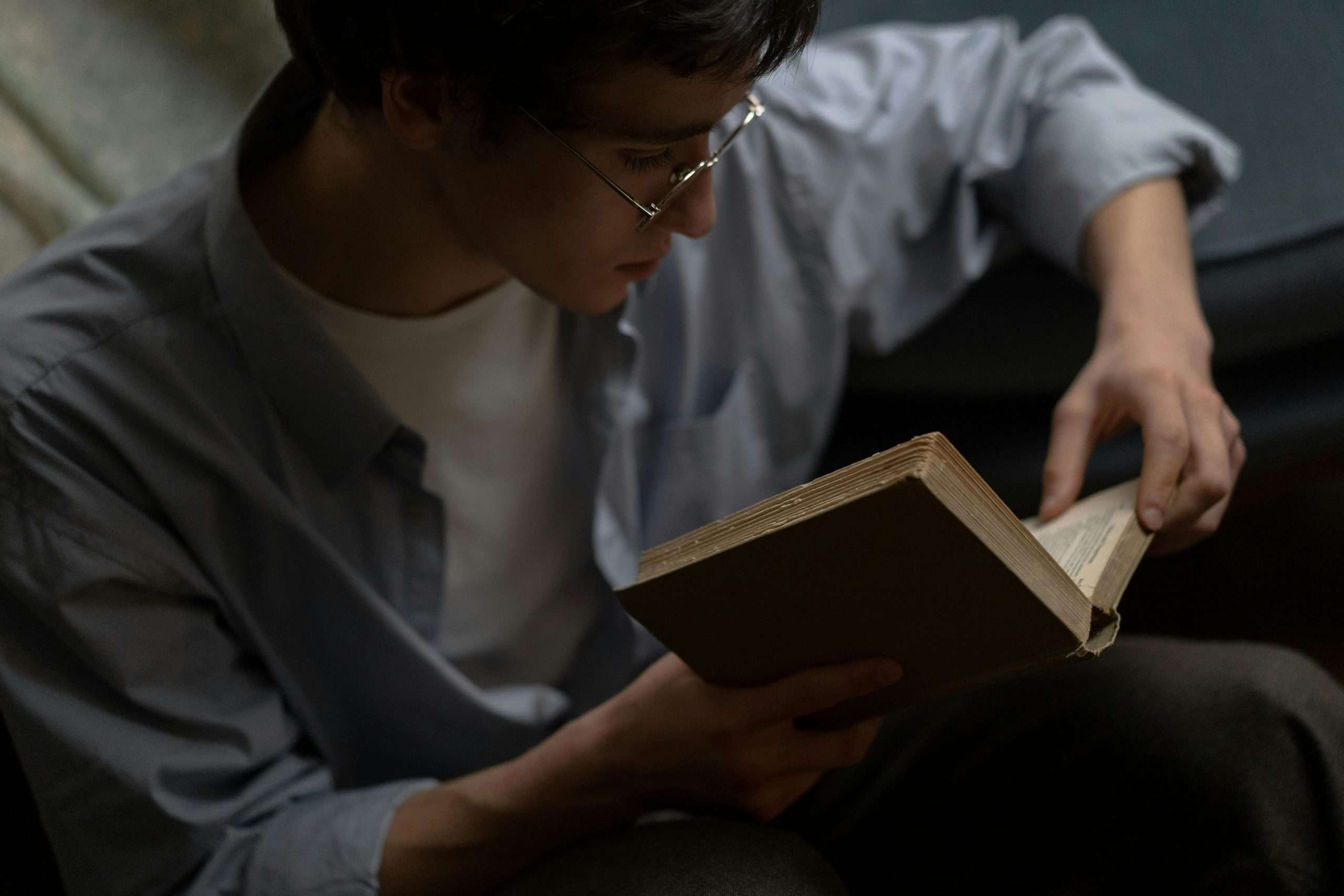
One thing I’ve learned from years of managing creative teams is that the people who actually finish things aren’t necessarily the most ambitious. They’re the most consistent. I had a copywriter at one of my agencies who read a book every three weeks without fail. Not because she had more time than anyone else, but because she treated her reading time as a non-negotiable appointment. She didn’t ask permission to protect it. She just protected it.
That posture matters. Especially for introverts who have been conditioned to treat their own needs as optional.
How Do You Choose the Right Books to Actually Finish?
One of the most underrated reading strategies is permission to quit. Not every book deserves your full attention. Not every book that was right for someone else is right for you. And not every book that was right for you at thirty is right for you at fifty.
I spent years finishing books I didn’t enjoy because abandoning them felt like failure. That’s a mindset worth examining. Every page you spend on the wrong book is a page you’re not spending on the right one. Give a book fifty pages. If it hasn’t earned your continued attention by then, set it down without guilt.
For introverts who process deeply, book selection matters more than it might for casual readers. We don’t skim the surface of a book. We inhabit it. That means a book that doesn’t genuinely interest you will feel like a slog in a way it might not for someone who reads more lightly. Pay attention to what you’re actually drawn to, not what you think you should read.
I’ve found that my reading falls into two categories: books that feed my professional thinking (strategy, leadership, psychology) and books that feed something harder to name, the part of me that needs beauty and narrative and depth. Both matter. The mistake I made for years was treating only the first category as legitimate.
Mixing genres also helps sustain the habit. If you read three heavy nonfiction books in a row, the fourth one will feel like homework. Alternate. Let yourself read something light between something demanding. Your reading life should have rhythm, not just rigor.
Where Does Environment Fit Into Building a Reading Habit?
Environment shapes behavior more than willpower does. That’s something I learned the hard way across twenty years of trying to build productive habits in chaotic agency environments. You cannot out-discipline a bad environment. You have to design the environment first.
For reading, this means creating a physical space that signals to your nervous system that it’s time to settle. It doesn’t have to be elaborate. A specific chair, a lamp you only use for reading, a cup of something warm. The ritual of arriving in that space is part of the practice. Over time, the space itself becomes a cue.
Many introverts find that certain outdoor environments support reading in a way indoor spaces don’t. There’s something about the combination of natural light, ambient sound, and open space that quiets the mental chatter that can make concentration difficult. The research on nature and psychological restoration is compelling, and I’ve experienced it firsthand. Some of my most absorbed reading sessions have happened on a porch or in a park rather than at a desk. The healing connection between sensitive people and the outdoors extends to reading as much as it does to any other restorative practice.

Phone placement is also part of environment design. Not phone discipline. Phone placement. If your phone is within arm’s reach, you will reach for it. That’s not a character flaw. It’s just how attention works in the presence of a device engineered to capture it. Put the phone in another room when you sit down to read. Not forever. Just for the duration of your reading session. That single physical change will do more for your reading habit than any app or productivity system.
Sound matters too. Some introverts read best in complete silence. Others find that low ambient sound, like a coffee shop murmur or instrumental music, provides just enough background stimulation to keep the mind from wandering. Experiment with what works for you rather than assuming silence is always the answer.
How Does Reading Connect to Introvert Self-Care and Recovery?
Reading is one of the most efficient forms of self-care available to introverts, and it’s chronically undervalued as such. We talk about self-care in terms of bubble baths and meditation apps, but for someone wired toward depth and internal reflection, an hour with a genuinely absorbing book can be more restorative than almost anything else.
The mechanism is straightforward. Reading requires focused attention on a single thread of meaning. That sustained focus is actually the opposite of the fragmented, reactive attention that drains introverts in social and digital environments. When you read, you’re not context-switching. You’re not managing other people’s emotional states. You’re not performing. You’re just thinking, quietly, in the company of someone else’s ideas.
That quality of attention has real psychological benefits. Berkeley’s Greater Good Science Center has explored how solitary activities support creativity and self-knowledge, and reading is one of the clearest examples of that dynamic. The ideas you encounter in books don’t just inform you. They become part of the internal conversation you’re always having with yourself.
For highly sensitive introverts, reading also provides a kind of emotional processing that’s hard to find elsewhere. Narrative fiction in particular allows you to inhabit other perspectives, work through complex emotions, and experience catharsis in a contained, low-risk environment. I’ve processed more difficult professional experiences through novels than through any debrief or coaching session. There’s something about the distance of fiction that makes certain truths easier to absorb.
The connection between reading and sleep is also worth noting. Many introverts struggle with the mental wind-down that good sleep requires. Screens make this worse. A book, especially fiction, provides a natural transition between the stimulation of the day and the quiet your nervous system needs to rest. The sleep and recovery strategies that work for sensitive people often include reading as a deliberate pre-sleep ritual, and for good reason.
I’ve also noticed that my reading habit and my emotional regulation are directly correlated. When I’m reading consistently, I’m more patient, more curious, more able to hold complexity without rushing toward resolution. When the habit slips, usually during high-pressure client cycles or major agency transitions, I become more reactive, more surface-level in my thinking. The books aren’t just entertainment. They’re maintenance.
What Role Does Solitude Play in Making Reading a Daily Practice?
Solitude isn’t the backdrop for reading. It’s the prerequisite. You cannot read deeply in a state of social vigilance. And many introverts, especially those who’ve spent years in demanding professional environments, spend more time in that vigilant state than they realize.
Learning to claim solitude intentionally was one of the most significant shifts in my adult life. Not solitude as isolation or withdrawal, but solitude as a deliberate practice of being with yourself. The kind of quiet that allows your own thoughts to surface rather than constantly responding to external demands.
Reading lives in that space. And the more comfortable you become with genuine solitude, the more easily reading will come. The two practices reinforce each other. Solitude creates the conditions for deep reading. Deep reading makes solitude feel rich rather than empty.
There’s a particular quality to the solitude that reading requires. It’s not passive. You’re actively engaged with ideas, characters, arguments. But the engagement is entirely internal. No one is waiting for your response. No one is watching your reaction. You can sit with confusion, circle back to a difficult passage, or simply let your mind wander into the territory a book opens up. That freedom is rare and genuinely nourishing.
The essential need for solitude among sensitive introverts isn’t a personality quirk to work around. It’s a legitimate psychological requirement. Building a reading habit is one of the most practical ways to honor that requirement, because it gives solitude a structure and a purpose that makes it easier to protect.

I think about a period a few years into running my first agency when I had essentially no solitude at all. I was managing a team of thirty, fielding client calls at all hours, and measuring my value by how available I was. My reading had completely collapsed. And I was, quietly, falling apart in ways I couldn’t name at the time. Reclaiming reading wasn’t just about books. It was about reclaiming the internal life that all that noise had crowded out.
Some introverts find that even brief periods of intentional alone time, structured around reading, make a measurable difference in their overall wellbeing. I’ve seen this described as a kind of meaningful alone time that goes beyond passive rest. Reading gives solitude a direction without turning it into productivity. That balance is harder to find than it sounds.
How Do You Protect Your Reading Time When Life Gets Loud?
The habit will get interrupted. That’s not a prediction. It’s a certainty. Client deadlines, family demands, illness, travel, the accumulated weight of a busy life. The question isn’t how to prevent interruption. It’s how to return after one.
Most people treat a broken habit as evidence that they’re not a “reading person.” That framing is worth rejecting entirely. Missing a week of reading doesn’t erase the habit. It just creates a gap. Gaps are normal. What matters is the return.
When I came back to reading after a long stretch away, I always started with something easy. Not intellectually lightweight necessarily, but emotionally accessible. A book I was genuinely excited about rather than one I felt obligated to finish. Re-entry is easier when the book is doing some of the work of pulling you in.
Protecting reading time in a busy household or professional life requires the same skills that introverts need for any kind of self-care: the ability to set limits, to communicate needs, and to treat your own restoration as legitimate rather than indulgent. The daily self-care practices that serve sensitive people consistently include protected quiet time, and reading is one of the most sustainable ways to structure that time.
One practical approach that’s worked for me: treat reading like a meeting you’ve already agreed to. It’s in the calendar. It has a start time. You don’t skip it because something else came up unless that something else is genuinely urgent. Most things that feel urgent aren’t. And most of the time you spend scrolling or half-watching television could, with a small shift in intention, become reading time instead.
Audiobooks deserve a mention here. I resisted them for years, convinced that “real” reading required a physical book. That’s a gatekeeping instinct worth releasing. Audiobooks during commutes, walks, or household tasks can significantly expand your reading life without requiring additional time. They’re not a lesser form of reading. They’re a different form, suited to different moments.
What Happens to Your Inner Life When Reading Becomes a Real Habit?
Something quieter and more significant than productivity happens when reading becomes genuinely consistent. Your inner life gets richer. Not in a vague, aspirational sense, but in a way you can actually feel.
You start noticing connections between ideas across books, across years, across disciplines. A concept from a philosophy book surfaces unexpectedly while you’re working through a client problem. A character’s response to failure gives you language for something you’ve been carrying without being able to name it. The books don’t stay in their separate containers. They become part of how you think.
For introverts who already process deeply, this effect is amplified. We’re not skimming ideas. We’re absorbing them, turning them over, testing them against experience. That’s why reading is such a natural fit for the introvert mind. It rewards exactly the kind of attention we’re already inclined to give.
There’s also a social dimension that surprised me. I’m more interesting in conversation when I’m reading consistently. Not because I’m performing knowledge, but because I have more genuine curiosity, more angles on things, more questions worth asking. The books don’t just feed my solitude. They improve my presence with other people.
Psychological research on reading and wellbeing consistently points toward the same conclusion: sustained engagement with books is associated with reduced stress, stronger empathy, and greater cognitive flexibility. Research published in PubMed Central has examined how reading-related practices affect mental health outcomes, finding meaningful connections between sustained literary engagement and psychological wellbeing. That’s not surprising to anyone who’s experienced what a good book can do for a depleted mind.
What I can tell you from personal experience is that the years when I read most consistently were the years I felt most like myself. Not coincidentally, they were also the years I led most effectively. The reading wasn’t separate from the work. It was part of what made the work possible.

The broader landscape of introvert self-care, solitude, and sustainable daily practices is something we explore in depth across our Solitude, Self-Care & Recharging hub. Reading is one thread in that larger conversation, but it’s a thread worth pulling.
About the Author
Keith Lacy is an introvert who’s learned to embrace his true self later in life. After 20 years in advertising and marketing leadership, including running agencies and managing Fortune 500 accounts, Keith now channels his experience into helping fellow introverts understand their strengths and build fulfilling careers. As an INTJ, he brings analytical depth and authentic perspective to every article, drawing from both professional expertise and personal growth.
Frequently Asked Questions
How long does it take to develop a reading habit?
Most people find that a reading habit starts to feel natural after three to four weeks of consistent daily practice, even if that practice is only fifteen to twenty minutes. The anchor matters more than the duration. Attaching reading to an existing routine, like morning coffee or a pre-sleep wind-down, dramatically reduces the friction of starting. Don’t measure progress by how many books you finish. Measure it by how many consecutive days you showed up.
Why do introverts tend to be strong readers?
Introverts are naturally oriented toward depth, internal reflection, and sustained focus, qualities that make reading feel rewarding rather than effortful. Where extroverts often need external stimulation to stay engaged, introverts tend to find rich inner engagement with ideas, narrative, and language. Reading also provides the kind of solitary, low-stimulation environment where introverts naturally recharge, which means the activity itself is restorative rather than depleting.
What’s the best time of day to read for introverts?
There’s no single best time, but two windows tend to work particularly well for introverts. Morning reading, before social demands accumulate, allows for sharp, focused engagement with ideas. Evening reading, especially fiction, provides a natural transition out of the overstimulation of the day and supports better sleep. The right time is the one you can protect consistently. Experiment with both and notice which leaves you feeling more restored.
How do you maintain a reading habit during high-stress periods?
Reduce the expectation rather than abandoning the habit entirely. During demanding professional or personal periods, even five minutes of reading counts. The goal is to keep the neural pathway active, not to hit a page count. Choose lighter, more accessible reading during stressful stretches and return to more demanding books when your bandwidth recovers. Treating a gap as a pause rather than a failure makes returning much easier.
Do audiobooks count as part of a reading habit?
Absolutely. Audiobooks engage the same content through a different sensory channel, and for introverts who spend significant time commuting, walking, or doing household tasks, they can meaningfully expand the amount of reading in a day without requiring additional time. Some books are better experienced in audio form, particularly memoirs and narrative nonfiction where the author’s voice adds dimension. The format is less important than the sustained engagement with ideas and story.