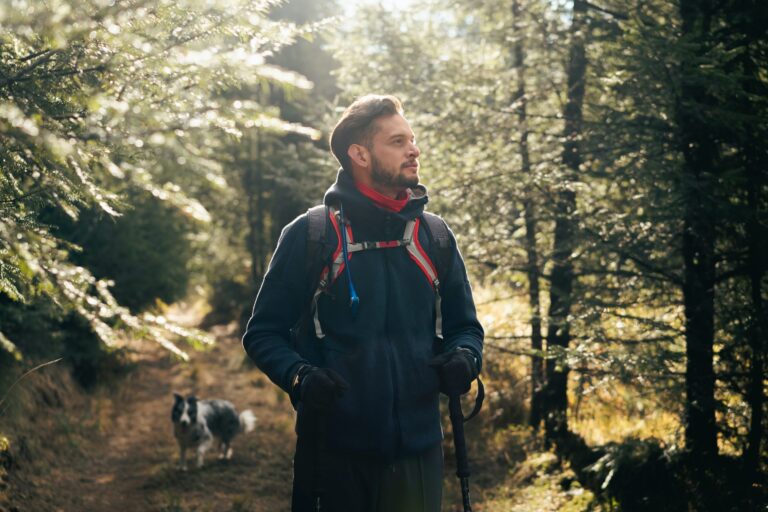

Highly sensitive people experience nature differently than most. Where others see a pleasant walk in the park, HSPs often feel something closer to a full nervous system exhale, a physical and emotional release that no amount of indoor rest quite replicates. The sensory richness of the outdoors, the layered sounds, shifting light, and textured ground beneath your feet, meets the HSP’s depth of processing in a way that genuinely restores rather than depletes.
That distinction matters. Because for highly sensitive people, nature isn’t simply a nice backdrop for relaxation. It’s one of the few environments calibrated closely enough to the HSP nervous system to support real recovery, genuine reflection, and something that feels almost like coming home to yourself.

I’ve been writing about the deeper layers of introvert and HSP self-care for a while now, and this particular angle keeps pulling me back. Not because it’s trendy, but because it’s personal. And because the science behind it is more compelling than most people realize. If you want to explore the broader territory of recharging and solitude, our Solitude, Self-Care and Recharging hub covers the full landscape. What I want to do here is go somewhere more specific: the relationship between HSP wiring and the natural world, and why that relationship is worth cultivating with intention.
Why Does Nature Feel Different to Highly Sensitive People?
Elaine Aron’s foundational research on high sensitivity describes a trait characterized by deeper cognitive processing of sensory and emotional information. HSPs notice more. They process more. They feel the weight of environments more acutely than people without this trait. That’s not a flaw in the system. It’s the system working exactly as designed.
What’s your personality type?
Take our free 40-question assessment and get a detailed personality profile with dimension breakdowns, context analysis, and personalised insights.
Discover Your Type8-12 minutes · 40 questions · Free
The challenge is that most modern environments are calibrated for a different kind of nervous system. Open offices, constant notifications, fluorescent lighting, and the relentless social demands of professional life generate a sensory load that HSPs absorb at a much higher rate than their non-sensitive colleagues. By the end of a typical workday, many highly sensitive people aren’t just tired. They’re overstimulated in a way that ordinary rest doesn’t fully address.
Nature operates on a different frequency. A 2019 study published in Frontiers in Psychology found that spending at least 120 minutes per week in natural environments was significantly associated with good health and strong wellbeing across a large population sample. What the research points toward, and what HSPs often report anecdotally, is that natural environments provide stimulation that is complex without being chaotic. Rich without being overwhelming. The rustling of leaves, the movement of water, the gradual shift of light through clouds: these are layered sensory inputs that the HSP nervous system can actually metabolize rather than simply endure.
There’s a concept in environmental psychology sometimes called “soft fascination,” the idea that natural settings hold attention gently rather than demanding it. For highly sensitive people whose attention systems are already working overtime, that gentleness isn’t a small thing. It’s the difference between an environment that asks more of you and one that finally gives something back.
What Does the Research Actually Say About Nature and Sensitive Nervous Systems?
The science here has gotten more specific in recent years, and it’s worth paying attention to. A 2017 study from Stanford researchers, covered extensively by Yale Environment 360, found that walking in natural settings reduced activity in the subgenual prefrontal cortex, the region of the brain associated with rumination and repetitive negative thinking. For HSPs, who tend toward deep emotional processing that can tip into overthinking, that finding is particularly significant.
A 2015 meta-analysis published in PubMed examined the effects of nature exposure on psychological stress and found consistent reductions in cortisol levels, heart rate, and self-reported anxiety across multiple study types. The effect was stronger for people who reported higher baseline stress levels, which maps closely onto the HSP experience of carrying more sensory and emotional load than average.

More recent work has examined the neurological mechanisms more closely. A 2024 study in Frontiers in Psychology explored how natural environments modulate autonomic nervous system activity, finding measurable shifts toward parasympathetic dominance (the “rest and digest” state) during nature exposure. For highly sensitive people whose sympathetic nervous systems are frequently activated by the demands of daily life, that parasympathetic shift isn’t just pleasant. It’s physiologically necessary.
I want to be careful not to overstate this. Nature isn’t a cure for the challenges that come with high sensitivity, and Psychology Today has written thoughtfully about the importance of not pathologizing the HSP trait itself. High sensitivity is a normal human variation, not a disorder requiring treatment. What nature offers isn’t therapy in the clinical sense. It’s more like returning to an environment where your nervous system was designed to function.
How Does Nature Interact With the HSP’s Depth of Processing?
One thing I’ve noticed in my own experience is that the outdoors doesn’t just calm me down. It seems to sharpen the quality of my thinking. Not in the urgent, deadline-driven way that coffee and pressure can produce, but in a slower, more integrative way. Ideas connect. Patterns emerge. Emotions that had been sitting in a kind of holding pattern start to actually move.
I ran advertising agencies for more than two decades. Some of my best creative thinking happened not in brainstorming sessions or strategy meetings, but on long walks through whatever city I happened to be in for a client presentation. I remember walking through Grant Park in Chicago the morning before a major pitch to a Fortune 500 retail client. The account was worth more than anything we’d handled before, and I’d been awake most of the night running scenarios. An hour outside didn’t solve the strategic problem. What it did was quiet the noise enough that I could actually hear what I already knew.
That experience maps onto what we understand about HSP cognitive processing. Highly sensitive people don’t just perceive more information, they process it more thoroughly. A 2022 review published via PubMed Central on sensory processing sensitivity found that HSPs show greater activation in brain regions associated with awareness, empathy, and integration of complex information. That’s a genuine cognitive strength. And like any strength, it functions best in the right conditions.
Natural environments seem to provide those conditions. The gentle, non-demanding stimulation of the outdoors gives the HSP’s processing system something to work with without overwhelming it. You’re not being asked to respond, react, or perform. You’re simply present, and your mind can do what it does best: notice, connect, and make meaning.
That’s also why I think nature works so well alongside the kind of reflective practices I’ve written about elsewhere. The importance of reflection for introverts is something I come back to often, and spending time outdoors creates a natural container for that reflection. The environment does some of the work of quieting external demands so that your internal processing can actually surface.
What Kinds of Nature Experiences Work Best for HSPs?
Not all outdoor time is created equal, and that matters for highly sensitive people. A crowded beach on a holiday weekend and a quiet trail through a state forest are both “nature,” but they produce very different experiences in an HSP nervous system.
The research on what’s sometimes called “restorative environments” points toward several qualities that make natural settings particularly effective for nervous system recovery. These include a sense of being away from ordinary demands, a feeling of extent (being in a space that feels larger than your immediate concerns), compatibility with your current intentions, and what researchers call fascination, the soft, effortless attention that natural settings tend to produce.
For HSPs specifically, the “away” quality tends to be especially important. Part of what makes urban and professional environments so draining is the constant social monitoring that sensitive people do, often without realizing it. Picking up on the emotional undercurrents in a meeting, noticing the subtle shift in a colleague’s tone, feeling the ambient stress of a busy office: all of that requires energy. Environments with fewer people, and fewer social cues to process, allow the HSP to genuinely step back from that work.
Solo nature time tends to be more restorative for most HSPs than group outdoor activities, at least for the purpose of genuine recharging. This isn’t antisocial. It’s the same logic that underlies everything we understand about the role of solitude in an introvert’s life. Alone time isn’t a retreat from connection. It’s the condition that makes meaningful connection possible again.
That said, there’s real value in shared nature experiences when they’re chosen carefully. A slow walk with one trusted person, in a quiet setting, with no agenda beyond being present: that can be deeply nourishing. What drains HSPs isn’t other people per se. It’s the performance layer that often comes with social situations. Strip that away, and shared silence in a beautiful place can be its own form of restoration.
How Can HSPs Build a Sustainable Relationship With Nature?
One pattern I’ve seen in myself and in conversations with other sensitive, introverted people is the tendency to treat nature as something you access when things get really bad. You push through weeks of overstimulation and depletion, and then finally take a long hike or spend a weekend somewhere quiet, and feel dramatically better. Then the cycle starts again.
That approach works, but it’s essentially crisis management. What serves HSPs better is treating nature contact as a regular maintenance practice rather than an emergency intervention. Small, consistent doses tend to produce more stable nervous system regulation than infrequent large ones.
During my agency years, I had a period where I was commuting into a major city five days a week, managing a team of about thirty people, and handling client relationships that required near-constant availability. My wellbeing strategy at the time was essentially “survive the week and recover on weekends.” It worked in the short term and cost me significantly over time. What I eventually figured out was that even fifteen minutes in the small park near our office at lunch changed the quality of my afternoons in ways that were measurable. Not a dramatic reset, but enough of a recalibration that I could actually function at the level the work required.
For HSPs building this kind of practice, it helps to think in terms of layers. Daily micro-doses might mean a brief walk outside in the morning, eating lunch near a window with a view of trees, or spending ten minutes in a garden before the day starts. Weekly deeper exposures might mean a longer walk, a visit to a park or nature reserve, or time near water. Occasional immersions, overnight trips, extended time in natural settings, provide the deeper reset that shorter exposures can’t fully replicate.
The micro-doses matter more than people realize. A 2021 study published in PubMed Central found that even brief urban nature exposures, defined as short periods of contact with trees, grass, or natural elements in city environments, produced measurable improvements in mood and cognitive performance. For HSPs who live in cities and can’t always access wilder landscapes, that finding is genuinely encouraging.
What Role Does Mindful Attention Play in HSP Nature Connection?
There’s a difference between being in nature and actually connecting with it. Plenty of people walk through beautiful places while mentally composing emails or rehearsing conversations. For HSPs, who are already wired toward deep sensory processing, the invitation is to lean into that wiring rather than override it.
Mindful attention in natural settings means letting the environment actually register. Noticing the specific quality of light at a particular moment. Feeling the temperature of the air on your skin. Listening for the layers in ambient sound rather than tuning them out. This kind of sensory presence isn’t something HSPs have to work hard to cultivate. It’s closer to something they have to stop suppressing.

Many HSPs spend a significant amount of energy in daily life managing their sensitivity rather than expressing it. Keeping the volume down on their perceptions so they can function in environments that weren’t designed for them. Nature offers a rare context where that management isn’t necessary. Where noticing everything isn’t a liability but a form of genuine engagement with the world.
I’ve found that pairing outdoor time with the kind of mindfulness practices that actually work for introverted, sensitive people produces something greater than either alone. Introvert mindfulness practices tend to favor depth over duration, internal focus over performance, and natural settings amplify both of those qualities. You don’t need a formal meditation practice to benefit from this. Simply slowing down enough to actually receive what the environment is offering is often sufficient.
Some HSPs find it helpful to bring a journal on outdoor walks, not to document everything, but to capture the thoughts and insights that tend to surface when the nervous system finally has room to breathe. Others prefer to leave all devices behind and let the experience be genuinely unrecorded. Both approaches have value. What matters is the quality of presence you bring.
How Does Nature Support the Emotional Processing That HSPs Carry?
Highly sensitive people absorb emotional information from their environments at a rate that can feel relentless. Picking up on the stress of a colleague who’s going through something difficult. Feeling the emotional residue of a tense meeting long after it’s ended. Carrying the weight of news and world events more deeply than others seem to. That emotional load is real, and it accumulates.
Nature provides something that’s hard to articulate but easy to recognize once you’ve experienced it: a kind of emotional neutrality that isn’t indifference. The forest doesn’t need anything from you. The ocean isn’t monitoring your reactions. The mountain doesn’t have an agenda. For people who spend most of their time in environments dense with social and emotional signals, that neutrality is a profound relief.
There’s also something about the scale of natural environments that tends to put HSP emotional experiences in a different perspective. I don’t mean that in a dismissive way, as in “your problems are small compared to the universe.” It’s more that standing in a place that has existed for centuries, watching processes that operate on timescales completely outside human concerns, creates a kind of spaciousness around whatever you’re carrying. The feelings don’t disappear. They just have more room.
This connects to something I think about often in relation to HSP self-care more broadly. The strategies that actually work for sensitive people tend to be ones that create space rather than ones that force resolution. You can’t think your way out of emotional overload. You can’t willpower your way through nervous system depletion. What you can do is create conditions where your system can do what it’s designed to do, process, integrate, and eventually release.
That’s why I consider nature contact one of the more important elements in what I’d call a complete introvert self-care approach. Not a replacement for other practices, but a distinct and irreplaceable one. The outdoors offers something that indoor rest, social connection, creative work, and even meditation can’t fully provide on their own.
What Happens When HSPs Lose Their Connection to Nature?
I spent a period of about eighteen months almost entirely indoors. Not by choice, exactly, but by the logic of a particularly demanding agency growth phase. New office space, a significant new client, a team that had nearly doubled in size. The work was genuinely exciting, and I was genuinely miserable in ways I couldn’t fully account for at the time.
Looking back, the loss of regular outdoor time was one of the factors I consistently underestimated. I was doing everything else I knew to do: protecting some solitude, trying to maintain clear communication boundaries, staying connected to the work that mattered to me. But something essential was missing, and it showed up as a kind of flatness, a reduced capacity for the depth of thinking and feeling that I’d always relied on.
HSPs who lose regular nature contact often describe similar experiences. A gradual dulling of perception. Increased irritability and emotional reactivity. Difficulty accessing the creative and intuitive thinking that normally comes naturally. A sense of being slightly disconnected from themselves. These aren’t dramatic symptoms, but they compound over time in ways that significantly affect quality of life and quality of work.

The good news, if there is any, is that reconnection tends to happen relatively quickly once you prioritize it. The nervous system responds to natural environments in ways that are fairly immediate, even if the deeper restoration takes longer. A single afternoon in a genuinely natural setting can shift something measurably. Regular exposure over weeks and months produces changes that feel more like a return to baseline than a temporary improvement.
For HSPs who’ve been running on empty for a while, that reconnection can feel almost startling. Like a part of you that had gone quiet suddenly has something to say again. That’s worth paying attention to. And it’s worth building structures around so that the connection doesn’t get lost the next time life gets demanding.
How Does Nature Connection Support the Broader HSP Self-Care Picture?
Nature contact doesn’t exist in isolation from the rest of an HSP’s wellbeing practice. It interacts with and amplifies other elements in ways that are worth thinking about deliberately.
Time outdoors tends to improve sleep quality, which matters enormously for sensitive people whose nervous systems need genuine rest to process the day’s intake. It supports the kind of emotional regulation that makes introvert communication confidence more accessible, because you’re not trying to engage with others from a place of depletion. It creates the mental clarity that makes creative work and deep thinking possible.
There’s also something about regular nature time that seems to support a healthier relationship with the HSP trait itself. Spending time in environments that reward sensitivity, where noticing more is genuinely useful, where depth of perception enriches the experience, tends to reinforce a more positive relationship with your own wiring. You’re not managing your sensitivity out there. You’re using it.
That shift in relationship to the trait is meaningful. Much of what makes HSP life challenging isn’t the sensitivity itself but the ongoing effort to contain it in environments that don’t accommodate it. Nature removes that demand. And over time, regular experiences of your sensitivity as an asset rather than a liability changes how you carry it in the environments where it is more challenging.
I think about this in the context of the broader self-care conversation for sensitive and introverted people. Thriving in an extroverted world as an HSP isn’t primarily about managing your sensitivity more effectively. It’s about building a life that includes enough of the right conditions for your nervous system to function well. Nature is one of those conditions. Not optional, not supplemental, but foundational.
Explore more resources on rest, restoration, and intentional solitude in our complete Solitude, Self-Care and Recharging Hub.
About the Author
Keith Lacy is an introvert who’s learned to embrace his true self later in life. After 20 years in advertising and marketing leadership, including running agencies and managing Fortune 500 accounts, Keith now channels his experience into helping fellow introverts understand their strengths and build fulfilling careers. As an INTJ, he brings analytical depth and authentic perspective to every article, drawing from both professional expertise and personal growth.
Frequently Asked Questions
Why do highly sensitive people often feel better in nature than in most other environments?
Natural environments provide complex sensory stimulation that the HSP nervous system can process without becoming overwhelmed. Unlike urban or professional settings that demand constant social monitoring and rapid response, nature offers what researchers call soft fascination, a gentle form of engagement that restores attentional capacity and supports nervous system regulation. HSPs absorb environmental information at a higher rate than average, and natural settings tend to provide input that is rich enough to be engaging without being depleting.
How much time in nature do HSPs actually need to experience benefits?
Research suggests that even brief exposures, as short as ten to fifteen minutes, can produce measurable improvements in mood and cognitive function. A frequently cited population study found that 120 minutes per week in natural environments was associated with significantly better health and wellbeing outcomes. For HSPs, the most effective approach tends to combine small daily doses of nature contact with longer weekly or occasional immersive experiences. Consistency matters more than duration for maintaining nervous system baseline.
Is solo nature time better for HSPs than group outdoor activities?
For the specific purpose of nervous system restoration, solo nature time tends to be more effective for most HSPs. Much of the depletion that sensitive people experience in daily life comes from the ongoing work of social monitoring, picking up on emotional cues, managing others’ reactions, and performing in social contexts. Solo outdoor time removes that layer entirely. Group nature experiences can be nourishing when they involve trusted companions, low social pressure, and shared silence, but they serve a different function than genuine solitary restoration.
What types of natural settings are most restorative for highly sensitive people?
Settings with lower human density tend to work best for HSPs seeking genuine restoration. Forests, bodies of water, open fields, and quiet parks all support parasympathetic nervous system activation. The specific environment matters less than the qualities it offers: a sense of being away from ordinary demands, sufficient space to feel genuinely removed from daily pressures, and natural stimulation that engages attention gently. Even urban green spaces with trees and natural elements provide meaningful benefit when wilder landscapes aren’t accessible.
How does regular nature contact affect an HSP’s emotional processing capacity?
Highly sensitive people absorb and carry emotional information from their environments continuously. Regular nature contact appears to support the integration and release of that accumulated emotional load in several ways. Natural settings provide emotional neutrality, an absence of social demands and signals that allows the nervous system to process what it’s been holding. Research on nature exposure and rumination suggests that time in natural settings reduces activity in brain regions associated with repetitive negative thinking. Over time, consistent nature contact tends to improve emotional regulation capacity and reduce the reactivity that builds when HSPs remain in depleting environments without adequate restoration.