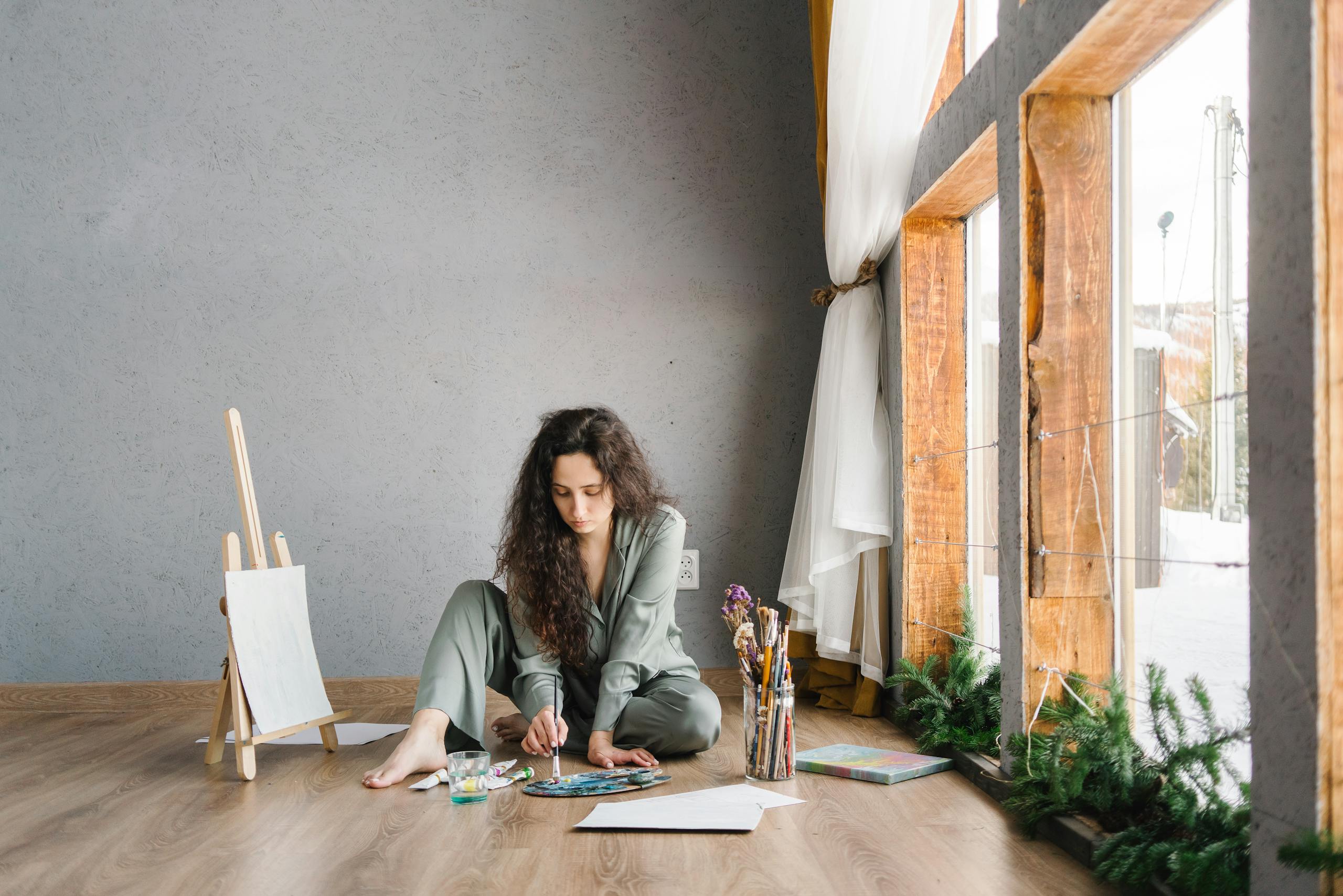

You know that moment when someone asks about your art and you’d rather just let the work speak for itself? That tension between creating something deeply personal and having to explain it to others captures something fundamental about the artistic experience for those of us wired for quiet reflection.
The creative process doesn’t announce itself with fanfare. It arrives in the spaces between obligations, in the hours when the world goes quiet and the internal landscape expands. During my years in advertising, I watched countless talented creatives struggle to balance their need for solitude with the collaborative demands of agency life. The ones who thrived weren’t necessarily the loudest voices in brainstorms. They were the ones who disappeared into their work and emerged with something no committee could have conceived.

Finding your place as an artist when social energy drains faster than creative energy fills presents challenges most career advice never addresses. Our General Introvert Life hub explores these dynamics across different contexts, and the artistic realm adds layers worth examining closely. The relationship between solitude and creative output runs deeper than preference. It shapes how work gets made, what stories get told, and which voices find their way into the world.
The Science Behind Solitary Creation
Carl Jung’s research on personality types identified what many artists already knew from experience. A 2019 neuropsychology study examining artistic creation found that Jung’s concept of “introverted intuition” describes people good at illusions, uninterested in external validation, and generating possibilities from internal thoughts. According to the research, most artists belong to this type.
What’s your personality type?
Take our free 40-question assessment and get a detailed personality profile with dimension breakdowns, context analysis, and personalised insights.
Discover Your Type8-12 minutes · 40 questions · Free
The distinction matters because it explains why traditional networking advice fails creative professionals so spectacularly. Hans Eysenck, a German-British psychologist, observed that introversion fosters creativity by concentrating the mind on tasks and preventing energy dissipation on social matters unrelated to work. We’re not talking about antisocial behavior. It’s about where cognitive resources flow when external demands aren’t pulling them elsewhere.
Dr. Mihaly Csikszentmihalyi’s research on flow states revealed that exceptional creators often experience their most productive moments during extended periods of uninterrupted focus. A University of Buffalo study found that anxiety-free time spent in solitude allows for creative thinking and work, suggesting this may be a beneficial form of withdrawal when driven by genuine interest rather than fear.
What gets lost in surface-level discussions about personality types is how the brain processes stimulation differently. Research indicates creative work demands both solitude for development and collaboration for refinement. The sequence matters. Generating original ideas requires turning inward first. Polishing those ideas into their final form benefits from external perspective. Trying to reverse that order leaves artists drained before they’ve created anything worth sharing.
How Artistic Process Differs From Collaborative Work
Managing Fortune 500 accounts taught me something crucial about creative output. The best campaign concepts never emerged from our loudest brainstorming sessions. They came from designers who took the brief home, spent a weekend alone with the problem, and returned with solutions no group process could have reached. The extroverted team members excelled at presenting and selling those ideas, but the ideas themselves? Those required different conditions entirely.
Artists working in solitude tap into what psychologist Ester Buchholz calls “the call of solitude.” Clinical psychologist Michael Alcee notes that when introverted cores aren’t honored, creative people easily slide into depression, anxiety, or social difficulties. Creatively underemployed, there’s nowhere to go besides stagnation and deflation.
Consider how the process actually unfolds. Painters don’t create masterpieces through committee discussion. Writers don’t craft compelling narratives by polling focus groups. Musicians don’t compose memorable melodies in crowded coffee shops. The work requires sustained attention on internal signals most people learn to ignore in favor of external validation.
Steve Wozniak, who co-founded Apple, wrote that engineers and inventors are like artists in this respect. They do their best work alone, not in teams or corporate offices. The pattern extends across creative disciplines. The common thread isn’t misanthropy. It’s the recognition that certain types of thinking demand protection from interruption.
Managing Energy When Creation Competes With Promotion
The modern creative economy presents a particular challenge. Making art requires one energy system. Marketing that art requires another, often incompatible one. Social media expectations demand constant self-promotion from people whose creative process depends on turning away from external noise.

One client project revealed this tension clearly. We hired a brilliant illustrator whose work perfectly captured our brand aesthetic. The designs exceeded expectations. The promotional campaign she was contractually obligated to support? That drained her completely. She could create beautiful work or talk about creating beautiful work, but doing both simultaneously proved impossible. Her energy budget didn’t stretch that far.
Artist communities designed for creative individuals often recognize this dynamic. They structure support systems acknowledging that promotional energy and creative energy come from different reserves. What works: batch processing external obligations. Spend concentrated time on creation, then shift to concentrated time on promotion. Trying to balance both daily leaves artists perpetually depleted in both areas.
Writer Raymond Chandler established a practice worth examining. He set aside four hours daily where he had to be completely alone. During this solitude, he gave himself permission not to write if inspiration didn’t strike. The key? He couldn’t do anything else either. No phone calls, no meetings, no social obligations. Just him and the possibility of work. Such structure protected the conditions creativity required without forcing output.
Finding Sustainable Rhythms
The artistic career that lasts decades looks different from the one that burns bright and fades. Sustainability requires matching work patterns to actual energy capacity, not idealized versions of how productive creative people should be.
Three patterns emerge from successful creative careers built by people who recharge in solitude. First, they establish non-negotiable protected time for deep work. Not flexible time that gets sacrificed when social obligations arise. Fixed, defended time where creation takes priority. Research on silence and creative work confirms that scheduling alone moments for meaningful work significantly enhances output quality.
Second, they separate creation from critique. Making something and evaluating what you’ve made activate different mental processes. Trying to do both simultaneously weakens both functions. Artists who maintain momentum create first, assess later. This sequencing protects the vulnerable early stages when ideas need space to develop before withstanding scrutiny.
Third, they limit collaborative work to specific phases. The impulse to involve others early in the creative process stems from insecurity, not wisdom. Famous artists throughout history consistently report doing their most innovative work in solitude, then bringing collaborators in once the core vision solidifies.
Practical Structures for Daily Practice
Theory helps less than practical systems. What actually works when balancing creative output with the external demands modern artists face?
Morning hours before the phone starts ringing. Late nights after social obligations end. Weekend blocks where calendars stay empty. The specific timing matters less than consistency. Establishing regular windows when creative work takes precedence builds momentum impossible to achieve through sporadic effort.
Environment deserves attention too. Some artists need complete silence. Others work better with specific background noise. The common requirement? Control. Being able to adjust lighting, temperature, sound levels, and visual surroundings without negotiating with others. This isn’t being difficult. It’s recognizing that creative output depends on specific conditions that vary between individuals.
Boundary setting presents its own challenges. Family and friends interpret time alone as availability for interruption. They see you’re home, assume you’re free, and don’t understand why answering a quick question breaks creative flow. Clear communication helps: “I’m working from 9 AM to 1 PM and can’t be interrupted.” Simple declarations work better than explaining the nuances of creative process to people who haven’t experienced it.
Managing Professional Expectations
The art world increasingly demands personalities that amplify work rather than letting work speak for itself. Gallery openings, networking events, social media presence, artist talks. Each obligation pulls energy from the actual creation.
After two decades building brands for clients who thrived on public attention, I recognized a pattern. The most authentic creative work came from people who resisted becoming their own brand. They made things worth experiencing, then let others handle the amplification. This approach seems impossible in an era where artists are expected to be their own marketing departments, but alternatives exist.
Strategic partnership makes sense. Finding gallery representation, agents, or managers who understand your work frees you from constant self-promotion. Yes, it costs money or percentage points. The calculation isn’t just financial. It’s whether preserving creative energy generates better work that builds a more sustainable career than exhausting yourself on promotion.
Musicians who struggle with touring demands often face similar choices. Perform publicly to build audience or protect the solitude that makes the music worth hearing in the first place? Both paths lead somewhere. One prioritizes external metrics. The other prioritizes the work itself. Neither choice is objectively correct. The right answer depends on what you’re optimizing for.
Batch processing helps here too. Concentrate public-facing activities into specific periods rather than spreading them throughout the year. Three intense weeks of gallery shows, interviews, and networking followed by months of uninterrupted studio time proves more sustainable than constant low-level promotional activity that never lets creative momentum build.
When Solitude Becomes Isolation
The line between productive solitude and unhealthy isolation deserves attention. Spending extended time alone makes perfect sense for creative work. Avoiding all human contact because interaction feels too difficult signals something different.
Research on solitude and creativity distinguishes between chosen solitude that enhances well-being and isolation driven by social anxiety or avoidance. The former fuels creative work. The latter indicates mental health concerns worth addressing.
Warning signs include withdrawing from relationships that previously mattered, declining all social invitations regardless of genuine interest, and feeling anxious about any interaction beyond necessary transactions. Creative people need substantial alone time. That’s not pathological. Losing connection with everyone who shares your values and interests? That suggests isolation rather than healthy solitude.
Balance looks different for artists than for people in conventional careers. Where others might socialize several times weekly, artists might need one meaningful connection every week or two. Cities with strong creative communities often provide better infrastructure for this balance, offering opportunities for selective engagement rather than constant social demands.
Finding other artists who understand the rhythm helps enormously. These connections explain why you disappear for weeks during productive periods without taking it personally when you decline invitations. Fellow creatives share similar energy management challenges and can offer support without demanding more than you have to give.
Building Careers That Last
The difference between artists who build sustainable careers and those who burn out often comes down to energy management rather than talent. Brilliant work means nothing if you’re too depleted to create it consistently.
Research on artist psychology indicates that chronic stress in creative professions leads to burnout characterized by emotional exhaustion, depersonalization, and reduced personal accomplishment. Financial insecurity, social isolation, and high self-imposed standards contribute significantly. Strong sense of purpose and intrinsic motivation can buffer against these stressors.
What this means practically: don’t mortgage your creative energy for opportunities that drain more than they provide. Gallery representation that demands constant availability? Commission work requiring extensive client collaboration? Teaching positions consuming evenings and weekends? Each opportunity carries hidden energy costs beyond the obvious time commitments.
Successful creative careers built by people who need substantial solitude share common patterns. Income sources align with their creative work rather than existing separately. Obligations that fragment time and attention get limited deliberately. Morning hours or whatever period when creative energy peaks receive protection. Most opportunities get declined, even interesting ones, to say yes to the work itself.
During my agency years, I watched talented creatives accept every opportunity, believing success required maximum visibility. Most burned out within a decade. The ones still creating meaningful work twenty years later? Selectivity defined their approach from the start. Fewer clients, higher rates, stricter boundaries. Less apparent hustle, more actual output. Early recognition that attention is finite led to protecting it accordingly.
Frequently Asked Questions
How much solitude do artists actually need?
Individual requirements vary dramatically. Some artists need several hours daily of completely uninterrupted time. Others work better alternating between intense social periods and extended solitary stretches. What matters most is recognizing your actual patterns rather than conforming to others’ expectations. Track your creative output over several months and notice when your best work happens. Those conditions reveal your genuine needs.
Can extroverted artists exist or is creativity inherently linked to introversion?
Plenty of exceptional artists identify as extroverts. The correlation between introversion and creativity isn’t absolute. Studies examining personality and creativity demonstrate that creative work itself requires focused attention that happens more easily in solitude. Extroverted artists often find ways to incorporate social energy into their process or balance intensive creative periods with equally intensive social ones. Personality influences process but doesn’t determine potential.
How do you handle networking when it drains creative energy?
Strategic approaches work better than avoiding networking entirely. Attend fewer events but prepare more thoroughly for each one. Focus on meaningful conversations with specific individuals rather than working the room. Follow up through written communication where you can control timing and energy expenditure. Consider partnership with someone who handles external relationship building while you focus on creation. What works is making the right connections rather than maximizing quantity.
Is it possible to sustain an art career without social media presence?
Difficult but not impossible. Alternative paths include gallery representation that handles marketing, teaching positions that provide income stability, or focusing on commission work through existing networks. Some artists maintain minimal social media presence by batch-creating content quarterly rather than posting constantly. Others partner with collaborators who manage public-facing aspects. The traditional path of building massive social followings isn’t the only viable route.
What if family and friends don’t understand why artists need so much alone time?
Clear boundaries communicated directly work better than expecting others to intuit your needs. Establish specific work hours and explain they’re non-negotiable. Share finished work that demonstrates what emerges from protected time. Find communities of other artists who normalize these patterns. Remember that you’re not asking permission to do your work. You’re informing people of how your schedule operates. The distinction matters.
Explore more creative lifestyle resources in our complete General Introvert Life Hub.
About the Author
Keith Lacy is an introvert who’s learned to embrace his true self later in life. With a background in marketing and a successful career in media and advertising, Keith has worked with some of the world’s biggest brands. As a senior leader in the industry, he has built a wealth of knowledge in marketing strategy. Now, he’s on a mission to educate both introverts and extroverts about the power of introversion and how understanding this personality trait can unlock new levels of productivity, self-awareness, and success.