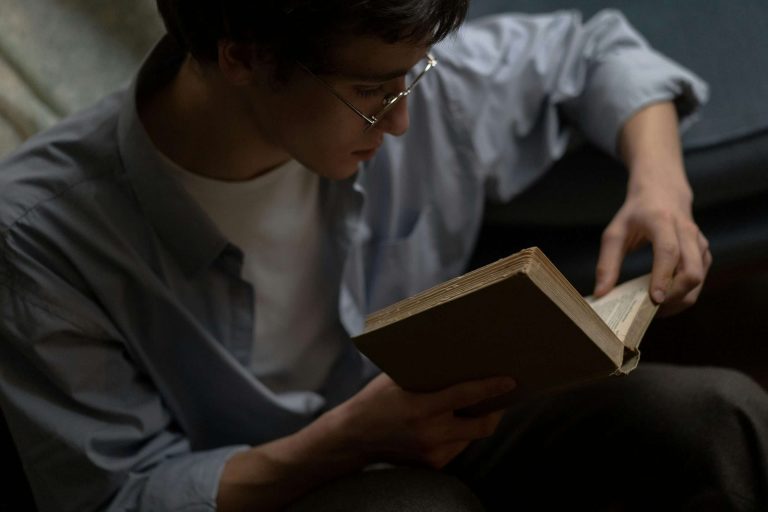

Quiet fictional characters are protagonists who process the world through observation, reflection, and internal depth rather than action or social dominance. These characters resonate deeply with introverted readers because their inner lives drive the story forward. The 12 books below feature heroes whose quietness is a strength, not a flaw to overcome.
Something happened to me the first time I read a novel where the main character chose to leave the party early, went home, and felt genuinely relieved. Not ashamed. Not broken. Just relieved. I remember thinking: that’s me. That’s actually me on the page.
After two decades running advertising agencies, I spent most of my career surrounded by people who performed their confidence loudly. Pitches were theater. Client dinners were endurance sports. And I kept reading business books full of heroes who thrived on chaos and crowds, as if that was the only template for success. Fiction was no different. The protagonist always seemed to be the one holding court at the dinner table, rallying the troops, charging into the fray.
So finding books with genuinely quiet characters, ones whose introversion wasn’t a character flaw waiting to be cured, felt like discovering something rare and honest.

If you’re exploring what introversion looks like across creative and professional life, the Ordinary Introvert reading and lifestyle hub covers the full range of how quiet people experience the world, from how we recharge to how we find meaning in solitude.
- Quiet fictional characters drive stories through observation and reflection, not social dominance or action.
- Reading books with introverted protagonists shapes how you view your own introversion as strength instead of flaw.
- Consuming stories where loud characters always win teaches you to internalize introversion as a weakness requiring change.
- Representation in fiction matters psychologically because narrative identity influences how you interpret your own personality traits.
- Introversion and shyness are distinct: introversion is preference for inner processing, while shyness stems from social anxiety.
Why Do Quiet Fictional Characters Matter So Much to Introverted Readers?
Representation in fiction isn’t just about demographics. It’s about psychology. When you spend years watching every hero in every story win through charisma, networking, and sheer social force, you start to internalize a quiet message: your way of being in the world is the wrong way.
What’s your personality type?
Take our free 40-question assessment and get a detailed personality profile with dimension breakdowns, context analysis, and personalised insights.
Discover Your Type8-12 minutes · 40 questions · Free
A 2021 analysis published through the American Psychological Association on narrative identity found that the stories we consume shape how we understand ourselves. Characters we identify with influence how we interpret our own traits, including whether we see them as strengths or liabilities.
That landed for me personally. During my agency years, I was constantly consuming stories, whether in books, films, or the mythology of business culture, where the loudest person in the room was the most valuable. I absorbed that. I tried to become that. And it cost me years of performing a version of myself that wasn’t real.
Quiet characters in fiction do something different. They show that depth, observation, and careful thinking are not consolation prizes for people who can’t manage extroversion. They’re legitimate, powerful ways of moving through the world.
What Makes a Fictional Character Genuinely Quiet Rather Than Just Shy?
Shyness and introversion get collapsed together constantly, in fiction and in real life. Shyness is anxiety about social judgment. Introversion is something different: a preference for inner processing, a need for solitude to recharge, and a tendency to go deep rather than wide in relationships and thinking.
The Mayo Clinic draws a clear distinction between social anxiety and introversion, noting that introverts often enjoy social connection but simply find it draining in ways that extroverts don’t. Quiet fictional characters, at their best, reflect this nuance. They’re not hiding from the world out of fear. They’re engaging with it on their own terms.
The characters on this list share specific traits. They notice things others miss. They think before they speak. They find crowds exhausting but one-on-one conversations meaningful. Their inner monologue is rich and active even when they’re outwardly still. And critically, the narrative treats these traits as assets rather than problems to fix.

Which Classic Novels Feature the Most Memorable Quiet Characters?
Classic literature has always had a complicated relationship with quiet characters. Some of the most iconic figures in the Western canon are deeply introverted, even if that word wasn’t used when the books were written.
1. Jane Eyre by Charlotte Brontë
Jane Eyre is one of the most quietly powerful protagonists in literary history. She’s not passive. She has fierce convictions and an iron moral core. But she processes everything internally, observes the people around her with careful precision, and speaks only when she has something worth saying. In a world that rewards performance, Jane wins through integrity and depth.
What I find remarkable about Brontë’s portrayal is that Jane never apologizes for her quietness. She simply is who she is, and the narrative honors that. That’s rarer than it should be.
2. To Kill a Mockingbird by Harper Lee
Atticus Finch is the quiet character adults often overlook in this novel because the story is narrated by Scout. But Atticus is a study in introverted leadership: measured, principled, uninterested in performance. He doesn’t raise his voice. He doesn’t seek approval. He does the right thing with a stillness that carries more weight than any speech could.
I thought about Atticus often during my agency years, particularly in client meetings where the loudest opinion usually won. There’s a kind of courage in staying quiet and certain when everyone else is performing certainty through volume.
3. The Remains of the Day by Kazuo Ishiguro
Stevens the butler is perhaps the most introverted narrator in modern fiction. His entire life is organized around restraint, observation, and the suppression of internal experience in favor of professional duty. Ishiguro uses Stevens’s quietness to explore something genuinely painful: what happens when an introverted person mistakes emotional suppression for dignity.
This one hit close to home. Spending years in corporate environments where showing vulnerability was considered weakness, I recognized Stevens’s particular kind of loneliness. The book is a quiet devastation, and it’s one of the most honest portraits of introversion I’ve ever read, even as it critiques what happens when quietness becomes armor rather than authenticity.
Are There Contemporary Novels That Get Introversion Right?
Modern fiction has gotten better at portraying quiet characters with nuance, though it still has a long way to go. The best contemporary novels treat introversion as a complete personality, not a quirk to explain or a wound to heal.
4. Eleanor Oliphant Is Completely Fine by Gail Honeyman
Eleanor is socially awkward, yes. But she’s also observant, deeply intelligent, and honest in ways that most people aren’t brave enough to be. Honeyman gives her a rich inner life and a voice that’s both funny and heartbreaking. The novel is careful to separate Eleanor’s social difficulties (which have specific trauma-based causes) from her fundamental personality, which is genuinely introverted and genuinely valuable.
5. A Man Called Ove by Fredrik Backman
Ove is grumpy, solitary, and deeply uncomfortable with emotional expression. He’s also one of the most quietly heroic characters in recent fiction. Backman shows us a man whose love is expressed through action rather than words, through fixing things, maintaining standards, and showing up reliably. Ove doesn’t talk about caring. He just does it, quietly and consistently.
That resonated with how I’ve always operated. My best work as an agency leader wasn’t in the big presentations. It was in the careful thinking I did alone at 6 AM, the detailed briefs I wrote before anyone else arrived, the problems I solved quietly so the team could move forward confidently.

6. Piranesi by Susanna Clarke
Piranesi is a character who lives in profound solitude and finds it genuinely nourishing rather than tragic. Clarke’s novel is a meditation on what it means to be at peace with your own company, to find meaning in observation and careful record-keeping, and to experience wonder in stillness. It’s one of the most unusual and beautiful portrayals of an introverted inner world in contemporary fiction.
7. The Midnight Library by Matt Haig
Nora Seed is a character who has spent her life feeling like she’s taken up too little space, made too few choices, connected too shallowly. Haig’s novel explores what happens when a quiet, reflective person confronts the gap between who they are and who they thought they were supposed to be. It’s a generous, warm book that treats introversion as a starting point for self-knowledge rather than a problem to solve.
Do Science Fiction and Fantasy Offer Good Quiet Characters?
Genre fiction has historically favored action heroes, but there’s a rich tradition of quiet, observant, deeply introverted characters in both science fiction and fantasy. These characters often serve as the ones who notice what others miss, the ones whose careful thinking saves the day while the louder characters are still arguing about strategy.
8. The Long Way to a Small, Angry Planet by Becky Chambers
Chambers’s ensemble cast includes several genuinely quiet characters, but Kizzy aside, it’s Sissix and Dr. Chef who carry the introverted energy: characters who process deeply, connect meaningfully with a few people, and find the noise of large social gatherings genuinely taxing. Chambers writes community in a way that makes space for different personality types without ranking them.
9. Flowers for Algernon by Daniel Keyes
Charlie Gordon is a character whose inner life is the entire story. Told through journal entries, the novel tracks Charlie’s consciousness with extraordinary intimacy. What strikes me about Charlie, both before and after his transformation, is how deeply he processes his experience, how much attention he pays to what’s happening inside him. The novel is a profound argument for the value of inner life, regardless of how it’s measured by external standards.
10. The House in the Cerulean Sea by TJ Klune
Linus Baker is a bureaucrat who prefers routine, solitude, and the company of his cat to social events. He’s not dramatic about it. He just knows what works for him and organizes his life accordingly. Klune treats Linus’s quietness with warmth and respect, and the novel’s central arc is about a quiet man discovering that his careful, observant way of engaging with the world is exactly what a difficult situation needs.

What Can Young Adult Fiction Teach Us About Quiet Characters?
Young adult fiction has arguably done more for introverted representation than any other genre in the past two decades. This makes sense: adolescence is exactly when many introverts first feel the pressure to perform extroversion, and YA authors have responded by creating characters who model a different way.
11. The Perks of Being a Wallflower by Stephen Chbosky
Charlie is observant to the point of seeing things other characters miss entirely. He’s the person at every party who watches more than he participates, who listens more than he speaks, and who processes his experiences through writing rather than talking. Chbosky treats Charlie’s quiet intensity as a genuine gift, even as he honestly portrays how exhausting and isolating it can feel.
There’s a line in this book that I’ve thought about for years: “I feel infinite.” Charlie says it at a moment of pure, quiet joy, standing in a tunnel with friends, not performing happiness but actually feeling it. That’s the introvert experience of connection at its best: rare, deep, and completely real.
12. Speak by Laurie Halse Anderson
Melinda’s silence in this novel is initially a trauma response, but Anderson develops her into a character whose quiet observation and artistic inner life are genuinely powerful. By the novel’s end, Melinda’s quietness has become a form of clarity rather than a wound. She sees what others don’t. She processes what others avoid. Her voice, when she finally uses it, carries weight precisely because she’s been listening so carefully.
How Does Reading About Quiet Characters Change How Introverts See Themselves?
There’s actual psychological research behind the idea that fiction builds empathy and self-understanding. A 2013 study published in Science found that reading literary fiction improves theory of mind, the ability to understand others’ mental states. Separately, researchers at the National Institutes of Health have documented how narrative engagement activates the same neural networks involved in real social experience.
What this means practically is that when an introverted reader spends time inside a quiet character’s head, something real happens. They practice seeing their own traits through a different lens. They experience, even briefly, what it feels like to have their inner world treated as valuable rather than insufficient.
That shift matters more than it might sound. A 2020 paper from Psychology Today noted that introverts frequently internalize cultural messages that their personality type is a deficit rather than a difference. Fiction that challenges that narrative isn’t just entertainment. It’s a form of psychological recalibration.
My own experience confirms this. Reading Ishiguro, Backman, and Chambers during a particularly difficult stretch of agency leadership helped me see my quietness differently. Not as something to manage or apologize for, but as something that had been working for me all along, even when I didn’t recognize it.
The Harvard Business Review has published extensively on introverted leadership, consistently finding that quiet leaders often outperform their extroverted counterparts in complex, ambiguous situations precisely because they listen more carefully and think before acting. Fiction that shows us quiet heroes doing exactly this reinforces something that professional culture still struggles to fully accept.

What Should Introverts Look for When Choosing Fiction?
Not every book marketed as “perfect for introverts” actually delivers a quiet character with genuine depth. Some books feature protagonists who are temporarily shy but spend most of the novel learning to be more outgoing, which sends exactly the wrong message. Others use quietness as a quirk rather than a personality.
A few questions worth asking before committing to a book: Does the character’s inner life drive the story, or is it treated as an obstacle? Does the narrative reward the character’s quietness, or does it treat social confidence as the goal? Are the character’s observations and careful thinking shown as assets? Does the character’s need for solitude get respected within the story, or is it constantly challenged as something to overcome?
The books on this list pass those tests. They feature characters whose quietness is woven into who they are at the deepest level, not a phase they’re passing through on the way to becoming someone louder.
One thing I’ve noticed, both in fiction and in the introverts I’ve connected with through Ordinary Introvert, is that we tend to read differently than extroverts describe reading. We’re not just following plot. We’re living inside the character’s head, checking whether their inner experience matches ours, finding language for things we’ve felt but never quite named. The right book doesn’t just entertain us. It confirms us.
If you’re building a reading list that genuinely reflects your personality, it’s worth thinking about introversion and careers together, since many of the same traits that make quiet characters compelling in fiction are the ones that create distinctive strengths in professional life. The APA’s personality research section offers a useful grounding in the science behind these traits.
Explore more about introvert identity and self-understanding in our complete Introvert Life Hub at Ordinary Introvert.
About the Author
Keith Lacy is an introvert who’s learned to embrace his true self later in life. After 20 years in advertising and marketing leadership, including running agencies and managing Fortune 500 accounts, Keith now channels his experience into helping fellow introverts understand their strengths and build fulfilling careers. As an INTJ, he brings analytical depth and authentic perspective to every article, drawing from both professional expertise and personal growth.
Frequently Asked Questions
What are the best books with quiet fictional characters?
Some of the strongest books featuring quiet fictional characters include “The Remains of the Day” by Kazuo Ishiguro, “A Man Called Ove” by Fredrik Backman, “Piranesi” by Susanna Clarke, “Eleanor Oliphant Is Completely Fine” by Gail Honeyman, and “Jane Eyre” by Charlotte Brontë. Each of these novels treats the character’s quietness as a genuine personality trait rather than a flaw to overcome, and each gives their protagonist a rich inner life that drives the story forward.
Is there a difference between a shy character and a quiet character in fiction?
Yes, and the distinction matters. Shy characters are typically driven by anxiety about social judgment, and their arc often involves overcoming that fear. Quiet characters, in contrast, are introverted by nature: they prefer depth over breadth in relationships, need solitude to recharge, and process the world internally. The best introvert fiction features characters whose quietness is a stable personality trait, not a problem the story is trying to fix.
Why do introverts connect so strongly with quiet characters in books?
Introverted readers often spend years consuming stories where the hero wins through social charisma and extroverted energy. Finding a character whose inner life, careful observation, and preference for solitude are treated as genuine strengths creates a powerful sense of recognition. Research from the American Psychological Association suggests that narrative identification, seeing yourself in a character, shapes how people understand their own traits. For introverts, quiet characters provide a different and more accurate mirror.
Are there good quiet characters in science fiction and fantasy?
Yes. Genre fiction has a strong tradition of quiet, observant characters whose careful thinking and deep processing are what in the end solve the central problem. Becky Chambers’s “The Long Way to a Small, Angry Planet,” TJ Klune’s “The House in the Cerulean Sea,” and Susanna Clarke’s “Piranesi” all feature introverted protagonists whose personality traits are central to the story rather than incidental. These books are particularly valuable because they show quiet characters thriving in imaginative, expansive worlds.
How can reading introvert fiction help with self-acceptance?
Reading about quiet characters who succeed, connect meaningfully, and live full lives on their own terms helps introverted readers see their own personality through a different frame. A 2013 study published in Science found that literary fiction improves the ability to understand mental states, including our own. For introverts who have internalized cultural messages that their personality is a deficit, fiction that portrays quietness as a strength provides a meaningful counternarrative. It doesn’t just entertain. It reframes.