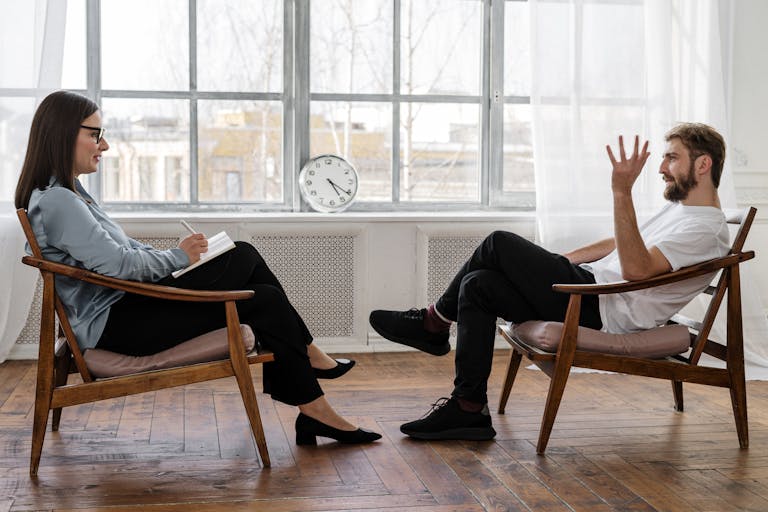

Watch any late night talk show and you will spot them immediately. The actor who fidgets in their chair, gives brief answers, seems desperate for the segment to end. Their film presence radiates confidence and charm. Yet here, under studio lights with a host firing questions, they look like they would rather be anywhere else on earth.
These moments fascinate me because I recognize that discomfort. During my years running advertising agencies, client presentations demanded the same performance energy that interviews require from actors. I could deliver a compelling pitch when the stakes were high. But the schmoozing afterward? The small talk at industry events? Those interactions drained me in ways my extroverted colleagues never seemed to understand.
Introverted actors who struggle with interviews reveal something important about how introversion actually works. Their visible discomfort challenges the assumption that performing equals extroversion. These talented individuals prove that channeling creative energy into a controlled performance bears no relationship to enjoying spontaneous social interaction with strangers.

Why Acting and Interviewing Require Completely Different Skills
Consider what acting actually involves. An actor prepares extensively, studies a script, inhabits a character who serves as a protective layer between themselves and the audience. They control the environment, know their lines, and can do multiple takes until the performance feels right. According to Casting Frontier’s analysis of introverted performers, quality acting requires deep understanding of a character’s emotions alongside valuable introspection of one’s own complexities. These skills align perfectly with how introverts naturally process information.
What’s your personality type?
Take our free 40-question assessment and get a detailed personality profile with dimension breakdowns, context analysis, and personalised insights.
Discover Your Type8-12 minutes · 40 questions · Free
Interviews strip away every element that makes acting manageable for introverts. Questions arrive unpredictably. No script exists. The actor must respond as themselves rather than through the safety of a character. Every awkward pause broadcasts live to millions. The pressure to be spontaneously entertaining contradicts everything about how introverted minds prefer to operate.
I experienced something similar when transitioning from prepared presentations to impromptu Q&A sessions. My presentation could be flawless, confident, even commanding. Then someone would ask an unexpected question and I would watch myself fumble through an answer that did not match the polished delivery from moments before. The unpredictability fundamentally changed the nature of the interaction.
Harrison Ford: The Reluctant Interview Subject
Few actors demonstrate interview discomfort as consistently as Harrison Ford. His filmography includes some of cinema’s most iconic roles, from Han Solo to Indiana Jones. On screen, Ford projects effortless charisma and commanding presence. During interviews, that same man often appears withdrawn, gives terse responses, and radiates visible impatience with the promotional process.
Ford addressed speculation about social anxiety directly in a 2023 interview with The Hollywood Reporter. He rejected the diagnosis entirely, stating he does not have social anxiety disorder but rather “an abhorrence of boring situations.” The distinction matters. Ford is not afraid of social interaction. He simply finds the repetitive promotional questions tedious and sees no reason to pretend otherwise.
His approach reminds me of a mentor I had early in my agency career. This man was brilliant at strategic thinking and could command a boardroom when the conversation mattered. But he refused to perform enthusiasm for the mundane aspects of corporate life. At first, I thought his directness was a liability. Eventually I understood that his authenticity earned more respect than manufactured charm ever could.

Ford’s career success despite interview reluctance offers an important lesson. The quality of your work can speak louder than your promotional skills. If you struggle with interview anxiety, remember that Ford became one of Hollywood’s biggest stars while being famously difficult to interview. He never pretended to be someone he was not.
Keanu Reeves: Finding Peace with Privacy
Keanu Reeves presents a different model of the introverted actor. Where Ford often seems irritated by promotional obligations, Reeves maintains a gentle, accepting demeanor while still clearly preferring solitude. According to Truity’s research on introverted actors, Reeves is known for keeping distance from people while remaining unfailingly kind and generous when interactions do occur.
Reeves has spoken candidly about his introversion. He once wrote that he hates when people ask why he is so quiet, noting that his quietness is simply how he functions. He pointed out the social double standard, observing that he would never ask others why they talk so much because that would be considered rude.
This observation resonates deeply with my own experience. In agency environments dominated by self-promoters and constant networking, my preference for listening and observing was frequently framed as a problem to solve rather than a different but equally valid approach. Learning to reframe my introversion as a strength rather than a weakness changed how I showed up professionally.
Reeves demonstrates that building authority without self-promotion is entirely possible. His reputation for kindness and authenticity has created a devoted following precisely because he refuses to perform a false version of himself. Fans appreciate his genuineness in an industry built on artifice.
Emma Watson: The Scholarly Approach to Introversion
Emma Watson offers perhaps the most articulate perspective on how introversion functions in an acting career. Unlike Ford’s irritation or Reeves’ gentle acceptance, Watson has studied her personality trait and speaks about it with analytical clarity. She has publicly recommended Susan Cain’s groundbreaking book Quiet: The Power of Introverts in a World That Can’t Stop Talking, noting how the book helped her understand that her need for solitude was not something wrong with her.
Watson has described feeling empowered when she realized her introversion was simply who she is rather than a flaw requiring correction. She recounted feeling confused about why she did not want to do what her friends wanted to do, interpreting her different preferences as personal failure rather than personality difference.

Her intellectual approach to understanding introversion mirrors my own path. Reading about personality psychology transformed how I understood myself as a leader. What I had interpreted as inadequacy turned out to be a documented personality pattern with its own distinct advantages. Understanding the neuroscience behind introversion helped me stop trying to become an extrovert and instead build systems that worked with my natural tendencies.
Watson channels her need for solitude into creative pursuits beyond acting, including painting, drawing, and writing. These activities provide the restorative time alone that she requires to function at her best. For introverts building careers in high-visibility fields, finding these recovery practices becomes essential for sustainable success.
The Paradox of Introverted Performers
Susan Cain’s research, available through her extensive work on introversion, demonstrates that many of humanity’s most creative individuals have been introverts. The assumption that performers must be extroverts represents a fundamental misunderstanding of how introversion actually functions. Introverts can perform brilliantly when the situation provides preparation time, clear structure, and a defined purpose. They struggle with the unstructured, spontaneous demands of typical interview formats.
Acting provides all the elements that allow introverts to shine. They can prepare thoroughly, inhabit a protective character persona, and focus their energy on a specific creative task. The performance itself does not drain them because it aligns with how they naturally prefer to work. The exhaustion comes from the promotional activities surrounding the performance rather than from the creative work itself.
This distinction explains why so many celebrated actors seem uncomfortable during press tours. Harrison Ford once noted that he cannot imagine exposing himself more than through his on-screen work, suggesting that what appears on film represents his authentic expression far more than interview responses ever could. The character work is the genuine self-expression. The promotional interviews are the performance that feels inauthentic.
I found this same dynamic in my agency work. Strategic presentations where I could prepare thoroughly felt authentic and energizing. The networking events and client dinners that followed felt performative in ways that depleted me. Understanding this distinction helped me allocate my energy more strategically rather than wondering why certain aspects of my job felt so much harder than others.

Strategies That Introverted Actors Use to Survive Interviews
Observing how successful introverted actors handle promotional obligations reveals strategies that translate to any professional context. These performers have had to develop approaches that allow them to meet industry expectations without completely abandoning their authentic selves.
Many limit their interview availability ruthlessly. They participate in essential promotional activities while declining optional appearances that would deplete them without proportional benefit. This boundary setting allows them to bring their best energy to the interviews they do accept rather than spreading themselves thin across too many commitments.
Some develop signature approaches that reduce cognitive load during interviews. Preparing thoughtful responses to predictable questions allows them to appear spontaneous while actually drawing on rehearsed material. This technique mirrors how actors prepare for performances, applying familiar methods to an unfamiliar context.
Others lean into their authenticity rather than fighting it. Ford’s directness and Reeves’ gentleness both represent genuine personality expressions rather than manufactured interview personas. Audiences often appreciate this authenticity more than polished media training because it feels real in an environment dominated by artifice.
For those of us working in corporate environments, these strategies translate directly. Preparing thoroughly for high-stakes conversations, setting boundaries around social obligations, and leaning into authenticity rather than performing a false extroversion all represent sustainable approaches to professional visibility.
What Introverted Actors Teach Us About Professional Success
The careers of these introverted performers challenge assumptions about what success requires. None of them became extroverts to achieve their goals. Each found ways to work with their natural tendencies rather than against them. Their visible discomfort with certain promotional activities did not prevent them from reaching the highest levels of their profession.
Ford’s career demonstrates that excellence in your actual work can overcome promotional limitations. Watson shows that understanding your personality allows you to build sustainable practices around it. Reeves proves that authenticity creates its own powerful form of connection with audiences.
These lessons apply directly to introverts in any field. You do not need to transform your personality to succeed. You need to understand it well enough to build systems that support rather than fight against your natural tendencies. Achieving professional visibility without exhaustion requires this kind of self-knowledge.
My own career transformed when I stopped apologizing for my introversion and started viewing it as valuable data about how I function best. The energy I had wasted trying to match extroverted colleagues became available for the deep work that actually moved my career forward. My quiet consistency turned out to be more valuable than charismatic inconsistency.
Embracing Your Interview Style
Whether you face job interviews, media appearances, or client presentations, the discomfort you feel as an introvert is not evidence of inadequacy. It reflects a fundamental mismatch between how these situations are typically structured and how your mind prefers to operate. Recognizing this mismatch allows you to prepare strategically rather than hoping you will somehow become a different person under pressure.
Preparation becomes your greatest asset. The more thoroughly you can anticipate questions and rehearse responses, the more the interview begins to resemble the kind of prepared performance where introverts excel. Structure creates the conditions for your natural strengths to emerge.
Authenticity serves you better than performed enthusiasm. Interviewers and audiences often sense when someone is faking extroversion, and that inauthenticity creates distance rather than connection. Your genuine engagement, even if quieter than others might expect, creates more meaningful impressions than forced energy.
Recovery time after high-stakes interactions is not optional. Build margins into your schedule that allow you to recharge before your next demanding social performance. Treating this recovery as essential rather than indulgent allows you to show up fully for the interactions that matter most.
The introverted actors who struggle with interviews while excelling at their craft reveal that success does not require becoming someone you are not. It requires understanding who you are deeply enough to build a life and career around your actual nature. Developing executive presence while hating self-promotion is possible when you approach the challenge with self-knowledge rather than self-criticism.
Their visible discomfort during promotional appearances reminds us that even the most successful people in highly social professions can be introverts. Their careers demonstrate that working with rather than against your temperament produces better results than forcing yourself into patterns that exhaust you. Their authenticity shows that being genuine creates stronger connections than performing a personality that does not belong to you.
Explore more career strategies designed for quiet professionals in our complete Career Skills and Professional Development Hub.
About the Author
Keith Lacy is an introvert who’s learned to embrace his true self later in life. With a background in marketing and a successful career in media and advertising, Keith has worked with some of the world’s biggest brands. As a senior leader in the industry, he has built a wealth of knowledge in marketing strategy. Now, he’s on a mission to educate both introverts and extroverts about the power of introversion and how understanding this personality trait can unlock new levels of productivity, self-awareness, and success.
Frequently Asked Questions
Why do some actors seem uncomfortable during interviews?
Many successful actors are introverts who excel at prepared, controlled performances but struggle with the spontaneous, unstructured nature of interviews. Acting allows thorough preparation and character protection, while interviews demand unpredictable social interaction as oneself rather than through a role.
Can introverts succeed in high-visibility careers like acting?
Absolutely. Actors like Harrison Ford, Keanu Reeves, and Emma Watson demonstrate that introversion does not prevent success in highly visible professions. The key is understanding your temperament and building sustainable practices around it rather than trying to become an extrovert.
How do introverted actors handle required promotional activities?
Successful introverted actors often limit their interview availability to essential appearances, prepare thoroughly for predictable questions, and lean into their authentic personality rather than performing false enthusiasm. They also build recovery time into their schedules to recharge after demanding social interactions.
Is there a difference between introversion and social anxiety?
Yes. Introversion describes a preference for less stimulating environments and a need to recharge through solitude. Social anxiety involves fear of judgment in social situations. Harrison Ford has specifically stated he does not have social anxiety disorder but simply finds boring interview situations tedious.
What can introverts learn from actors who struggle with interviews?
Introverted actors teach that professional success does not require personality transformation. Their careers demonstrate the value of thorough preparation, strategic boundary setting, authentic self-expression, and building recovery time into demanding schedules. Working with your temperament produces better results than fighting against it.