
Mindful pathways are the deliberate, inward-facing practices that help introverts process experience, regulate emotion, and sustain mental clarity without burning through their limited social energy. For people wired toward depth and internal reflection, mindfulness isn’t a trendy wellness add-on. It’s a natural fit for how the introvert mind already works, and learning to lean into it consciously can shift everything about how you handle stress, relationships, and the relentless noise of modern life.
My own relationship with mindful practice didn’t start in a meditation studio. It started in a conference room in Chicago, sometime around my third year running an agency, when I realized I was making decisions from a place of pure exhaustion rather than genuine clarity. Something had to change.

Before we get into the specific pathways that work best for introverted minds, it’s worth noting that this article sits within a broader conversation. Our Introvert Mental Health Hub covers the full landscape of emotional wellbeing for introverts, from anxiety and sensory sensitivity to empathy, perfectionism, and beyond. Mindful practice connects to nearly all of it.
Why Does Mindfulness Feel Different for Introverted People?
Most mainstream mindfulness content is designed for people who need to slow down. The assumption is that the average person is living too fast, too loud, too distracted, and that mindfulness is the brake pedal. That framing makes sense for extroverts who genuinely need to be pulled inward. For introverts, though, the situation is more layered.
What drains your social battery?
Not all social exhaustion is the same. Our free quiz identifies your specific drain pattern and gives you personalised recharging strategies.
Find Your Drain PatternUnder 2 minutes · 8 questions · Free
Many of us are already spending significant time inside our own heads. The challenge isn’t getting in there. The challenge is knowing what to do once we’re there, how to be present with our inner world rather than trapped in it, and how to use that inward orientation as a genuine resource rather than a source of rumination or withdrawal.
There’s a meaningful difference between reflection and rumination. Reflection is generative. You sit with an experience, you process it, you extract something useful, and you move forward with more clarity than you had before. Rumination is the same experience on a loop, with no exit, no resolution, just the same anxious thoughts cycling through on repeat. Mindful practice, when it’s well-suited to an introverted temperament, is what keeps reflection from collapsing into rumination.
During my agency years, I managed a team that included several highly sensitive people, and I watched this distinction play out constantly. One of my account directors, an INFJ with extraordinary perceptiveness, would sometimes disappear into herself after a difficult client call. Not because she was disengaged, but because she was processing. The problem was that without any structured pathway for that processing, she’d sometimes emerge hours later still carrying the same emotional weight she’d started with. When she eventually found a mindful practice that worked for her, the shift was visible. She came back from those internal retreats with perspective rather than just more anxiety.
What Makes a Mindful Pathway Actually Work for an Introvert?
Not every mindfulness practice translates equally well across personality types. Group meditation classes, accountability apps with social sharing features, or practices that require you to verbalize your inner experience to a partner can create friction for people who process best in private. The most effective mindful pathways for introverts tend to share a few qualities.
They’re solitary, or at least they allow for solitude. They work with the introvert’s natural preference for depth over breadth, meaning they go somewhere rather than just staying at the surface. They create space for observation without demanding immediate action or verbal expression. And they’re sustainable, which means they don’t require a social infrastructure to maintain.
One thing I’ve noticed about introverts who struggle with mindfulness is that they often try to adopt practices wholesale from sources that weren’t designed with them in mind. They try a 30-person guided meditation retreat and feel drained rather than restored. They download an app that sends them cheerful push notifications and find the interruptions more stressful than helpful. Then they conclude that mindfulness just isn’t for them, when what’s actually happened is that the delivery mechanism was wrong, not the underlying practice.

For introverts who also identify as highly sensitive people, this mismatch can be especially pronounced. HSP overwhelm and sensory overload can make crowded or stimulating mindfulness environments feel counterproductive. A practice that’s supposed to calm the nervous system shouldn’t begin by overwhelming it.
How Does the Introvert Nervous System Respond to Mindful Practice?
There’s a reasonable body of evidence suggesting that mindfulness-based practices can reduce physiological stress responses, support emotional regulation, and improve attention. What’s less often discussed is how the introvert nervous system, particularly when combined with high sensitivity, interacts with these practices in specific ways.
Introverts tend toward higher baseline levels of internal arousal, which is part of why external stimulation can feel overwhelming more quickly than it does for extroverts. Mindful practices that reduce external input and create a quiet, low-stimulation environment work with this biology rather than against it. A review published in PubMed Central examining mindfulness-based interventions found meaningful connections between these practices and reduced anxiety symptoms, which is particularly relevant for introverts who carry a significant internal emotional load.
Anxiety is a genuine concern in this population. Many introverts, especially those who spent years performing extroversion in professional environments, develop low-grade chronic anxiety that becomes so familiar it barely registers anymore. It just feels like normal. The National Institute of Mental Health’s overview of generalized anxiety disorder is a useful starting point for anyone wondering whether what they’re experiencing goes beyond ordinary stress. For many introverts, it does.
I spent a solid decade in that low-grade anxiety state without naming it. I thought the constant hum of tension I carried was just the cost of running an agency. Deadlines, client demands, staff issues, financial pressure. All of that was real. But the anxiety was also being fed by something else, by the daily energy expenditure of operating in an extroverted professional culture while pretending it wasn’t costing me anything. Mindful practice, when I finally found forms of it that suited my temperament, helped me separate the legitimate stressors from the unnecessary performance tax I was paying.
Which Specific Pathways Suit the Introvert Mind Most Naturally?
There’s no single correct answer here, and anyone who tells you otherwise is selling something. What I can offer is a set of pathways that consistently show up as effective for introverts across the mental health and psychology literature, as well as in my own experience and in conversations with the many introverts I’ve connected with over the years.
Contemplative Walking
Walking as a mindful practice is distinct from walking as exercise. The intention is different. You’re not trying to hit a step count or maintain a heart rate zone. You’re using the rhythm of movement, the sensory input of the environment, and the absence of social demand to create a space where your mind can process freely. Many introverts find that their best thinking happens on walks, not because walking makes them smarter, but because it removes the friction of forced stillness while still providing the solitude and low stimulation their nervous systems need.
For highly sensitive introverts especially, nature-based walking adds another dimension. The natural environment provides sensory input that tends to be restorative rather than depleting, soft light, organic sounds, irregular patterns that engage attention without overwhelming it.
Breath-Centered Meditation
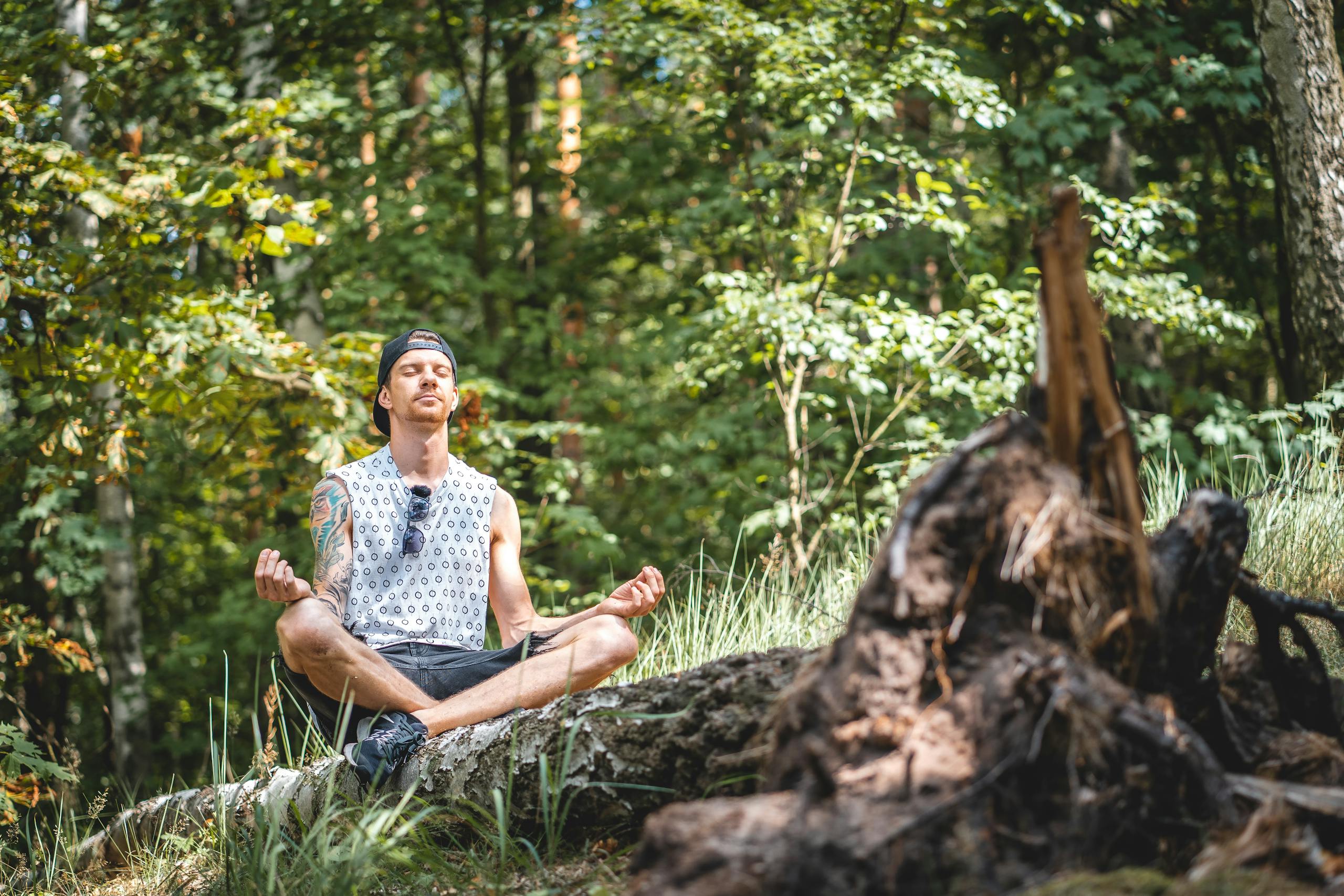
Formal breath-centered meditation, practiced alone and in silence, aligns well with the introvert preference for depth and internal focus. The practice of returning attention to the breath when the mind wanders is, at its core, a training in the kind of gentle self-redirection that introverts often need when internal processing tips from reflection into rumination. Additional research indexed through PubMed Central has examined how breath-focused practices affect the autonomic nervous system, with findings relevant to stress regulation in people who carry significant internal emotional loads.
The key variable for introverts is environment. A quiet room, no social accountability, no shared space. Even the presence of another person in the room can shift the experience from restorative to performative for many introverts, and performative mindfulness isn’t mindfulness at all.
Structured Reflection Without Writing
Given how thoroughly journalling has been covered elsewhere in this hub, it’s worth acknowledging that some introverts process better through pure thought than through writing. Structured internal reflection, where you deliberately sit with a specific question or experience for a set period of time, can be as effective as written reflection for people who find the act of writing itself to be a barrier rather than a bridge.
The structure matters. Open-ended rumination isn’t reflection. Setting a mental container, “I’m going to spend fifteen minutes with this specific thing that happened today, and then I’m going to let it go,” creates the kind of bounded processing that prevents the introvert tendency toward infinite internal loops.

Creative Absorption
Flow states reached through creative work, drawing, music, cooking, building, writing, any absorbing solo activity, function as a form of mindfulness even when they’re not labeled as such. The psychological state of deep creative absorption shares many features with formal mindfulness practice: present-moment focus, reduced self-monitoring, a quieting of the inner critic, and a sense of time passing differently.
For introverts, creative absorption has the added benefit of feeling natural rather than prescribed. You’re not “doing mindfulness.” You’re just doing something you love. The restorative effect is real either way.
How Do Emotional Complexity and High Sensitivity Intersect With Mindful Practice?
Many introverts carry a level of emotional complexity that makes standard mindfulness advice feel thin. When someone tells you to “just observe your thoughts without judgment,” that’s genuinely useful guidance. But when your inner landscape includes layers of emotional processing that most people don’t experience with the same intensity, the practice requires more nuance.
Highly sensitive introverts, in particular, often find that mindful practice surfaces emotions they weren’t consciously aware of carrying. That can be valuable. It can also be destabilizing if you don’t have frameworks for working with what comes up. Understanding how HSPs process emotion is a useful companion to any mindful practice, because the depth of feeling that characterizes high sensitivity means that sitting in stillness can sometimes open doors you weren’t expecting.
There’s also the question of empathy. Many introverts, especially those who score high on sensitivity measures, absorb the emotional states of the people around them with remarkable efficiency. That’s not always a conscious choice. It happens at a level below deliberate attention, which means that by the time you sit down for a mindful practice at the end of the day, you may be carrying emotional material that isn’t even yours. The complexity of HSP empathy is something I’ve seen play out in professional settings more times than I can count, and it’s directly relevant to how you structure a mindful practice. Part of what you’re doing in that quiet space is sorting out what belongs to you and what you’ve picked up from others.
One of the most talented creatives I ever worked with was an art director who was also, unmistakably, a highly sensitive person. She would come into Monday morning status meetings having already absorbed the anxiety of everyone else in the building, before the meeting had even started. She didn’t know that’s what was happening. She just knew she felt inexplicably heavy. When she eventually developed a morning mindful practice that included a deliberate “clearing” component, setting aside emotional material that didn’t originate with her, the change in her baseline wellbeing was significant.
What Role Does Anxiety Play in the Introvert’s Need for Mindful Pathways?
Anxiety and introversion aren’t the same thing, but they overlap frequently enough that it’s worth addressing directly. Many introverts develop anxiety not because of their introversion itself, but because of the chronic mismatch between their natural wiring and the environments they’ve been required to function in. Years of performing extroversion, of pushing through social exhaustion, of dismissing their own needs as inconvenient, take a measurable toll.
Mindful pathways address anxiety in a few distinct ways. At the physiological level, practices that activate the parasympathetic nervous system create a counterweight to chronic stress arousal. At the cognitive level, mindful observation of anxious thought patterns can interrupt the automatic quality of anxiety spirals. And at the identity level, building a consistent practice that honors the introvert’s need for solitude and internal processing sends a message to the self that those needs are legitimate, which is its own form of healing.
HSP anxiety, with its particular texture and intensity, responds especially well to practices that reduce external stimulation while creating space for internal processing. The highly sensitive nervous system is already doing a great deal of work interpreting and responding to the environment. Giving it a regular quiet period isn’t indulgent. It’s maintenance.
A clinical overview of mindfulness-based stress reduction available through the National Library of Medicine provides useful context for how these practices have been studied and applied in therapeutic settings. The evidence base is solid enough that these approaches are now incorporated into mainstream clinical treatment for anxiety and stress-related conditions.
How Does Perfectionism Interfere With Building a Mindful Practice?
One of the most common reasons introverts abandon mindful practices before they’ve had a chance to take hold is perfectionism. And this is a population where perfectionism runs deep. The INTJ in me spent years approaching every new practice with a mental checklist of how it was supposed to go, and then feeling like a failure when the actual experience didn’t match the ideal.
Mindfulness, by its nature, resists perfectionism. There is no perfect meditation session. There is no flawless contemplative walk. The mind wanders. The body is uncomfortable. External sounds intrude. Emotions surface unexpectedly. The practice isn’t about achieving a pristine inner silence. It’s about returning, again and again, to the intention of being present. Every return is the practice. The wandering isn’t a failure.
For introverts who struggle with high standards, the trap of perfectionism applied to self-care is particularly insidious. You end up not doing the thing that would help you because you can’t do it perfectly. That’s a pattern worth examining directly, because it shows up in mindful practice just as reliably as it shows up everywhere else.
A useful reframe is to think of a mindful practice the way you’d think of physical fitness. You wouldn’t skip every workout because you couldn’t run a perfect mile. You’d show up, do what you can, and trust that consistency over time produces results. The same logic applies here. An imperfect five minutes of breath-centered meditation practiced daily will do more for your mental clarity than a perfect forty-five minute session you attempt twice a year.
How Does Mindful Practice Support Introverts in High-Demand Professional Environments?
Running an advertising agency means living inside a perpetual demand economy. Clients want things now. Staff need decisions immediately. Creative work has hard deadlines. The phone, as Psychology Today’s coverage of introvert communication preferences has noted, is its own particular source of introvert stress. In that environment, the introvert who doesn’t have a mindful practice is essentially running on a battery that never gets recharged.
What I eventually figured out, later than I should have, was that the quality of my decision-making was directly correlated with the quality of my internal state. When I was depleted, I made reactive decisions. I said yes to things I should have declined. I avoided difficult conversations because I didn’t have the energy for them. I missed signals in client relationships because my attention was spread too thin. A consistent mindful practice created a floor beneath all of that. It didn’t eliminate the demands of the job. It gave me a stable place to stand while meeting them.
There’s also a resilience dimension to this. The American Psychological Association’s framework for resilience emphasizes the role of self-awareness, emotional regulation, and adaptive coping in building the capacity to handle adversity. All three of those capacities are developed through consistent mindful practice. For introverts in demanding professional roles, this isn’t abstract. It’s the difference between burning out in year five and still having something to give in year twenty.
A graduate research paper examining mindfulness in workplace settings explores how these practices affect professional performance and stress management, providing useful academic grounding for something many introverts discover through direct experience.
What Happens When Rejection or Criticism Disrupts Your Mindful Practice?
Introverts tend to process rejection and criticism more deeply than the experience might seem to warrant from the outside. A piece of critical feedback that a colleague absorbs and moves past in an afternoon can occupy an introvert’s internal processing for days. That’s not weakness. It’s a function of depth. The same capacity that makes introverts thoughtful, perceptive, and thorough also means that difficult experiences don’t stay at the surface.
Mindful practice can be both a support and a complication during periods of rejection or criticism. On one hand, having a consistent practice gives you a structured place to process difficult emotions rather than letting them circulate indefinitely. On the other hand, sitting in stillness when you’re carrying significant emotional pain can be genuinely hard. The practice doesn’t make the pain disappear. It creates a container for it.
Processing rejection as a highly sensitive person involves a particular kind of emotional work that benefits from the same qualities that make mindful pathways effective in general: patience, self-compassion, and a willingness to sit with discomfort rather than immediately seeking to escape it. The mindful practice doesn’t fix the rejection. It gives you a way to be with it that doesn’t make things worse.
One of the most valuable things I’ve learned, both from my own experience and from watching introverts I’ve managed and mentored, is that the impulse to think your way out of emotional pain is very strong in this population and very rarely effective. You can’t analyze your way through grief or rejection. You have to feel it, process it, and let it move through. Mindful practice creates the conditions for that to happen.

How Do You Build a Mindful Practice That Actually Lasts?
Sustainability is the variable that separates a mindful practice from a mindful experiment. Most people who try mindfulness don’t fail because the practice doesn’t work. They fail because they haven’t designed a practice that fits their actual life, temperament, and constraints.
For introverts, the design considerations are specific. You need solitude, so you need to protect time that is genuinely yours. You need a low-stimulation environment, which means being intentional about where and when you practice. You need a format that suits your processing style, whether that’s movement-based, breath-based, creative, or contemplative. And you need to let go of the idea that there’s a correct way to do this that you might be failing to achieve.
Start small and specific. Five minutes of intentional breath observation in the morning before you check your phone is a real practice. A fifteen-minute solo walk at lunch with no podcasts and no phone calls is a real practice. Ten minutes of creative absorption in the evening before you shift to passive consumption is a real practice. The size of the practice matters far less than the consistency of it.
What tends to kill consistency for introverts is the same thing that kills it for everyone: trying to do too much too fast, then feeling like a failure when the unsustainable version collapses. Build something you can actually maintain. Protect it. And trust that the cumulative effect of small, consistent practices is genuinely significant over time.
There’s a broader conversation about introvert mental wellbeing that connects all of these threads. The full range of mental health topics relevant to introverts, from sensory sensitivity and anxiety to empathy, perfectionism, and emotional processing, is gathered in our Introvert Mental Health Hub. If mindful pathways resonate with you, there’s a good chance other topics in that collection will too.
Running on empty?
Five drain profiles, each with specific triggers, warning signs, and a recharging playbook.
Take the Free QuizUnder 2 minutes · 8 questions · Free
About the Author
Keith Lacy is an introvert who’s learned to embrace his true self later in life. After 20 years in advertising and marketing leadership, including running agencies and managing Fortune 500 accounts, Keith now channels his experience into helping fellow introverts understand their strengths and build fulfilling careers. As an INTJ, he brings analytical depth and authentic perspective to every article, drawing from both professional expertise and personal growth.
Frequently Asked Questions
What are mindful pathways for introverts?
Mindful pathways are deliberate, inward-facing practices that help introverts process emotion, regulate their nervous systems, and maintain mental clarity without depleting their social and cognitive energy. They include practices like contemplative walking, breath-centered meditation, structured internal reflection, and creative absorption. For introverts, the most effective pathways are those that honor the need for solitude, depth, and low-stimulation environments.
How is mindfulness different for introverts than for extroverts?
Most mainstream mindfulness content is designed to help people slow down and turn inward. Introverts are often already oriented inward, so the challenge isn’t accessing internal experience but learning how to work with it productively. For introverts, mindful practice is less about creating inward access and more about developing the capacity to be present with their inner world without slipping into rumination, anxiety loops, or emotional overwhelm.
Can mindful practice help with introvert anxiety?
Yes, and the connection is well-supported. Many introverts develop chronic low-grade anxiety from years of operating in extroverted environments that don’t match their natural wiring. Mindful practices that activate the parasympathetic nervous system, interrupt anxious thought patterns, and create space for genuine self-care address anxiety at multiple levels simultaneously. For highly sensitive introverts, practices that specifically reduce external stimulation are particularly effective.
Why do introverts struggle to maintain a consistent mindful practice?
The most common barriers are perfectionism, mismatched practice formats, and trying to sustain an unsustainable initial commitment. Introverts often adopt practices designed for different temperaments, find them draining or ineffective, and conclude that mindfulness isn’t for them. The solution is designing a practice that suits the introvert’s specific needs: solitary, low-stimulation, depth-oriented, and small enough to be genuinely sustainable over time.
How does high sensitivity affect mindful practice for introverts?
Highly sensitive introverts often find that mindful practice surfaces emotions and sensory experiences more intensely than they might expect. The same depth of processing that characterizes high sensitivity means that sitting in stillness can open significant emotional territory. This isn’t a reason to avoid mindful practice. It’s a reason to approach it with appropriate preparation, including understanding how HSP emotional processing works and having frameworks for working with difficult emotions when they arise.