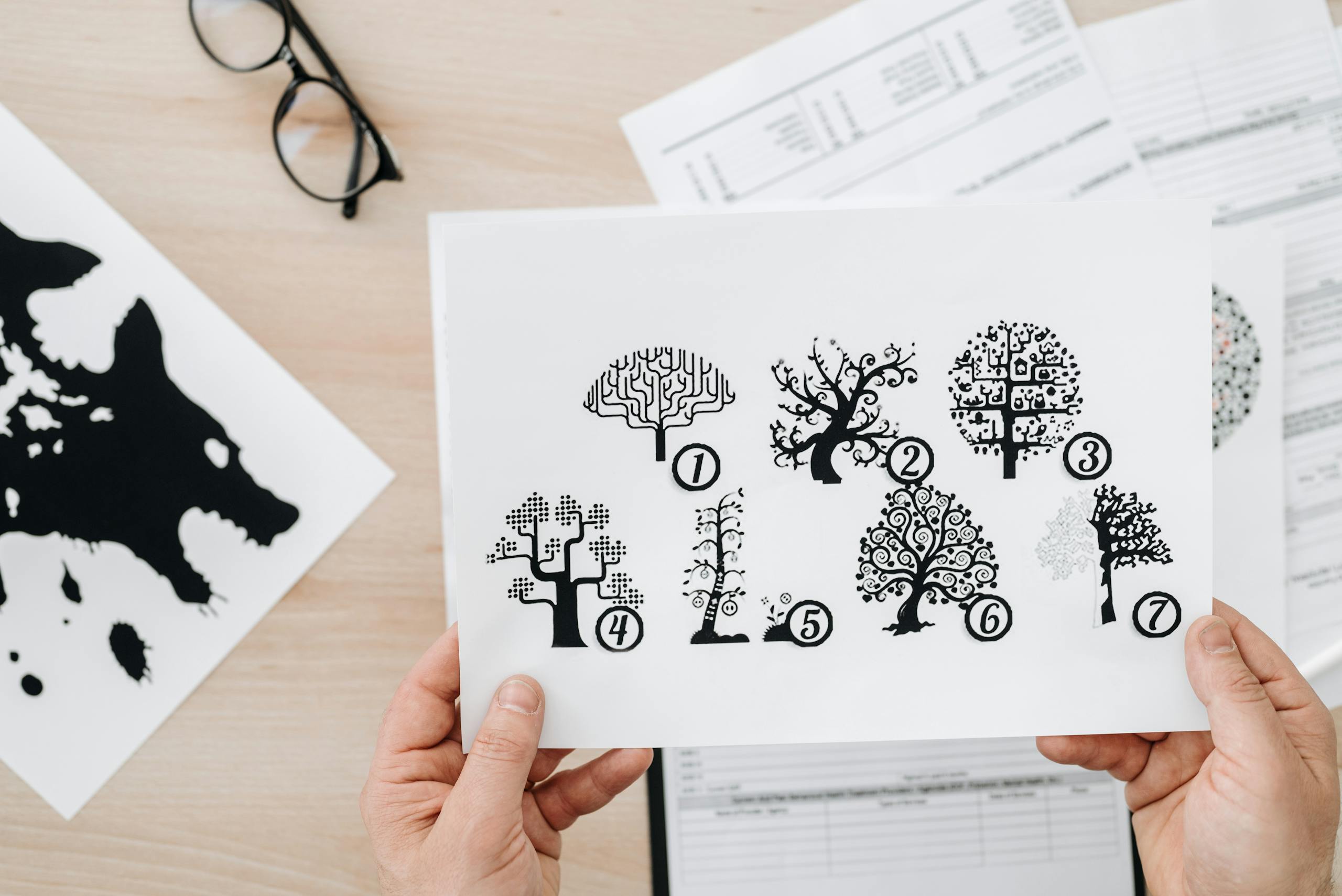
A Myers-Briggs self assessment is a structured reflection tool that measures your preferences across four personality dimensions: where you direct your energy, how you take in information, how you make decisions, and how you approach structure. Unlike a clinical diagnosis, it gives you a working framework for understanding why you think, communicate, and lead the way you do.
Taken honestly, it can surface patterns you’ve sensed for years but never had language for. That’s what happened to me. And it changed how I ran my agency.

Most people encounter the Myers-Briggs either through a workplace training, a curious Google search late at night, or a friend who won’t stop talking about their type. However you got here, the question worth asking isn’t just “what’s my type?” It’s “what am I actually measuring, and what do I do with it?” Our MBTI General and Personality Theory hub explores the full range of that question, but the self-assessment experience itself deserves a closer look.
Why Does the Self-Assessment Format Matter So Much?
There’s a meaningful difference between being typed by someone else and typing yourself. A self-assessment asks you to observe your own behavior, preferences, and instincts, then report them accurately. That sounds straightforward. It rarely is.
What’s your personality type?
Take our free 40-question assessment and get a detailed personality profile with dimension breakdowns, context analysis, and personalised insights.
Discover Your Type8-12 minutes · 40 questions · Free
Early in my agency career, I would have answered those questions as the version of myself I was trying to become, not the one I actually was. I was managing a team of about eighteen people, handling client relationships across several Fortune 500 accounts, and doing everything I could to project the confident, high-energy presence I thought leadership required. If you’d asked me whether I preferred large group discussions or one-on-one conversations, I would have said large groups. Because that’s what I was doing all day. Because I thought that’s what I was supposed to want.
A 2005 American Psychological Association analysis on self-perception and accuracy found that people often describe themselves in ways shaped by aspiration rather than observation, particularly in high-performance environments. That gap between who we are and who we’re trying to be can seriously distort a self-assessment if we’re not careful.
So before you answer a single question, it helps to understand what you’re actually being asked to assess. You’re not measuring your capability. You’re measuring your natural preference, what feels effortless versus what feels like effort. Those are very different things.
What Are the Four Dimensions You’re Actually Rating?
Each question in a Myers-Briggs style assessment maps to one of four dichotomies. Understanding what each one is really asking changes how you respond.
The first is Extraversion versus Introversion. This isn’t about whether you’re shy or outgoing. It’s about where you direct your attention and what restores your energy. Our full breakdown of E vs I in Myers-Briggs covers this in depth, but the short version is this: introverts process internally first, prefer depth over breadth in conversation, and recharge through solitude. Extraverts do the opposite. Neither is better. They’re just different orientations.
The second dimension is Sensing versus Intuition, which describes how you take in information. Sensing types trust concrete facts, lived experience, and present reality. Intuitive types naturally gravitate toward patterns, possibilities, and what could be. Both approaches are valid, and both have blind spots.
The third is Thinking versus Feeling, which is about how you make decisions. Thinking types prioritize logic and objective analysis. Feeling types weigh relationships and values. Worth noting: this has nothing to do with emotional intelligence. Feeling types aren’t more emotional, and Thinking types aren’t cold. They simply apply different criteria when reaching conclusions.
The fourth is Judging versus Perceiving, which reflects how you approach structure. Judging types prefer closure, planning, and defined outcomes. Perceiving types prefer flexibility, open options, and spontaneous adaptation. In a workplace context, this dimension often creates the most friction between colleagues.
How Do You Answer Honestly When Your Habits Have Overridden Your Preferences?
This is where most self-assessments go sideways. After years of adapting to a workplace culture, a relationship dynamic, or a role that demanded certain behaviors, many people genuinely can’t tell the difference between what they prefer and what they’ve trained themselves to do.
I spent more than a decade running client presentations, leading agency pitches, and facilitating creative reviews. By the time I finally sat down and completed a proper assessment, I was so accustomed to performing extraversion that it felt natural. It wasn’t. It was practiced. There’s a difference.
A useful technique is to think about how you behave when there’s no audience and no expectation. Not at work. Not with people who are watching. On a Saturday afternoon with nothing scheduled. Do you reach for your phone to call someone, or do you settle into a book? Do you feel restless without stimulation, or do you feel relieved to finally have quiet? Those instincts, the ones that surface when no one is keeping score, tend to be more accurate than your professional habits.
A 2020 study published in PLOS ONE via PubMed Central found that personality traits measured under low-stakes conditions showed stronger predictive validity than those measured in performance contexts. In plain terms: you’re more yourself when you’re not trying to impress anyone.
Another useful anchor is energy. Not what you can do, but what costs you something. Spending three hours in back-to-back meetings might be something you’re perfectly capable of. That’s competence. But does it leave you energized or depleted? That’s preference. Answer from the depletion, not the capability.
What Role Do Cognitive Functions Play in a More Accurate Self-Assessment?
Most free MBTI-style tests give you four letters. That’s a starting point, not a complete picture. Behind those letters is a layered structure of cognitive functions, eight mental processes that describe not just what you prefer, but how you actually think.
Each personality type has a dominant function, an auxiliary function, and several supporting or inferior functions. These interact with each other in ways that shape your actual behavior far more precisely than a letter combination alone. If you’ve ever felt like your type description was mostly right but somehow incomplete, cognitive functions are usually why.
Consider two types that share three letters: INTJ and INTP. Both are introverted, intuitive, and thinking types. Yet they operate very differently in practice. The INTJ leads with Introverted Intuition and uses Extroverted Thinking as its primary decision-making tool, which produces a decisive, systems-oriented leadership style. The INTP leads with Introverted Thinking, which produces a more analytical, framework-building approach that prioritizes internal logical consistency over external execution. Same three letters, meaningfully different minds.
Taking a cognitive functions test alongside a standard Myers-Briggs self assessment can help you cross-reference your results and catch cases where your four-letter type doesn’t quite fit. It adds a layer of verification that a surface-level questionnaire can miss.
One function worth understanding in this context is Extraverted Sensing. Types with strong Se, like ESTPs and ESFPs, are highly attuned to their immediate physical environment and tend to respond to the world in real time. If you’re someone who naturally notices sensory details others overlook, feels most alive in fast-moving situations, and finds abstract planning tedious, that pattern points toward a prominent Se in your function stack. Recognizing that through a self-assessment requires knowing what to look for beyond the basic letter preferences.

What Happens When Your Results Don’t Feel Right?
Getting a result that doesn’t resonate is more common than most people realize. There are a few reasons this happens, and none of them mean the framework is broken.
The most frequent cause is answering from your adapted self rather than your natural self, which we’ve already covered. A close second is what’s called mistyping, where someone consistently lands on a type that shares surface behaviors with their true type but differs at the function level. Our article on mistyped MBTI results goes deep on this, but the short version is that two types can look similar from the outside while being driven by completely different internal processes.
A third cause is stress. Under significant pressure, people often exhibit behaviors associated with their inferior function, the least developed part of their personality. An INFJ under stress might suddenly become hyperattentive to sensory details and physical health, behaving in ways that look more like an ISFJ or ESFP. If you took your assessment during a particularly difficult period, your results might reflect a stressed version of yourself rather than your baseline.
My honest advice: take the assessment twice. Once answering from your current self, and once answering from your most natural, unguarded self, the version of you that exists when there’s no performance required. If the results differ, that gap is worth paying attention to.
You can take our free MBTI personality test as a starting point, then revisit your answers with fresh eyes a few days later. That second pass often reveals instincts you overrode the first time through.
How Should You Read Your Results Once You Have Them?
A four-letter type is a description, not a prescription. That distinction matters more than most people appreciate when they first get their results.
Your type tells you something about your natural orientation, your default patterns, and the mental processes you tend to rely on. It doesn’t tell you what you’re capable of, what career you should pursue, or whether you’ll succeed in a given role. People across all sixteen types build meaningful careers, strong relationships, and fulfilling lives. The type just describes the path that tends to feel most natural versus the path that tends to require more deliberate effort.
When I finally accepted my INTJ results fully, my first instinct was relief. Then, almost immediately, a kind of grief. Because it confirmed that the way I’d been leading for years, performing extroversion, filling silence with energy I didn’t have, treating every client dinner like a networking event I needed to dominate, had been costing me something. A lot, actually.
Reading my results honestly meant acknowledging that I’d been operating against my natural preferences for a long time. Not because I couldn’t do it. Because I’d convinced myself that doing it was the only way to lead effectively. It wasn’t. And once I stopped, the quality of my thinking got sharper, my client relationships got deeper, and my team started trusting me more. Not less.
Research published in Personality and Individual Differences via PubMed Central found that self-concordant behavior, acting in ways aligned with your actual personality rather than socially performed versions of it, correlates significantly with wellbeing and sustained performance. That’s not a small finding. It’s essentially evidence that being yourself works better than performing someone else.
Can a Self-Assessment Be Useful in a Team or Workplace Context?
Yes, with important caveats. Used well, shared personality assessments can improve communication, reduce friction, and help teams build on complementary strengths. Used poorly, they become labels that limit people or excuse behavior rather than explain it.
At my agency, we went through a period where we ran personality assessments as part of our onboarding process. The intention was good. We wanted people to understand each other’s working styles early. What we discovered was that the real value wasn’t in the results themselves. It was in the conversations the results prompted.
A senior copywriter who’d always seemed difficult to brief turned out to be a strong Introverted Thinking type who needed time to process information before responding. Once the team understood that, they started sending briefs a day earlier and stopped interpreting his silence as disengagement. His output improved. The relationship improved. All because someone finally had language for what was actually happening.

According to 16Personalities’ research on team collaboration, personality-aware teams report higher satisfaction and more effective conflict resolution than those operating without that shared framework. The caveat remains: the framework has to be used as a tool for understanding, not a shortcut for judgment.
One practical note: never use someone’s type to assign them roles or limit their opportunities. An introvert can absolutely lead a client presentation. A Perceiving type can absolutely meet a deadline. Personality describes tendencies, not ceilings.
What Makes Some Self-Assessment Experiences More Reliable Than Others?
Not all Myers-Briggs style assessments are created equal, and the conditions under which you take one matter as much as the questions themselves.
Length is one factor. Longer assessments with more items per dimension tend to produce more reliable results because they capture more data points. A twelve-question quiz on social media is entertainment. A thoughtfully constructed assessment with forty or more questions, designed to probe each dimension from multiple angles, is a different kind of instrument.
Forced choice formats, where you must choose between two options rather than rating on a scale, tend to surface clearer preferences. Rating scales allow people to hedge. Forced choices require a decision. And decisions, especially ones that feel slightly uncomfortable, often reveal more about your actual orientation than comfortable middle-ground answers do.
Context also matters. Taking an assessment when you’re relaxed and reflective produces different results than taking it after a difficult week. A 2018 study referenced in Truity’s work on deep thinking and personality noted that people who engage in regular self-reflection tend to produce more stable and accurate personality assessments over time. Consistency of self-awareness, not just a single sitting, is what builds a reliable picture.
Finally, your mindset during the assessment shapes everything. Approach it with curiosity rather than a desired outcome. The people who get the most from a Myers-Briggs self assessment are the ones who are genuinely willing to be surprised by what they find.
What Should You Do After You Have Your Type?
Getting your four letters is the beginning of something, not the end of it. The most useful thing you can do immediately after is read your type description with a critical eye. Not to validate it entirely, but to notice what resonates and what doesn’t.
Make a short list of the parts that feel deeply true. Then make a list of the parts that feel off. That second list is often where the most interesting self-knowledge lives. It might point to areas where you’ve developed compensating behaviors, where your type expresses itself unusually, or where you’ve genuinely grown beyond a typical pattern for your type.
From there, explore the cognitive function model. Understanding your dominant function, the mental process you rely on most naturally, tends to produce more insight than any four-letter description can. For INTJs like me, that’s Introverted Intuition, a function that processes information through long-range pattern recognition and internal synthesis. Knowing that helped me stop apologizing for needing time alone to think before responding. It wasn’t withdrawal. It was how my best thinking happened.
Consider also how your type interacts with the people around you. Global personality distribution data from 16Personalities suggests that introverted types are less represented in visible leadership roles, not because they’re less capable, but because most organizational cultures have historically rewarded extroverted behaviors. Knowing your type helps you recognize which environments will support your natural strengths and which ones will require constant adaptation.
And be patient with the process. I’ve been sitting with my INTJ results for years now, and I’m still finding new layers of meaning in them. Personality isn’t a puzzle you solve once. It’s a framework you keep returning to as your life and circumstances evolve.

There’s a lot more to explore once you have your type in hand. The full context for understanding where Myers-Briggs fits within broader personality science, including the history, the theory, and the practical applications, lives in our MBTI General and Personality Theory hub, which is worth bookmarking as a reference.
Curious about your personality type?
Our free MBTI assessment goes beyond the four letters. Get a full breakdown of your scores, see how your type shows up at work and in relationships.
Take the Free Test8-12 minutes · 40 questions · Free
About the Author
Keith Lacy is an introvert who’s learned to embrace his true self later in life. After 20 years in advertising and marketing leadership, including running agencies and managing Fortune 500 accounts, Keith now channels his experience into helping fellow introverts understand their strengths and build fulfilling careers. As an INTJ, he brings analytical depth and authentic perspective to every article, drawing from both professional expertise and personal growth.
Frequently Asked Questions
How long does a Myers-Briggs self assessment typically take?
Most well-constructed Myers-Briggs style assessments take between fifteen and thirty minutes to complete. Shorter versions with fewer questions may take five to ten minutes, but tend to produce less reliable results because they capture fewer data points per dimension. Taking your time with each question, rather than answering quickly on instinct, generally produces a more accurate outcome. If a question feels genuinely difficult to answer, that difficulty itself is informative, often pointing to a dimension where your preference is less pronounced.
Can your Myers-Briggs type change over time?
Your core personality preferences tend to remain relatively stable throughout adulthood, but your results on a self-assessment can shift based on life stage, stress levels, and how much you’ve developed your less dominant functions. Someone who tests as a strong Introvert in their twenties might score closer to the middle of the spectrum in their forties after years of professional development. That doesn’t mean their type changed. It usually means they’ve developed more range. Most personality researchers suggest that your dominant cognitive function remains consistent even as your behavioral flexibility grows.
Is the Myers-Briggs self assessment scientifically valid?
The Myers-Briggs framework has a complex relationship with academic psychology. Critics point to concerns about test-retest reliability, noting that some people receive different results when retested weeks apart. Supporters argue that the framework has strong face validity and practical utility, particularly in personal development and team communication contexts. A fair assessment is that the MBTI is a useful self-reflection tool rather than a clinical diagnostic instrument. Treating it as a starting point for self-awareness rather than a definitive psychological verdict produces the most value.
What’s the difference between a free online test and the official MBTI assessment?
The official Myers-Briggs Type Indicator, administered through certified practitioners, uses a standardized item bank developed and validated over decades of research. Free online assessments vary significantly in quality. Some are carefully constructed and produce reliable results. Others are brief quizzes with limited validity. The main practical difference is that the official instrument includes a feedback session with a qualified practitioner who helps you interpret your results in context. Free assessments are a solid starting point, particularly when paired with additional reflection tools like a cognitive functions test.
Why do some people feel like their Myers-Briggs type doesn’t fit them?
Several factors can produce results that feel inaccurate. Answering from your professional persona rather than your natural self is the most common cause. Stress and burnout can also shift your responses toward atypical patterns. Some people are genuinely close to the middle of one or more dimensions, making their type feel less definitive. And in some cases, the four-letter result is technically correct but feels incomplete because it doesn’t capture the nuance of the underlying cognitive function stack. Exploring the cognitive functions associated with your type, or taking a separate cognitive functions assessment, often resolves the disconnect.