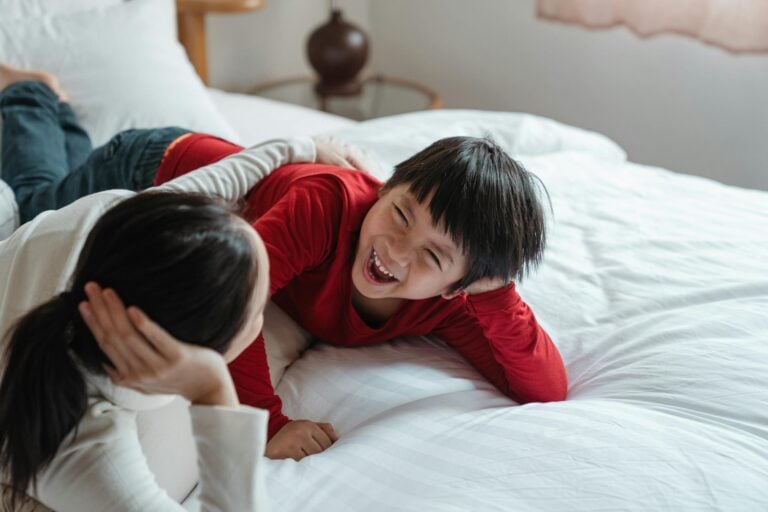

The parents trying to have alone time meme resonates so deeply because it captures something real: the near-impossible task of carving out a few minutes of quiet when small humans have decided your presence is non-negotiable. For introverted parents, that humor carries an extra layer of exhaustion underneath it.
Alone time isn’t a luxury for introverts. It’s how we process the day, restore our energy, and show up as better versions of ourselves for the people we love most. When parenting makes that space nearly impossible to find, the meme stops being funny and starts feeling like a cry for help wrapped in a laugh track.
If you’ve ever hidden in a bathroom just to get three minutes of silence, or pretended to need something from the car just to sit in the driveway alone, you already know exactly what I’m talking about.
Parenting as an introvert touches on so many layers of family life, from energy management to communication styles to the way we model emotional regulation for our kids. Our Introvert Family Dynamics and Parenting hub explores the full terrain of what it means to raise a family when you’re wired for quiet, and this particular corner of that conversation, the relentless humor and hidden pain behind the alone time meme, deserves its own honest look.

Why Does This Meme Hit Introverted Parents So Much Harder?
Memes work because they compress a complicated feeling into something instantly recognizable. The parents trying to have alone time meme, in all its variations, usually shows a parent attempting some small act of solitude, reading a book, sitting quietly with coffee, closing a door for sixty seconds, only to be immediately interrupted by a child who materializes out of nowhere like they have a sixth sense for parental peace.
What’s your personality type?
Take our free 40-question assessment and get a detailed personality profile with dimension breakdowns, context analysis, and personalised insights.
Discover Your Type8-12 minutes · 40 questions · Free
For extroverted parents, that interruption might be mildly annoying. For introverted parents, it can feel genuinely destabilizing. Not because they love their children any less, but because their nervous systems process stimulation differently. An afternoon of constant noise, physical touch, emotional requests, and interrupted thoughts doesn’t just tire an introvert out. It depletes something fundamental.
I remember running a particularly intense pitch week at the agency years ago. Four days of back-to-back client presentations, team meetings, and after-hours strategy sessions. By Friday afternoon, I was functionally useless even though nothing externally had gone wrong. My INTJ brain had simply run out of the internal processing space it needed to keep operating. I went home, sat in a dark room for an hour, and slowly came back to myself.
Parenting doesn’t give you that dark room. It gives you a child standing in the doorway asking if they can have a snack.
What makes the meme resonate so specifically with introverted parents is that it captures the gap between what we need biologically and what parenthood actually allows. Cornell University research on brain chemistry has shown that introverts and extroverts process dopamine differently, with introverts tending toward overstimulation more quickly in high-stimulation environments. A house full of children is, by definition, a high-stimulation environment.
So when introverted parents share that meme with a knowing laugh, what they’re really sharing is the quiet exhaustion of loving their family deeply while also needing to step away from them regularly, and feeling guilty about both the need and the impossibility of meeting it.
What Does the Meme Actually Reveal About Introvert Energy Needs?
There’s a misconception that introverts simply prefer quiet. It’s more precise than that. Introverts restore energy through internal processing, and that restoration requires low-stimulation conditions. Noise, interruption, emotional labor, and social performance all draw from the same internal reservoir. When that reservoir empties, the depletion isn’t just physical tiredness. It affects emotional regulation, patience, creativity, and the ability to be genuinely present.
Parenting, especially of young children, is one of the most relentless forms of stimulation a person can experience. The physical demands are obvious. Less discussed is the cognitive and emotional load: tracking multiple children’s needs simultaneously, managing conflict, holding space for big feelings, maintaining safety, and doing all of it while being touched, called for, and needed constantly.
For parents who identify as highly sensitive, that load compounds significantly. If you’ve noticed that emotional intensity in your household affects you on a physical level, that you absorb your children’s moods almost before they’ve fully expressed them, the experience of HSP parenting and raising children as a highly sensitive parent may describe your experience more precisely than introversion alone.
The meme captures the surface comedy of a parent hiding behind a closed door. What it doesn’t show is what happens when that door never gets closed. Introverted parents who consistently can’t access alone time often become irritable in ways that confuse them, withdrawn in the middle of family interactions, or prone to emotional shutdown at the exact moments their children need them most. That’s not a character flaw. It’s a depletion pattern that Harvard Health’s research on mind and mood recognizes as having genuine physiological underpinnings.

Knowing your own personality makeup matters here more than most people realize. If you’ve never formally assessed where you fall on the introversion-extroversion spectrum, or how your other personality traits interact with your parenting style, the Big Five personality traits test offers a research-backed framework that goes beyond simple introvert or extrovert labels. Understanding your full profile can help you explain your needs to a partner, a co-parent, or even an older child who keeps wondering why mom or dad sometimes needs to disappear for a while.
Is Needing Alone Time as a Parent Actually Selfish?
Let’s address the guilt directly, because it’s woven into every version of this meme. The humor works partly because there’s an undercurrent of shame in it. Parents aren’t supposed to want to escape their children. Loving your kids is supposed to mean wanting to be with them constantly. So when you find yourself genuinely counting the minutes until bedtime not because you’re a bad parent but because your nervous system is screaming for quiet, the guilt arrives right alongside the relief.
During my years running the agency, I watched this exact dynamic play out in a different context. I had team members, good people and talented professionals, who would push through exhaustion rather than step back and recharge, because stepping back felt like weakness or disengagement. The result was never better performance. It was always burnout, poor decisions, and eventual disengagement anyway, just later and more dramatically.
Parenting follows the same logic. A parent who never refills their internal reserves doesn’t become more present. They become less available, more reactive, and more disconnected, even when they’re physically in the room. The alone time isn’t pulling you away from your children. It’s what makes it possible to actually show up for them.
There’s also a modeling dimension worth considering. Children who watch a parent acknowledge and meet their own needs learn something valuable: that self-awareness and self-care are not selfish acts but responsible ones. An introverted parent who says “I need some quiet time to recharge, and then I’ll be ready to play” is teaching their child something about emotional intelligence that no structured lesson could replicate.
Some parents worry that their need for solitude signals something more concerning about their emotional state. If the desire to withdraw feels less like healthy recharging and more like chronic emotional numbness or disconnection, it may be worth exploring that distinction more carefully. Tools like the borderline personality disorder test can help clarify whether what you’re experiencing is introvert recharge patterns or something that might benefit from professional support.
How Do Introverted Parents Actually Carve Out Alone Time Without Losing Their Minds?
Practical strategies matter here, because the meme captures the problem but doesn’t offer solutions. And introverted parents don’t just need commiseration. They need actual approaches that work within the reality of family life.
The first shift that made a genuine difference for me, both in my agency years and in personal life, was treating alone time as a scheduled commitment rather than something I’d get to “when things calmed down.” Things never calm down. In the agency, I blocked time on my calendar that was non-negotiable for internal processing work, reviewing strategy, thinking through problems, writing. At home, the same principle applies. Alone time that gets scheduled has a far better chance of actually happening than alone time that gets hoped for.
Some approaches that introverted parents have found genuinely useful:
Waking up before the household stirs is one of the most consistently cited strategies. Even thirty minutes of quiet before the family activates can set a different tone for the entire day. It’s not perfect, children wake early and unpredictably, but when it works, that pre-dawn window becomes almost sacred.
Communicating the need explicitly to a partner, rather than hoping they’ll intuit it, changes the dynamic significantly. Many introverted parents struggle with this because asking for alone time feels like admitting they can’t handle parenthood. In reality, naming the need clearly is a sign of self-knowledge, not inadequacy. A partner who understands that thirty minutes of solitude produces a more present, patient co-parent is usually willing to make that trade.
Creating micro-moments of quiet throughout the day, rather than waiting for a large block of time that may never come, is another approach worth considering. A few minutes of sitting outside alone after school pickup. Five minutes of quiet in the car before going inside. These smaller pauses don’t replace genuine alone time, but they prevent the full depletion that makes recovery so much harder.
Certain parents also find that physical activity done alone, running, walking, swimming, provides a dual benefit: the body moves, and the mind gets the quiet processing space it needs. PubMed Central research on exercise and mental health supports the connection between physical movement and emotional regulation, which makes solo exercise a particularly efficient form of recharge for introverted parents who are short on time.

It’s worth noting that the strategies that work for one introverted parent may not work for another, because introversion intersects with other personality dimensions in complex ways. Someone who scores high on neuroticism in the Big Five, for instance, may find that their alone time gets consumed by anxious rumination rather than genuine rest, which requires a different approach entirely. Understanding your full personality profile helps you design recharge strategies that actually fit how your mind works, not just how introversion is generically described.
What Happens When Introverted Parents Don’t Get Enough Alone Time?
The meme version of this is funny. The lived version is harder to laugh at.
Chronic depletion in introverted parents tends to manifest in patterns that can look like different problems entirely. Irritability that seems disproportionate to the trigger. Emotional flatness in moments that should feel connecting. A kind of going-through-the-motions quality to parenting that the parent notices and hates in themselves but can’t seem to shake. Difficulty being genuinely playful or creative with children because the internal resources that fuel those things have run dry.
I’ve watched this happen to people I respect enormously. One of my most talented creative directors, an INFP who brought extraordinary empathy and imagination to his work, hit a wall during a period when agency demands were relentless and he had no recovery time. He didn’t become loud or difficult. He became absent in a way that was harder to address, present in body, gone in every meaningful sense. It took months of recovery to get back to himself.
Parenting doesn’t allow for a months-long recovery. Children need you consistently, which is exactly why the depletion spiral is so dangerous for introverted parents. The less alone time they get, the less capacity they have, and the harder it becomes to be the parent they want to be, which generates guilt, which adds to the emotional load, which depletes them further.
Recognizing this pattern early matters. Frontiers in Psychology research on personality and emotional processing has explored how individual differences in how people process emotional information affect their capacity for sustained caregiving. Introverted parents aren’t weaker caregivers. They’re caregivers with a specific energy architecture that requires specific conditions to function well.
Some parents also find that the chronic stress of not having their needs met starts to affect how they show up in other relationships, with a partner, with friends, even with colleagues. If you’ve noticed that parenting-related exhaustion is bleeding into other areas of your life in ways that feel hard to manage, it may be worth considering whether your current support structure is adequate. Roles that involve intensive caregiving, which parenting absolutely is, benefit from the same kind of self-assessment that professionals in formal caregiving fields use. The personal care assistant test online offers one framework for thinking about caregiving capacity and personal limits that translates meaningfully to the parenting context.
How Do You Talk to Your Kids About Needing Alone Time Without Making Them Feel Rejected?
This is where the meme’s humor gives way to something that requires real skill. Children, especially young ones, experience a parent’s withdrawal as rejection unless it’s explained in terms they can understand and trust.
The language matters enormously. “I need some quiet time to fill up my energy so I can be a great parent for you” lands very differently than simply disappearing behind a closed door. Children are remarkably capable of understanding the concept that different people have different needs, when those needs are explained with warmth rather than defensiveness.
One approach that works well is making the recharge process visible and predictable. If a child knows that after dinner, there is a fifteen-minute window where a parent reads alone, and that after that window the parent will be fully available, the child can hold that structure. Unpredictable withdrawal is what creates anxiety. Consistent, explained withdrawal becomes simply part of how the family operates.
There’s also an age-calibration element here. What works for a seven-year-old is different from what works for a three-year-old or a teenager. Younger children need shorter separations with clear, concrete reassurances. Older children can engage with more nuanced conversations about personality differences and energy management. Teenagers, many of whom are handling their own introversion or extroversion, may actually find these conversations genuinely interesting and connecting.
Being likable as a parent, in the genuine sense of being someone your children feel warmly toward and trust, doesn’t require being endlessly available. It requires being consistently honest, warm, and emotionally present when you are available. The likeable person test touches on some of the qualities that build genuine connection, qualities like authenticity, warmth, and reliability, that introverted parents often possess in abundance, even when they need time alone to sustain them.

What Can Introverted Parents Learn From the Meme Beyond the Laugh?
Memes serve a social function that’s easy to underestimate. They create community around shared experience. When an introverted parent shares the parents trying to have alone time meme and gets fifty responses from other parents saying “THIS IS MY LIFE,” something important happens: the isolation of that experience breaks down a little.
Parenting can be profoundly lonely, paradoxically, given that you’re almost never physically alone. Introverted parents often feel a particular kind of isolation because they can’t always articulate why they’re struggling when nothing has gone objectively wrong. The children are healthy. The family is intact. And yet they’re running on empty in ways they can barely explain.
The meme gives that feeling a shared language. And shared language is where community begins.
Beyond the communal recognition, the meme also points toward a conversation that introverted parents need to have more openly with themselves and with the people in their lives: that their need for solitude is not a flaw in their parenting but a feature of their personality that, when honored, makes them better at everything they do.
I spent the first decade of my agency career trying to perform extroversion because I believed that’s what leadership required. The result was a version of me that was less effective, less creative, and less genuine than the INTJ who eventually stopped pretending. The same principle applies to parenting. Performing an extroverted parent when you’re wired differently doesn’t serve your children. It serves an idea of what parenthood is supposed to look like.
Your children don’t need a parent who is always “on.” They need a parent who is genuinely present when they show up. And genuine presence, for an introverted parent, requires the alone time that the meme jokes about but the reality demands.
Physical wellbeing also plays a role in energy management that often gets overlooked in conversations about introversion. Parents who are consistently depleted sometimes find that building in structured physical activity, even brief sessions, helps maintain the baseline energy that makes recharging more efficient. If you’ve considered whether a more structured fitness routine might support your overall resilience as a parent, the certified personal trainer test offers insight into whether that kind of professional support might be a good fit for where you are right now.
The science behind why solitude matters for introverts isn’t simply anecdotal. Nature research on personality and neural processing continues to deepen our understanding of how individual differences in brain function shape the way people experience and recover from social demands. Introverted parents aren’t imagining their need for quiet. They’re responding to genuine neurological architecture.
And PubMed Central research on parental stress and family wellbeing consistently points to parental mental health as one of the strongest predictors of child outcomes. A parent who protects their mental health, including through the solitude they need to function, is doing something directly beneficial for their children, even when it doesn’t look that way from the outside.
Understanding family dynamics through the lens of Psychology Today reveals that healthy family systems are built on individual members knowing and honoring their own needs, not suppressing them in service of an impossible standard of constant availability.

If this article has resonated with you, there’s a lot more to explore about how introverts show up in family life across every stage and relationship. The Introvert Family Dynamics and Parenting hub covers the full range of these experiences, from raising children with different personality types to managing introvert energy within a partnership.
About the Author
Keith Lacy is an introvert who’s learned to embrace his true self later in life. After 20 years in advertising and marketing leadership, including running agencies and managing Fortune 500 accounts, Keith now channels his experience into helping fellow introverts understand their strengths and build fulfilling careers. As an INTJ, he brings analytical depth and authentic perspective to every article, drawing from both professional expertise and personal growth.
Frequently Asked Questions
Why do introverted parents need alone time more than extroverted parents?
Introverted parents restore their energy through solitude and internal processing rather than through social interaction. Parenting involves near-constant stimulation, noise, physical touch, and emotional demands, all of which draw from an introvert’s internal energy reserves. Without regular opportunities to refill those reserves through quiet time alone, introverted parents experience genuine depletion that affects their patience, creativity, emotional availability, and overall capacity to parent well. This is a neurological reality, not a personal failing.
Is it normal to feel guilty about wanting alone time as a parent?
Yes, and it’s also worth examining that guilt carefully. Many parents, especially introverted ones, have internalized the idea that good parenting means wanting to be with your children every moment. In reality, a parent who consistently ignores their own energy needs becomes less present, more reactive, and less emotionally available over time. Wanting and protecting alone time is not a sign of loving your children less. It’s a form of self-awareness that directly benefits your children by keeping you functioning at your best.
How can I explain my need for alone time to young children without making them feel rejected?
Use simple, concrete language that frames alone time as energy-filling rather than escape. Telling a child “I need some quiet time to fill up my energy so I can be a great parent for you” is honest and reassuring. Making the pattern predictable matters enormously: children who know that a parent’s quiet time is followed by full, warm availability can hold that structure without anxiety. Unpredictable withdrawal creates fear. Consistent, explained withdrawal becomes simply part of how your family works.
What are realistic strategies for introverted parents to get alone time?
Waking before the rest of the household, scheduling alone time as a non-negotiable block rather than hoping for it to appear, communicating the need explicitly to a partner, and creating micro-moments of quiet throughout the day are all approaches that introverted parents find genuinely useful. Solo physical activity, like running or walking, offers a dual benefit of movement and mental quiet. The most important shift is treating alone time as a legitimate need to be planned for, not a luxury to be earned after everything else is handled.
What does the parents trying to have alone time meme reveal about introvert parenting more broadly?
The meme captures something real: the near-impossible gap between what introverted parents need and what parenting typically allows. Beyond the humor, it creates shared language around an experience that many introverted parents feel but struggle to articulate. It also points toward a larger conversation about how introverted parents can honor their own energy needs without guilt, communicate those needs to family members, and build family routines that work for their personality rather than against it. The laugh is real, and so is the exhaustion underneath it.