
Games designed for meditation use gentle, low-stakes gameplay to quiet mental chatter and bring attention into the present moment. Unlike traditional sitting meditation, these experiences meet your mind where it already is, giving it something soft to hold onto while stress slowly releases.
For introverts and highly sensitive people, meditative games offer something uniquely valuable: a private, self-paced space to decompress without the social performance that so many wellness trends seem to require.
My relationship with meditation has always been complicated. Sitting still with my thoughts, especially after a long day of client presentations and agency politics, felt less like peace and more like a board meeting with no agenda. My mind would produce a running commentary on everything I’d said wrong, every decision I was second-guessing, every email I hadn’t answered. What eventually worked for me wasn’t silence. It was something to do with my hands and my eyes while my nervous system quietly caught up.

If you’re working through the broader terrain of mental health as an introvert, the Introvert Mental Health Hub pulls together everything from anxiety and sensory overload to emotional processing and perfectionism. This article fits into that larger conversation as a practical, low-barrier entry point for anyone who finds traditional mindfulness practices frustrating.
Why Do Introverts Struggle With Traditional Meditation?
Conventional meditation advice tends to assume that stillness is universally accessible. Sit down, close your eyes, follow your breath. For many introverts, and especially for highly sensitive people, that instruction lands somewhere between difficult and genuinely distressing.
My mind doesn’t idle. It processes. That’s not a flaw I’ve managed to fix after years of self-awareness work. It’s simply how I’m wired as an INTJ. When I tried traditional breath-focused meditation during a particularly brutal agency merger, I’d sit for five minutes and emerge feeling more wound up than when I started. My brain had used the silence as an opportunity to rehearse worst-case scenarios in high definition.
What neuroscience has begun to confirm is that the default mode network, the part of the brain that activates during rest and self-referential thinking, can actually intensify rumination when there’s no gentle external anchor. For people who already process emotion deeply, that quiet can amplify rather than soothe. A study published in PubMed Central examining mindfulness-based interventions found that the effectiveness of meditation varies considerably based on individual traits, including anxiety levels and sensory sensitivity.
Highly sensitive people face a particular version of this challenge. When the world has been too loud, too bright, or too emotionally dense, the act of turning inward without any structure can feel overwhelming rather than restorative. If you recognize yourself in that description, the piece on HSP overwhelm and managing sensory overload speaks directly to why your nervous system responds the way it does.
Games designed for meditation work differently. They give the analytical mind a light task, something just engaging enough to occupy the part of the brain that wants to plan and solve, while the deeper nervous system begins to settle. It’s not distraction. It’s scaffolding.
What Actually Makes a Game Meditative?
Not every calm game qualifies. There’s a meaningful difference between a game that reduces stress and one that genuinely supports a meditative state. The distinction matters if you’re using this as a mental health practice rather than just entertainment.
Meditative games tend to share a few specific qualities. They have no failure states, or the consequences of failure are so gentle they don’t trigger the stress response. They involve repetitive, rhythmic actions that mirror the function of breathwork or mantra. They reward presence over performance. And they create what psychologist Mihaly Csikszentmihalyi described as flow, a state of absorbed engagement where self-consciousness temporarily dissolves.
I ran creative teams for years, and I watched how my most talented designers would enter something close to a trance state when working on visual problems they found absorbing. One of my senior art directors used to say she did her best thinking while playing a simple tile-matching game on her phone during lunch. At the time I thought it was avoidance. Later I understood she was regulating. The game gave her nervous system a reset that made the next three hours of work sharper and more intuitive.

The American Psychological Association’s work on resilience emphasizes that recovery practices don’t need to look the same for everyone. What matters is whether the activity genuinely restores your capacity to function and feel. For introverts who process emotion intensely, a meditative game can serve that function just as legitimately as a breathing exercise.
Anxiety often sits underneath the difficulty with traditional meditation. When the mind is already running hot with worry, being told to simply observe thoughts without engaging them can feel impossible. The National Institute of Mental Health’s overview of generalized anxiety describes how chronic worry creates cognitive patterns that are genuinely difficult to interrupt through willpower alone. A gentle game provides an alternative entry point, a side door into calm rather than a frontal assault on anxiety.
For those of us who also carry the weight of HSP anxiety, that side door isn’t a shortcut. It’s a legitimate adaptation to how our nervous systems actually work.
Which Types of Games Support a Meditative State?
The category is broader than most people expect. Meditative games span digital apps, tabletop experiences, and even analog solo activities that function like games. What they share is intentional design around calm engagement rather than competition or urgency.
Slow-Paced Digital Games
Games like Alto’s Odyssey, Flower, and experience have built devoted followings among people who use them specifically for stress recovery. Alto’s Odyssey is a side-scrolling snowboarding game with no enemies, gentle procedural landscapes, and a soundtrack that shifts with the weather. Flower puts you in control of wind carrying flower petals across open fields. experience is a wordless adventure through a vast desert that many players describe as genuinely moving.
What these games do well is create a sense of forward motion without urgency. Your attention is engaged but not strained. The visual environments are designed to be beautiful rather than stimulating. And the absence of failure pressure means your nervous system never gets the signal to brace.
I came to Flower during a period when I was managing a particularly difficult agency transition. We’d lost a major account and I was carrying the weight of that decision quietly, the way INTJs tend to do, processing alone rather than talking it through. Thirty minutes with that game most evenings didn’t solve anything, but it gave my nervous system enough of a break that I could approach the next morning with something closer to clarity.
Puzzle and Pattern Games
Certain puzzle games produce a meditative state through a different mechanism: the satisfaction of pattern completion. Games like Monument Valley, Unpacking, and even well-designed versions of Tetris or Mahjong engage the spatial and pattern-recognition parts of the brain in ways that crowd out anxious thinking without requiring emotional effort.
Monument Valley is architecturally stunning and moves at whatever pace you choose. Unpacking, which involves sorting and placing household objects into rooms, has become unexpectedly popular as a meditative experience because it’s tactile, quiet, and emotionally resonant without being demanding.
The pattern-completion satisfaction in these games mirrors something that many introverts already do naturally: organizing physical spaces, arranging items, creating order from chaos. For people who feel deeply and process intensely, there’s genuine comfort in the act of things fitting where they belong. That impulse connects to the deeper emotional processing that highly sensitive people experience, the need to find meaning and resolution in the world around them.

Nature Simulation and Farming Games
Stardew Valley has earned a reputation as one of the most genuinely calming games ever made, which is remarkable given that it’s technically a farming and relationship simulator with a fair amount of content to manage. What makes it meditative is the rhythm. Plant, water, harvest. Talk to a neighbor. Go fishing. The days are short, the stakes are low, and the world rewards patience over speed.
Games in this category work partly because they simulate the restorative qualities of nature without requiring you to leave your home. There’s a meaningful body of evidence suggesting that exposure to natural environments, even simulated ones, can reduce physiological stress markers. A PubMed Central analysis of nature-based interventions found measurable effects on stress and mood from engagement with natural environments, including virtual ones.
For introverts who find social interaction depleting, the simulated social world of Stardew Valley is also appealing in a specific way. You can engage with characters on your own terms, at your own pace, without the unpredictability of real human interaction. There’s no pressure to respond quickly or perform warmth you don’t feel. That quality speaks to something many introverts recognize: the desire for genuine connection without the exhaustion of managing someone else’s emotional expectations.
Analog and Tactile Meditative Games
Digital isn’t the only option. Certain analog experiences function as meditative games in every meaningful sense. Jigsaw puzzles are the most obvious example. The tactile engagement, the progressive emergence of an image, the satisfying click of pieces finding their place, these qualities produce a state of absorbed attention that many people find more grounding than screen-based alternatives.
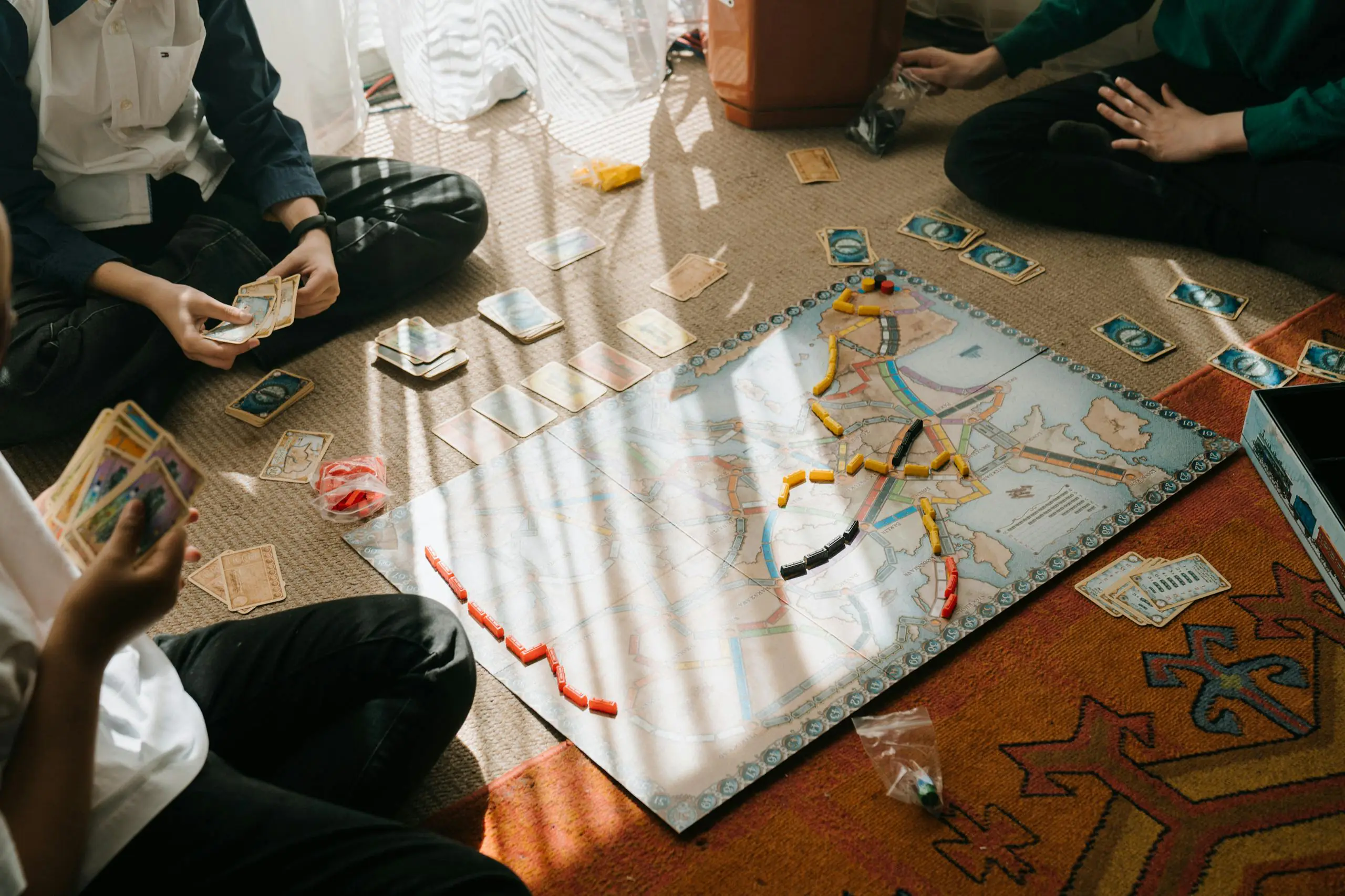
Solo card games like Solitaire, certain forms of Mahjong played with physical tiles, and even adult coloring books with structured geometric patterns all qualify. The common thread is rhythmic, low-stakes engagement that occupies the hands and the eyes while leaving the deeper mind free to settle.
One of my most reliable decompression rituals during the agency years was a physical jigsaw puzzle on the dining room table. No screens, no notifications, no one needing anything from me. My team used to joke that they could tell when I’d had a rough week by whether the puzzle had progressed. It wasn’t avoidance. It was maintenance.
How Do Meditative Games Interact With Deep Emotional Processing?
One of the more interesting things I’ve noticed in my own experience is that meditative games don’t just quiet the mind. Sometimes they create conditions where something important surfaces. You’re engaged enough that the defensive vigilance drops, and suddenly you realize what you’re actually feeling underneath the noise.
This isn’t accidental. When the analytical mind is gently occupied, the emotional processing that often gets suppressed during busy days has room to move. For introverts who tend to internalize rather than express, that can be genuinely valuable. Not every feeling needs to be talked through. Some just need space to exist and pass.
Highly sensitive people often carry a particular relationship with this kind of processing. The depth of feeling that makes HSPs such perceptive, empathetic people also means that emotions don’t simply fade on their own schedule. They need somewhere to go. A meditative game can provide that container, a quiet hour where the body is calm enough for the emotional backlog to process without becoming overwhelming.
That depth of empathy is worth understanding on its own terms. The way highly sensitive people absorb and respond to others’ emotional states, what makes HSP empathy both a gift and a source of exhaustion, is precisely why recovery practices matter so much. Meditative games offer a form of recovery that doesn’t require more emotional labor. You’re not being asked to feel anything specific. You’re just being given permission to rest.
There’s also a relationship between meditative gaming and perfectionism worth naming directly. Many introverts, especially those with highly sensitive temperaments, bring an exacting internal standard to everything they do. Traditional meditation can actually trigger that perfectionism: Am I doing this right? Is my mind too busy? Should I be further along by now? A game with no performance metric sidesteps that trap entirely. You can’t fail at watching flower petals drift across a field.
If perfectionism is a pattern you recognize in yourself, the exploration of HSP perfectionism and high standards offers a more thorough examination of where that drive comes from and how to work with it rather than against it.

Can Games Help Process Rejection and Emotional Wounds?
This one surprised me when I first thought about it carefully. Rejection, whether professional or personal, lands differently for introverts and highly sensitive people. It tends to go deep and stay there. The internal processing can run for days, cycling through the same moments, the same words, the same what-ifs.
During a period when I’d lost a significant client relationship that had been personally important to me, not just professionally, I found that meditative games served a specific function. They gave me somewhere to put my attention that wasn’t the wound. Not to escape it, but to create enough distance that I could approach it more gently when I was ready.
There’s a concept in trauma-informed therapy called titration, the idea that processing difficult material works better in small doses than in sustained immersion. A meditative game can function as a natural titration tool. You engage with the feeling for a while, then you rest in something gentle, then you return. The rhythm of that movement is often more sustainable than trying to process everything at once.
Rejection hits particularly hard for people who feel deeply, and understanding the mechanisms behind that sensitivity matters. The piece on HSP rejection and the healing process examines why rejection registers so intensely for sensitive people and what genuine recovery actually looks like.
What I’ve found, both personally and in conversations with introverts over the years, is that the games that help most during emotionally difficult periods tend to be the ones with the most beautiful environments and the least narrative tension. You want something that reminds you the world is still soft and worth being present in, without asking you to perform that belief before you feel it.
How Do You Build a Meditative Gaming Practice That Actually Sticks?
The difference between using games as a genuine mental health tool and using them as avoidance often comes down to intention and structure. Both matter.
Intention means choosing a game specifically because of how it makes you feel, not because it’s the most engaging option available. There’s a meaningful difference between reaching for a meditative game because you want to give your nervous system a rest and reaching for a highly stimulating game because you want to stop thinking. The first is restoration. The second is numbing. Both have their place, but they’re not the same practice.
Structure means creating a container around the practice. A set window of time, somewhere between twenty minutes and an hour, works better than open-ended play. The boundary matters because it signals to your brain that this is a deliberate practice, not a default state. I used to set a physical timer during my agency years when I needed to decompress before a difficult conversation or a high-stakes presentation. The timer made it a ritual rather than a distraction.
Environment matters too. Playing a meditative game on the same device you use for work email, with notifications enabled and a browser full of open tabs, undermines the practice before it starts. If possible, create some physical and digital separation. A tablet used only for this purpose, or at minimum a dedicated mode with notifications silenced, helps establish the mental context that this time is different.
A PubMed Central resource on mindfulness-based stress reduction notes that consistency and environmental cues play a significant role in whether mindfulness practices become sustainable habits. The same principle applies here. Your brain learns what a particular context means, and over time, entering that context begins to produce the desired state more quickly.
One thing worth being honest about: meditative games work best as part of a broader mental health approach, not as a replacement for other forms of support. If anxiety or depression is significant, these practices complement professional care rather than substitute for it. The research on complementary approaches to mental wellness consistently points toward layered strategies rather than single solutions.
What Should Introverts Look for When Choosing a Meditative Game?
Not every calm game will work for every introvert. Temperament matters here, and so does the specific kind of mental fatigue you’re recovering from.
If your exhaustion is primarily social, from too many meetings, too much performance, too much managing other people’s reactions, you’ll probably want a game with minimal social mechanics. Something that places you in a beautiful environment with no characters making demands on your attention. Flower, Alto’s Odyssey, and similar experiences work well here.
If your exhaustion is primarily cognitive, from complex decisions, information overload, or sustained analytical work, you might actually benefit from a game with a bit more structure. A gentle puzzle, a pattern-matching game, or a simple building simulation gives your brain a different kind of problem to work on, one with clear rules and satisfying resolutions. That shift in cognitive mode can be more restorative than complete disengagement.
If your exhaustion is emotional, from absorbing other people’s stress, managing conflict, or carrying unprocessed feelings, the nature simulation and farming game category often works best. The combination of gentle routine, beautiful environments, and low emotional stakes creates a container that feels safe enough for your nervous system to release what it’s been holding.
Pay attention to what happens in your body during the first five minutes of a game. If you feel your shoulders drop slightly, if your breathing slows, if the internal commentary quiets even a little, that’s a signal the game is doing what you need. If you feel more alert, more stimulated, or more anxious after five minutes, it’s probably not the right tool for this moment.
The broader question of how introverts manage their inner lives, including what we absorb from others and how we protect our energy, connects to the Psychology Today piece on introvert social preferences, which captures something real about why introverts need deliberate recovery practices in the first place.

One more thing worth naming: the guilt. Many introverts, particularly those with perfectionistic tendencies, feel guilty about using games as a mental health tool. There’s a voice that says you should be meditating properly, or exercising, or doing something productive. That voice is worth questioning. Recovery that actually works is more valuable than recovery that looks correct from the outside. What matters is whether you feel more like yourself afterward.
The Ohio State University research on perfectionism and wellbeing offers a useful frame here: the pursuit of the ideal approach often undermines the actual outcome. A twenty-minute session with a gentle puzzle game that genuinely restores your capacity to be present is worth more than an hour of meditation practice you’re doing wrong and feeling bad about.
More resources on the intersection of sensitivity, mental health, and introvert experience are collected in the Introvert Mental Health Hub, which covers everything from anxiety and emotional processing to perfectionism and healing from rejection.
About the Author
Keith Lacy is an introvert who’s learned to embrace his true self later in life. After 20 years in advertising and marketing leadership, including running agencies and managing Fortune 500 accounts, Keith now channels his experience into helping fellow introverts understand their strengths and build fulfilling careers. As an INTJ, he brings analytical depth and authentic perspective to every article, drawing from both professional expertise and personal growth.
Frequently Asked Questions
Are games a legitimate form of meditation?
Yes, when used with intention. Games designed around calm engagement, repetitive rhythm, and low-stakes interaction can produce measurable relaxation responses in the nervous system. They work differently from breath-focused meditation but serve a similar function: reducing mental noise and bringing attention into the present moment. For people who struggle with traditional sitting meditation, they can be a more accessible and equally effective alternative.
What makes a game meditative rather than just relaxing?
A meditative game produces a state of absorbed, non-anxious attention rather than simply reducing stimulation. It typically involves repetitive or rhythmic actions, has no failure pressure, rewards presence over performance, and creates what psychologists describe as a flow state. Many relaxing games share some of these qualities, but meditative games are specifically designed around the experience of calm engagement rather than entertainment or challenge.
How long should a meditative gaming session last?
Between twenty minutes and an hour tends to work well for most people. Less than twenty minutes may not be enough time for the nervous system to fully settle, particularly if you’re coming from a high-stress environment. More than an hour can shift from restoration into avoidance, depending on what you’re using the practice to manage. Setting a timer and treating the session as a deliberate ritual rather than open-ended play helps maintain the mental health benefit.
Can meditative games help with anxiety?
They can be a useful part of an anxiety management approach, particularly for people who find that traditional mindfulness practices increase rather than decrease rumination. Gentle games provide an external anchor for attention without requiring emotional effort, which can help interrupt anxious thought patterns. They work best as a complement to other strategies rather than a standalone solution, and they’re not a substitute for professional support when anxiety is significant.
Are there specific games recommended for highly sensitive people?
Highly sensitive people often respond well to games with beautiful, nature-inspired visuals and minimal auditory or visual intensity. Flower, experience, Alto’s Odyssey, Stardew Valley, and Monument Valley are frequently cited by HSPs as genuinely restorative. Puzzle games like Unpacking and physical jigsaw puzzles also work well. The key quality to look for is an absence of sudden sounds, flashing visuals, or competitive pressure, all of which can activate rather than calm a sensitive nervous system.