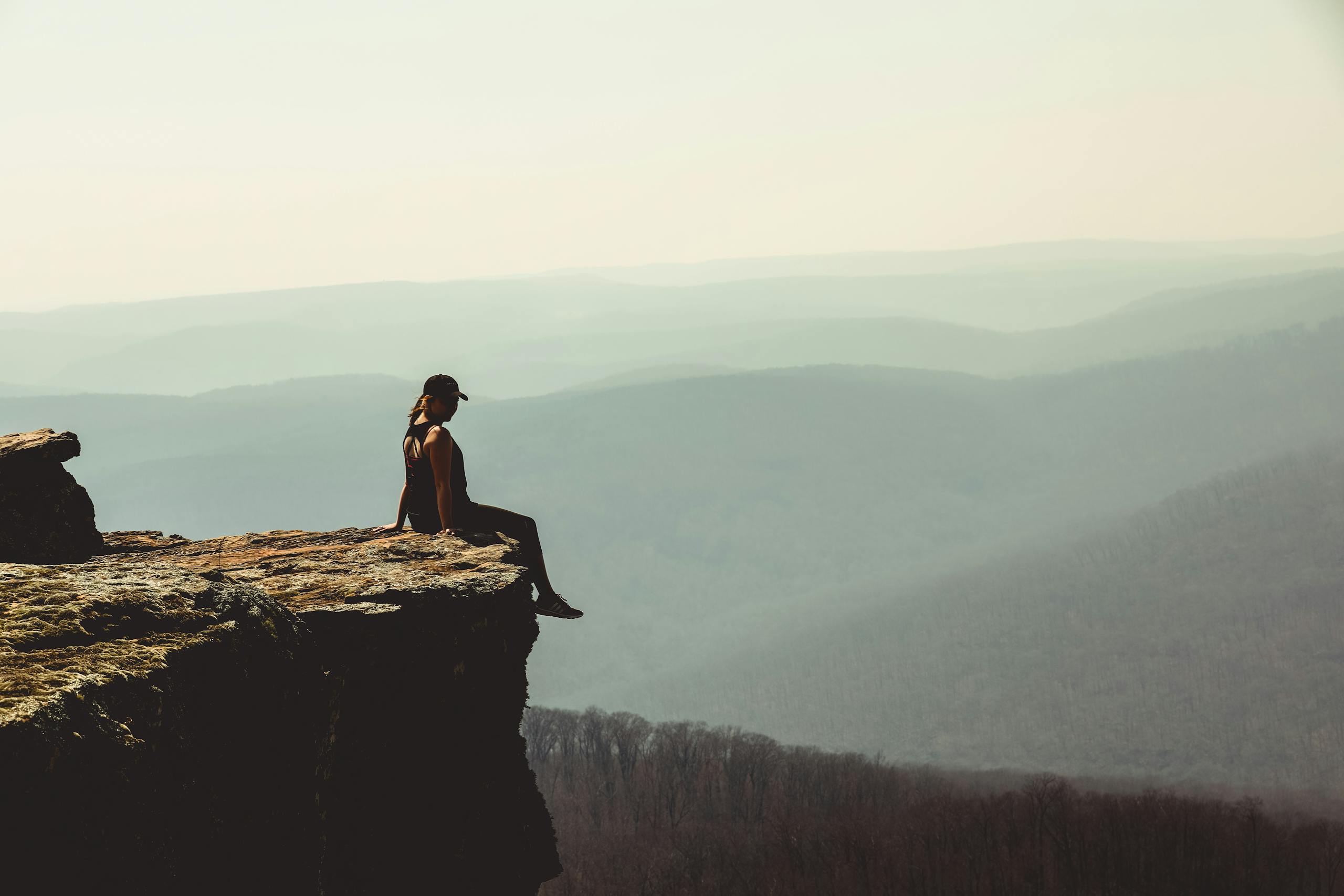

Jon Kabat-Zinn’s mountain meditation is a guided mindfulness practice that invites you to embody the stillness, stability, and presence of a mountain, remaining grounded no matter what weather passes through. For introverts and highly sensitive people who carry the weight of an overactive inner world, this practice offers something quietly profound: a way to stop fighting your own depth and start standing in it.
Kabat-Zinn developed this practice as part of his Mindfulness-Based Stress Reduction program, and its premise is deceptively simple. You are not the storm. You are the mountain the storm moves across. That distinction changed how I understood my own mind, and it took me an embarrassingly long time to find it.

Mental health for introverts isn’t just about managing stress. It’s about building a relationship with the inner landscape most of us spend our lives trying to quiet. Our Introvert Mental Health hub explores that full range, from anxiety and overwhelm to emotional processing and the particular weight of feeling everything so deeply. The mountain meditation fits naturally into that conversation, because it was built for minds that won’t stop moving.
What Is the Jon Kabat-Zinn Mountain Meditation?
Jon Kabat-Zinn is a molecular biologist turned mindfulness teacher who founded the Stress Reduction Clinic at the University of Massachusetts Medical School in 1979. His Mindfulness-Based Stress Reduction program, known as MBSR, became one of the most studied secular mindfulness frameworks in modern medicine. The mountain meditation is one of several visualization practices he developed within that program, alongside the lake meditation and the loving-kindness practice.
The practice works like this. You settle into a comfortable seated position, close your eyes, and bring to mind the image of a mountain. Not a postcard mountain, but a real one: ancient, rooted, massive, and unmoved by what happens on its surface. Seasons change. Storms arrive and pass. Snow covers the peak. Wildfire scorches the lower slopes. Through all of it, the mountain remains exactly what it is.
Then Kabat-Zinn invites you to recognize that you are that mountain. Your thoughts, emotions, and sensations are the weather. They are real. They matter. But they are not you. You are the stable ground beneath all of it.
That framing hit me differently than most meditation instructions I’d encountered. So much of what I’d read about mindfulness felt like it was asking me to stop thinking, to quiet the mental activity that felt central to who I am as an INTJ. The mountain metaphor asked something different. It asked me to change my relationship with my thoughts, not eliminate them. That’s a distinction worth sitting with.
Why Does This Practice Resonate So Deeply With Introverts?
Most introverts I know don’t struggle with silence. We struggle with what lives inside the silence. The mind keeps processing. Conversations replay. Decisions get examined from seventeen angles. Emotions arrive slowly and then settle in for a long stay.
That internal richness is genuinely a strength. It produces the kind of depth, creativity, and careful thinking that served me well across two decades running advertising agencies. My teams knew that when I came back with a recommendation, I had already considered the counterarguments. What they didn’t see was the cost of that processing, the nights when the mental activity wouldn’t stop, when every decision from the day continued circling long after it should have been settled.
The mountain meditation speaks directly to that experience. It doesn’t ask you to think less. It asks you to find the part of you that exists beneath the thinking. For people who process emotion and information with unusual depth, that invitation is genuinely relieving.
There’s also something about the imagery itself that resonates with how many introverts experience their inner life. Mountains are solitary. They are not social creatures. They don’t require approval or noise to maintain their presence. They simply are. For someone who has spent years explaining to extroverted colleagues why they need quiet to do their best work, the mountain is a surprisingly validating symbol.

Highly sensitive people, in particular, often carry a version of HSP overwhelm that goes well beyond sensory overload. The internal environment itself becomes overwhelming. Emotions pile on top of each other. The mountain practice offers a way to observe that accumulation without being buried by it. You’re not escaping the sensitivity. You’re finding a place to stand inside it.
How Does the Mountain Meditation Work on a Practical Level?
Kabat-Zinn’s original guided version runs approximately twenty minutes, though the practice can be shortened for daily use. The structure moves through several distinct phases.
You begin by grounding your physical body. Feet flat. Spine long. Hands resting. The physical posture matters because it mirrors the intention: upright, stable, present.
From there, the visualization builds gradually. You imagine the most beautiful mountain you can conceive, or one you’ve actually seen. You notice its base, wide and solid. Its slopes, rising toward the sky. Its peak, often hidden in cloud. You take in the whole image before you begin to merge with it.
Then comes the central move. You recognize that the mountain’s qualities are already yours. The stillness is already in you. The stability is already in you. You are not borrowing these things from an imaginary mountain. You are remembering them.
The final phase works with change. Kabat-Zinn guides you through the seasons passing across the mountain. Spring rain. Summer heat. Autumn wind. Winter snow. The mountain is present for all of it, changed by none of it in any fundamental way. Your emotions, your moods, your difficult days, these are the seasons. They pass. You remain.
One thing I noticed when I first committed to this practice consistently was how different it felt from other mindfulness approaches I’d tried. Breath-focused meditation always felt slightly like a battle. My mind would wander, I’d notice, I’d return to the breath, repeat. The mountain gave me something to actually inhabit rather than something to return to. That shift made consistency much easier to maintain.
The science of mindfulness-based practices supports the general framework. Published research in PMC has examined how MBSR interventions affect stress and emotional regulation, with findings suggesting meaningful benefits for people dealing with chronic stress and anxiety. Kabat-Zinn’s broader program has been examined across a range of clinical populations, and the mountain meditation fits within that evidence base as a visualization-based extension of core mindfulness principles.
What Does the Mountain Metaphor Offer People Who Feel Everything Deeply?
One of the harder things about being a deeply feeling person is that emotions don’t arrive with clear labels. They arrive as weather. A low pressure system that you can’t quite name settles in. You know something is happening. You’re not always sure what. And in the absence of clarity, the mind keeps working, keeps processing, keeps trying to make sense of the signal.
People who experience HSP anxiety often describe exactly this pattern: an emotional activation that precedes any clear cognitive understanding of what triggered it. The body knows something before the mind catches up. That gap between feeling and understanding can be genuinely distressing.
The mountain meditation doesn’t try to close that gap by force. It doesn’t ask you to understand the emotion before you can be at peace. It asks you to hold the emotion the way a mountain holds weather: fully present to it, not threatened by it. That’s a radically different instruction than “figure out why you feel this way before you’re allowed to feel okay.”
I spent a lot of years in agency leadership trying to process emotions on a schedule that the work demanded. A client would deliver difficult feedback, and I had about forty-five seconds to decide how to respond before the room expected something from me. Over time, I got good at the forty-five-second version. What I didn’t get good at was the longer processing that needed to happen later. The mountain practice gave me a structure for that. I could sit with the difficult thing, hold it, watch it move through, and come out the other side without having forced a resolution that wasn’t ready yet.
That capacity for holding rather than forcing is particularly valuable for people who engage in deep emotional processing. The mountain doesn’t rush the storm. It simply remains present until the storm is finished.

How Does This Practice Help With the Weight of Absorbing Others’ Emotions?
Many introverts and highly sensitive people carry something that goes beyond their own emotional experience. They carry the emotional residue of the people around them. A tense meeting doesn’t just produce tension in the room. It produces tension that comes home with you, that sits at the dinner table, that wakes you up at 3 AM.
I managed a creative director at my agency who was one of the most gifted people I’ve ever worked with. She was also someone who absorbed the emotional state of every client meeting, every internal review, every offhand comment from a colleague. By Friday afternoon, she was carrying the weight of an entire week’s worth of other people’s stress. Her work was extraordinary. Her capacity to sustain it was genuinely threatened by how much she took in.
What she was experiencing is something many people recognize: the double-edged nature of HSP empathy. The same sensitivity that makes you attuned to others, that makes you a better collaborator, a better friend, a better leader, also makes you porous in ways that are exhausting to manage.
The mountain metaphor offers a useful reframe here. Mountains are not indifferent to weather. The rain changes the mountain over geological time. But the mountain is not destabilized by a single storm. You can be moved by someone’s pain without being swept away by it. You can be present to someone’s anger without becoming angry. The mountain holds the weather without becoming the weather.
Practicing this consistently builds something that feels less like a technique and more like a posture. A way of standing in the world that is both fully present and fundamentally stable. That combination is hard to find in any other practice I’ve encountered.
The American Psychological Association’s framework on resilience describes exactly this kind of capacity: the ability to adapt to adversity and difficulty without losing core functioning. The mountain meditation is, in practical terms, a training ground for that kind of resilience.
What About the Perfectionism That Keeps Introverts From Meditating at All?
Here’s something I’ve noticed in myself and in conversations with other introverts: we are remarkably good at deciding we’re not doing meditation correctly. The mind wanders and we conclude we’ve failed. The visualization doesn’t feel vivid enough and we decide we’re not visual thinkers. We sit for fifteen minutes and feel nothing dramatic and we conclude the practice doesn’t work for us.
That pattern is worth naming directly, because it keeps a lot of people from a practice that could genuinely help them. HSP perfectionism has a particular flavor: it’s not just about external performance standards. It’s about internal ones. We hold our inner experience to the same exacting standard we hold everything else, and when the experience doesn’t match what we imagined it should be, we dismiss it.
The mountain meditation is actually well-suited to interrupt that pattern, because the mountain doesn’t perform. It doesn’t try to be more mountain-like on the days when it’s covered in fog. It doesn’t apologize for the seasons when it looks less impressive. It simply is what it is, completely and without apology.
Kabat-Zinn himself is clear on this point in his writing and his guided sessions. There is no correct version of this experience. A wandering mind during meditation is not a failed meditation. It is a meditation in which you noticed your mind wandering, which is itself the practice. The noticing is the work.
My own perfectionism showed up in meditation as an obsessive concern with whether I was relaxed enough. I would spend the first ten minutes of a sitting evaluating my relaxation level, which is, if you think about it, a spectacularly counterproductive activity. The mountain image helped me sidestep that loop. I wasn’t trying to achieve relaxation. I was trying to embody stability. Those are different targets, and the second one is much less likely to collapse under self-scrutiny.

How Does the Mountain Meditation Support Recovery From Difficult Experiences?
One of the less discussed aspects of Kabat-Zinn’s mountain imagery is what it implies about difficult experiences. The mountain doesn’t avoid storms. It doesn’t try to redirect them. It doesn’t pretend they’re not happening. It receives them, fully and without resistance, and remains itself throughout.
That’s a different model than most of us were handed for dealing with painful experiences. Most of us learned, in various ways, that the goal is to move through difficult things as quickly as possible. Process it, resolve it, file it away. Get back to functioning.
For introverts and highly sensitive people, that model often doesn’t fit the actual timeline of their inner experience. Some things take longer to process. Some emotional weather systems are slow-moving and complex. Trying to rush them doesn’t make them pass faster. It just adds the additional weight of feeling like you’re doing grief or disappointment or rejection incorrectly.
People working through HSP rejection and the healing process often describe exactly this tension: the sense that they should be further along, that their emotional response is disproportionate, that something is wrong with how long things linger. The mountain offers a different frame. The storm is as long as it is. The mountain doesn’t measure it. It simply remains present until the storm is finished, and then it remains present after.
There’s real value in having an image for that kind of patient presence. Abstract instructions to “be patient with yourself” don’t always land. But the image of a mountain holding a winter storm, not fighting it, not rushing it, just being solid underneath it, that lands somewhere different. It gives the mind something concrete to return to when the abstract reassurances stop working.
Mindfulness-based approaches have shown meaningful promise in supporting emotional recovery across a range of contexts. Additional published research in PMC has examined the role of mindfulness in emotional regulation and psychological flexibility, suggesting that practices which build present-moment awareness can support recovery from difficult emotional experiences over time.
How Do You Build a Consistent Mountain Meditation Practice?
Consistency is where most meditation intentions fall apart, and I’ve been there more times than I’d like to admit. The practice that felt essential during a difficult stretch becomes optional when things stabilize, and then it disappears entirely until the next difficult stretch arrives.
What finally helped me build something sustainable was treating the mountain meditation less like a stress-management tool and more like maintenance. You don’t wait until your car breaks down to change the oil. The practice is most valuable when you do it before you need it, so that when the difficult weather arrives, the posture is already familiar.
Practically, that means finding a time that doesn’t require willpower to protect. For me, that’s early morning, before the day has made any demands. The agency years trained me to be up before the rest of the building. I redirected that habit toward something more useful than email.
Kabat-Zinn’s full guided version is available through his recordings and through the MBSR program materials. For daily practice, many people find that a shortened version of ten to twelve minutes serves them well. The essential elements are the posture, the mountain visualization, and the movement through the seasons. Everything else is support structure.
The clinical overview of mindfulness-based interventions available through the National Library of Medicine outlines the general structure of MBSR and related practices, which can be useful context if you want to understand where the mountain meditation fits within the broader framework Kabat-Zinn developed.
One practical note: the mountain meditation works best when you’re not trying to solve something during it. That was a hard lesson for me. My natural mode is to use quiet time to think through problems. The mountain practice asks for something different: presence without agenda. You’re not there to figure anything out. You’re there to be the mountain. Let the weather move through. Trust that the stability is already in you, even when it doesn’t feel that way.
Anxiety, in particular, can make that trust feel impossible. The National Institute of Mental Health’s resources on generalized anxiety describe how persistent worry and anticipatory fear can make it genuinely difficult to access any sense of groundedness. The mountain practice doesn’t cure anxiety. But practiced consistently, it builds a reference point: a felt sense of stability that you can return to even when the anxiety is loud.
It’s also worth acknowledging that meditation isn’t the only tool in the kit. The broader field of mindfulness research has grown considerably, and academic work examining mindfulness-based practices continues to explore how different approaches serve different people. The mountain meditation is one entry point, not the only one.

What Makes This Practice Different From Other Mindfulness Approaches?
Most mindfulness instructions are anchored in observation: watch your thoughts, notice your breath, return your attention. Those instructions are sound. They’re also, for many introverts, a setup for a particular kind of self-consciousness. Watching yourself think is something introverts do constantly. Adding a formal practice framework to it can sometimes intensify the loop rather than interrupt it.
The mountain meditation works differently because it gives you an identity to inhabit rather than a process to perform. You are not watching yourself think. You are being the mountain while thoughts happen. That shift from observer to embodied presence changes the quality of the experience significantly.
It also changes the relationship with difficult emotions. Observational mindfulness can sometimes produce a kind of clinical distance from your own experience, which has its uses but can also feel alienating for people who value emotional depth. The mountain doesn’t create distance. It creates ground. You’re not above the storm looking down at it. You’re beneath it, solid, holding it from below.
That distinction matters for people who have complicated relationships with their own emotional intensity. Many introverts and highly sensitive people have been told, implicitly or explicitly, that their depth of feeling is a problem to be managed. The mountain says something different: your depth is the ground. It’s the thing that holds everything else. That reframe is worth more than most productivity hacks I’ve encountered in two decades of professional life.
Introverts also tend to respond well to practices with clear conceptual frameworks, and the mountain metaphor is unusually rich in that regard. You can think about it during the day without formally meditating. Sitting in a difficult client meeting, you can ask yourself: what would the mountain do right now? Not as a performance question, but as a genuine orientation. Am I the storm, or am I the ground? That question has saved me from more reactive decisions than I can count.
The introvert tendency toward internal richness, which Psychology Today has noted as a defining characteristic of introverted processing, becomes an asset in this practice rather than a liability. The more vividly you can hold an internal image, the more fully the mountain metaphor can do its work.
If you want to go deeper into the mental health dimensions of introversion and high sensitivity, the resources in our Introvert Mental Health hub cover the full range of what comes with a richly interior life, from the gifts to the genuine challenges.
About the Author
Keith Lacy is an introvert who’s learned to embrace his true self later in life. After 20 years in advertising and marketing leadership, including running agencies and managing Fortune 500 accounts, Keith now channels his experience into helping fellow introverts understand their strengths and build fulfilling careers. As an INTJ, he brings analytical depth and authentic perspective to every article, drawing from both professional expertise and personal growth.
Frequently Asked Questions
What is the Jon Kabat-Zinn mountain meditation and how long does it take?
The Jon Kabat-Zinn mountain meditation is a guided visualization practice developed as part of the Mindfulness-Based Stress Reduction program. It invites you to embody the qualities of a mountain: stillness, stability, and groundedness, while observing thoughts and emotions as passing weather. The full guided version runs approximately twenty minutes, though many practitioners use a shortened ten to twelve minute version for daily practice. The essential elements are a grounded physical posture, the mountain visualization, and a movement through the seasons as a metaphor for changing inner experience.
Is the mountain meditation suitable for people with anxiety?
The mountain meditation can be a useful support for people managing anxiety, though it works best as part of a broader approach rather than as a standalone solution. The practice builds a felt sense of groundedness and stability that can provide a reference point when anxiety is activated. Because it doesn’t ask you to stop thinking or feeling, it tends to be less frustrating for anxious minds than purely breath-focused practices. That said, people with significant anxiety may benefit from working with a therapist or mental health professional alongside any mindfulness practice.
Why do introverts and highly sensitive people connect with this practice specifically?
Introverts and highly sensitive people often have rich, active inner lives that don’t quiet easily. The mountain meditation works well for this population because it doesn’t try to stop the inner activity. Instead, it offers a stable identity to inhabit while the activity continues. The metaphor also validates emotional depth: the mountain holds all weather, including intense storms, without being diminished by them. For people who have been told their sensitivity is a problem, that reframe can be meaningfully different from standard mindfulness instructions.
How is the mountain meditation different from standard breath-focused mindfulness?
Breath-focused mindfulness works primarily through the practice of noticing when attention wanders and returning it to the breath. The mountain meditation works differently: it gives you an embodied identity to inhabit rather than a process to perform. You are not watching yourself think from a distance. You are being the mountain while thoughts and emotions move through. This shift from observer to grounded presence changes the quality of the experience, particularly for people who find observational practices can intensify self-consciousness rather than reduce it.
How often should you practice the mountain meditation to notice a difference?
Most mindfulness practitioners and the MBSR framework generally suggest daily practice to build the kind of consistent groundedness the mountain meditation cultivates. Even a shortened ten-minute session practiced regularly tends to produce more meaningful results than longer sessions practiced occasionally. The goal is to make the mountain posture familiar enough that you can access it during difficult moments in daily life, not just during formal sitting periods. Many people find that after several weeks of consistent practice, the mountain metaphor becomes an accessible reference point they can return to throughout the day without a formal session.